You worked hard to get your patent approved. You waited. You paid fees. You answered office actions. And finally, the patent office said yes. It feels like you crossed the finish line. But here is the truth most founders do not hear: a granted patent is not the end. It is the start of a new phase. The real question is simple and serious — if someone copies you today, would your claims actually hold up? Would they survive review? Would they stand strong in a fight? This is your post-grant reality check.
Before we go deeper, take a minute to see how modern teams protect their inventions without slowing down product work: https://powerpatent.com/how-it-works
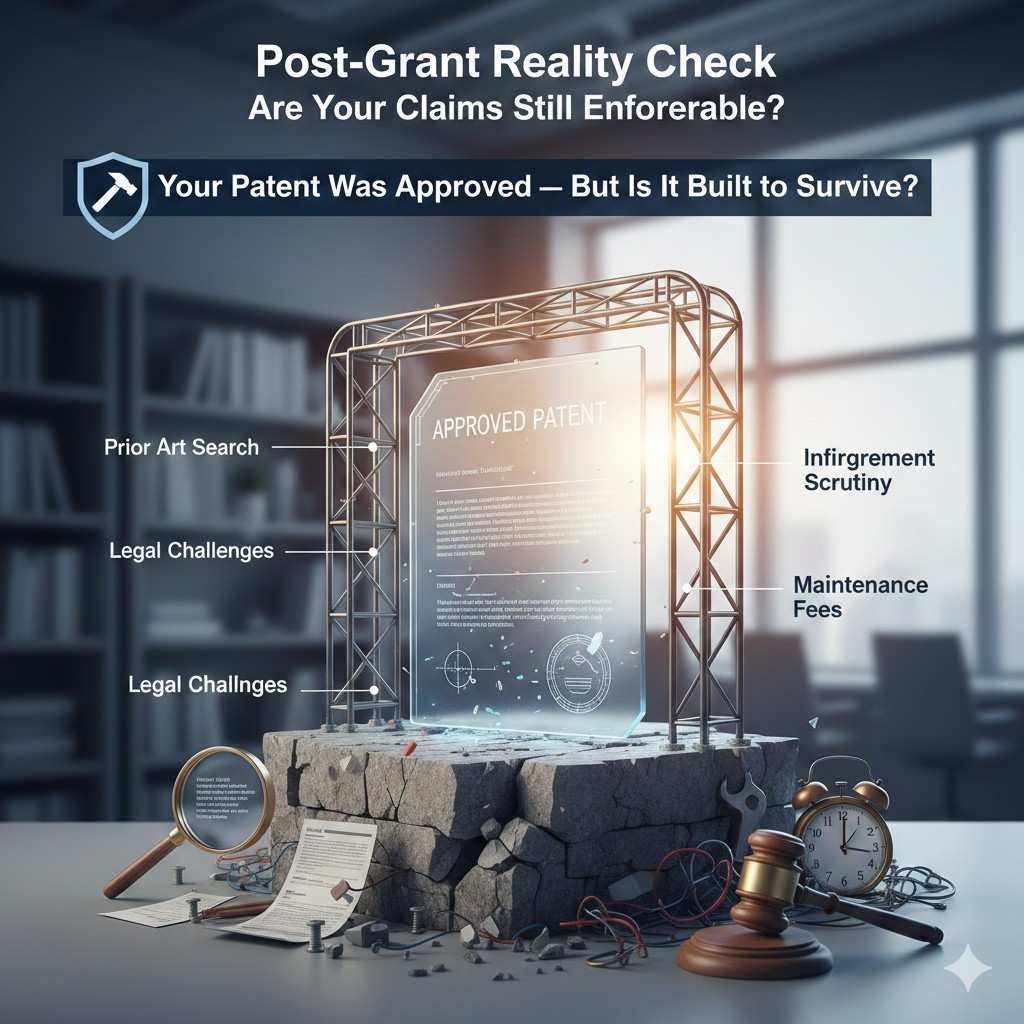
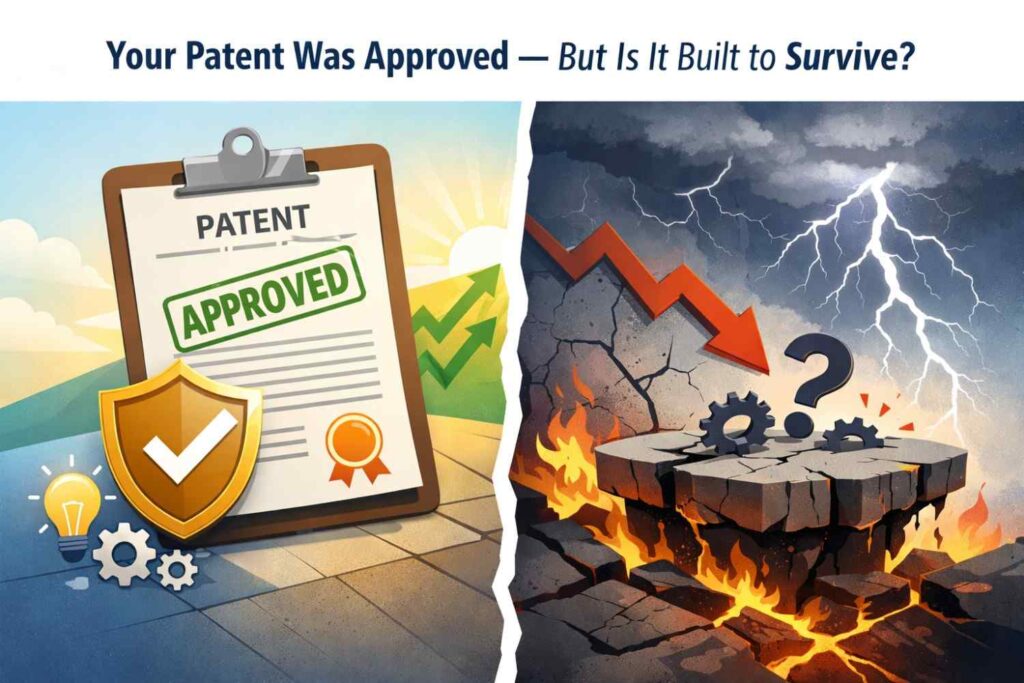
Your Patent Was Approved — But Is It Built to Survive?
Getting your patent approved feels like a major win. It should. You took an idea from your head, turned it into words, and convinced the patent office it was new. That is not easy.
But here is the part many founders miss: approval does not mean protection is strong. It only means the examiner allowed it based on what they saw at the time.
The real test happens later, when money is on the line and someone challenges your claims.
If your startup depends on that patent to stop copycats, raise funding, or defend market share, you cannot afford to assume it is solid. You need to know if it would actually survive pressure. This is where a smart post-grant check becomes critical.
If you are building deep tech and want patents that are built to last, not just approved, take a look at how modern founders are doing it differently: https://powerpatent.com/how-it-works
The Difference Between Approval and Strength
A patent examiner’s job is not the same as a competitor’s lawyer. An examiner reviews prior art within a time limit. They do not search forever. They do not have the budget or incentive to destroy your claims. They are trying to move cases forward.
A competitor, on the other hand, has every reason to tear your patent apart. If your startup threatens their market, they will look for weaknesses.
They will search older patents, research papers, product manuals, even obscure blog posts. They will try to show your invention was obvious or already known.
That means your granted claims might have passed one filter, but they have not yet passed the hardest one. You need to ask: if someone spent serious money to invalidate this, would it hold up?
The Hidden Risk in Narrow Claims
Sometimes founders feel safe because their claims are very specific. They think, “This is so detailed, no one can touch it.” But narrow claims can be easy to design around.
If your claim protects a very specific setup, a competitor can change one small detail and avoid infringement. They still copy your core idea, but in a slightly different form. Now your patent sits on the shelf while they sell a similar product.
After grant, review your claims with one key question in mind: are you protecting the big idea, or just one version of it? If your patent only covers one configuration of your system, your moat may be thinner than you think.
A strategic move here is to map your claims against your actual product roadmap. If your product has evolved since filing, your patent might no longer match what you are selling.
That gap can weaken enforcement. If you see a mismatch, it may be time to file continuation applications to cover broader or updated concepts.
When Broad Claims Become Fragile
On the flip side, some patents are written very broadly. That sounds good in theory. Broad claims can cover more variations and block competitors more effectively. But if they are too broad without strong support, they become easy targets.
If your claims stretch beyond what you clearly described in the specification, a challenger can argue that the patent does not fully support the scope of protection. That can lead to parts of your claims being struck down.
After grant, go back and read your own patent like a stranger would. Pretend you are trying to break it. Do the examples in the description clearly support every key part of your claims?
If not, you may need to strengthen your portfolio with additional filings that add detail and backup.
This is where having software tools plus real attorney oversight makes a difference. A smart review is not just about reading words. It is about stress-testing the logic behind them.
That is exactly what modern patent teams are doing through platforms like https://powerpatent.com/how-it-works, where claims are crafted and reviewed with long-term survival in mind.
Post-Grant Review Is a Real Threat
Many founders assume that once a patent is granted, it is locked in. That is not true. There are formal processes where third parties can challenge your patent after it issues. These proceedings can move fast and focus heavily on prior art.
If your claims are close to existing technology, even if the examiner allowed them, a well-funded challenger may succeed in knocking them out.
This is especially common in fast-moving fields like AI, biotech, hardware systems, and software infrastructure.
A practical step you can take now is to conduct your own internal prior art review. Search again. Look beyond what was cited during prosecution. If you find art that looks close, do not panic.
Instead, ask whether your claims clearly distinguish over it. If not, consider strategic follow-on filings that carve out stronger positions.
It is much better to discover weaknesses yourself than to learn about them in the middle of a dispute.
Your Claims Must Match Your Business Strategy
A patent is not just a legal document. It is a business tool. That means your claims should align with how you make money.
If your startup’s value comes from a specific technical advantage, your claims must cover that advantage clearly.
If your competitive edge is in how your system scales, or how your model trains, or how your hardware interacts with software, your claims need to reflect that.
Too often, patents focus on technical details that are not central to revenue. They protect side features instead of the core engine. After grant, step back and ask: if a competitor copies the feature that drives our revenue, would this patent stop them?
If the honest answer is no, you need to act. That may mean filing additional applications to protect the true value drivers of your company.
Modern startups do not treat patents as one-time events. They treat them as evolving assets. They update, expand, and refine their protection as their products grow.
If that approach sounds aligned with how you build software and ship updates, it should also guide how you handle IP. You can see how founders are doing this in a streamlined way at https://powerpatent.com/how-it-works.
Investors Will Look Deeper Than You Think
If you plan to raise capital, assume that serious investors will not just ask, “Do you have patents?” They will ask, “How strong are they?”
Sophisticated investors often bring in outside counsel to review your portfolio. They look at claim scope, prior art risk, and alignment with your product. If they sense weakness, it can lower valuation or delay the deal.
Doing your own post-grant reality check puts you ahead. Instead of reacting to investor concerns, you can confidently explain why your claims are strong and how your portfolio supports long-term growth.
One tactical move is to prepare a simple internal memo that explains what each key patent covers and why it matters to revenue and competitive position. This forces clarity. If you struggle to explain that link, your protection may need improvement.
Enforcement Starts With Clear Claim Language
In real disputes, everything comes down to claim language. Judges and decision-makers look at the exact words in your claims. If those words are vague, unclear, or open to multiple meanings, enforcement becomes harder.
After grant, review each independent claim carefully. Are there terms that could be interpreted in different ways? Are there phrases that rely too much on functional language without clear structure?
If so, consider whether continuation filings can clarify and strengthen the language while maintaining strong coverage. Patents are not static. There are ways to refine your position if you act early.
The key idea here is simple. A granted patent is not proof of strength. It is an opportunity. An opportunity to build a real moat around your business.
If you want to make sure your claims are not just approved but built to survive, you need the right tools and guidance.
That means combining smart software that understands your tech with real attorneys who think about enforcement from day one. That is the model modern founders are choosing at https://powerpatent.com/how-it-works.
This is your moment to look at your patent with fresh eyes. Not with pride, but with strategy. Because in the real world, survival is what matters.
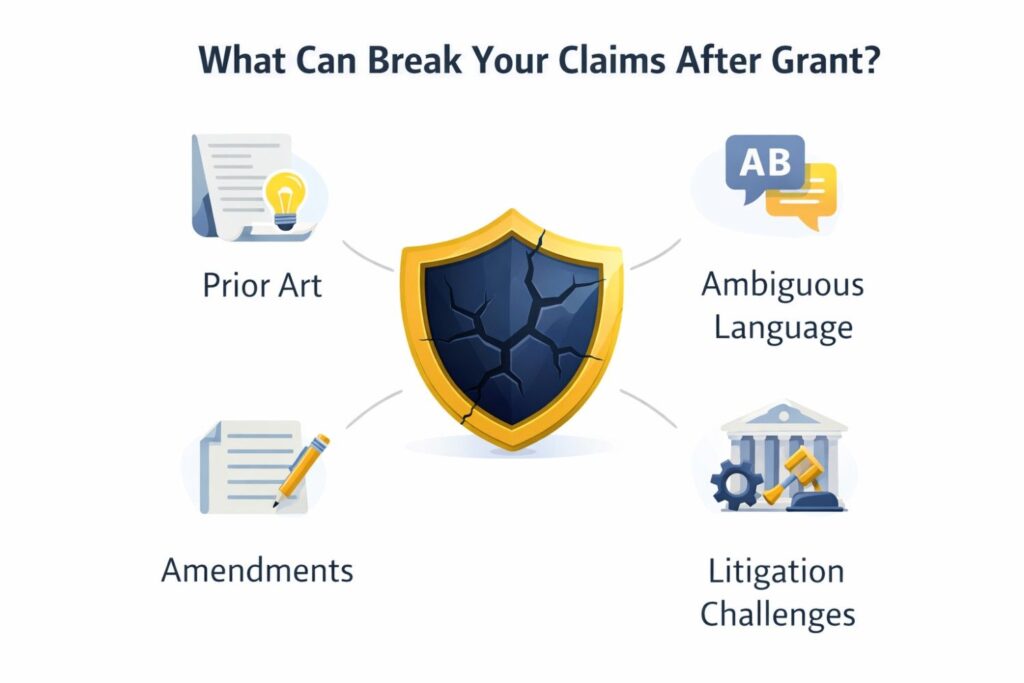
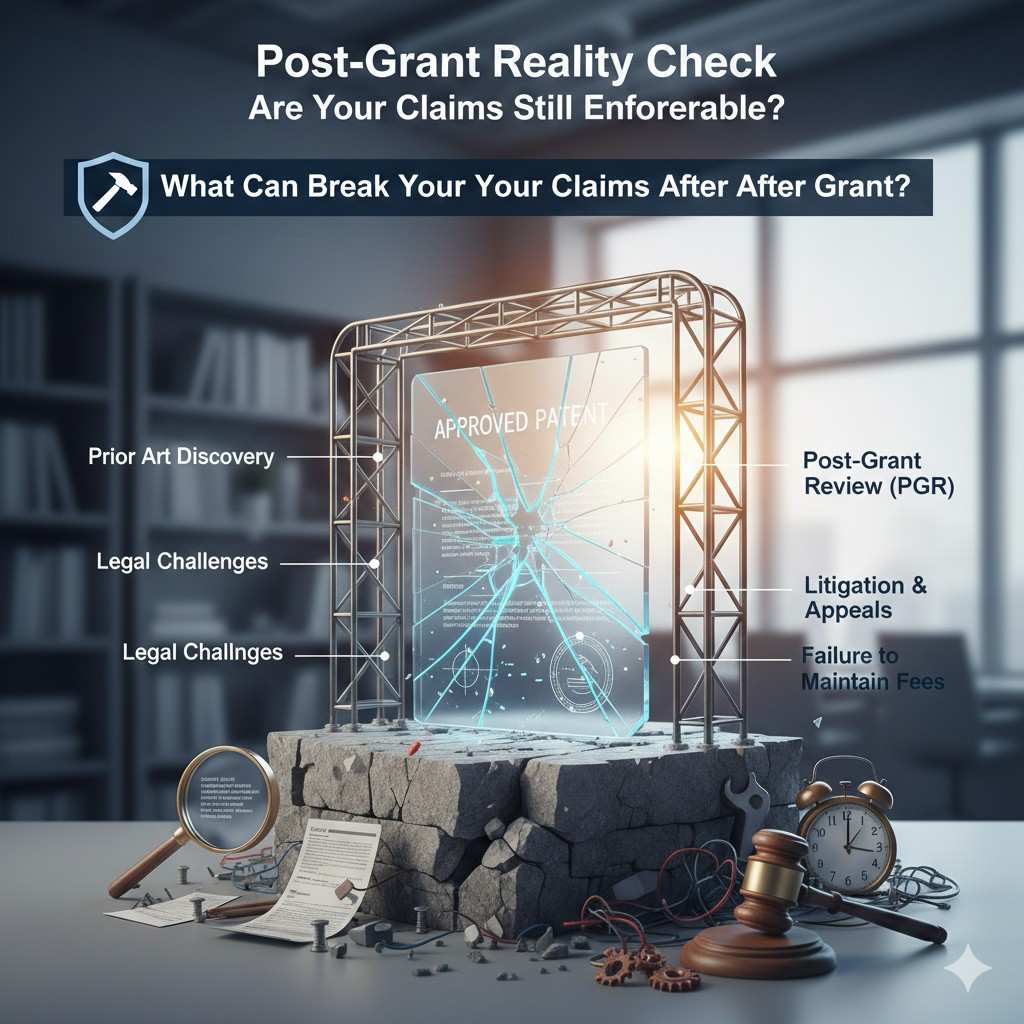
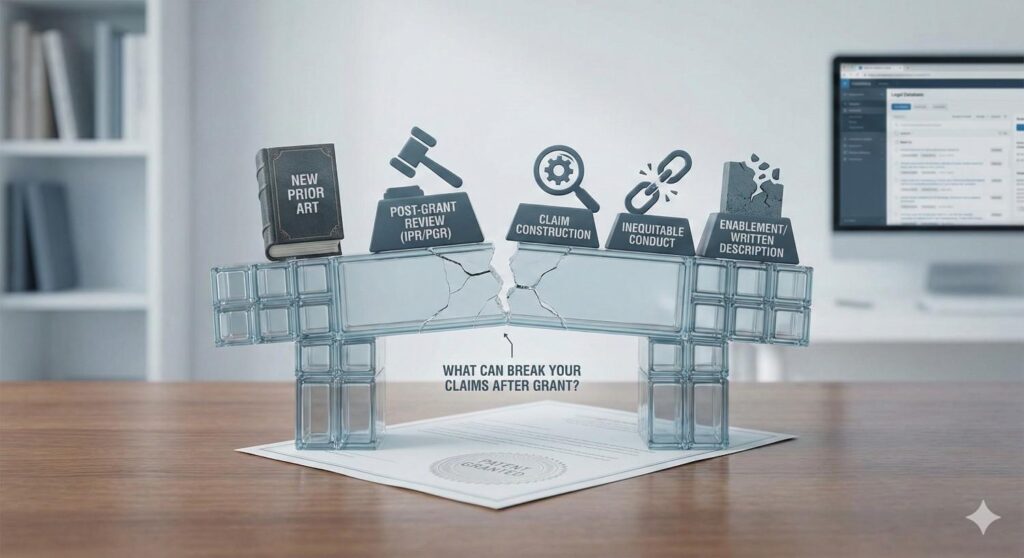
What Can Break Your Claims After Grant?
A granted patent can look strong on paper and still fall apart under pressure. That is the uncomfortable truth. Most founders think risk ends once the patent office issues the certificate. In reality, that is when risk shifts.
It moves from “Will this get approved?” to “Will this survive attack?”
If your patent protects something central to your startup, you need to understand what could weaken it. Not in theory. In real life. In court. In a challenge. In due diligence. This section is about facing that reality head on.
If you want your patents built with long-term survival in mind from the start, not patched later, see how modern founders approach it here: https://powerpatent.com/how-it-works
Prior Art You Did Not See Coming
Most patents are challenged based on prior art. That means someone claims your invention was already known. It could be another patent, a research paper, a product manual, or even a public demo.
During examination, the patent office searches for prior art. But they do not search forever. They work under time limits. They rely on certain databases. They may miss things.
A competitor does not have those limits. If your product threatens their revenue, they may hire experts whose only job is to find earlier disclosures that look close to your claims.
The real risk is not just that prior art exists. It is that your claims may read on it more closely than you think. Sometimes founders focus on what makes their product special. But the claim language might be broader than the actual improvement. That creates a gap a challenger can exploit.
A smart move after grant is to run a fresh prior art review with a defensive mindset.
Do not just look for exact matches. Look for combinations. Many challenges argue that two or three earlier references together make your invention obvious.
If you discover art that looks uncomfortably close, you still have options. You can file continuation applications that focus on narrower but stronger claim sets.
You can adjust strategy before a competitor forces your hand. That kind of proactive move can save millions later.
Obviousness Attacks Are Common
One of the most common ways patents get attacked is through obviousness arguments. The challenger says your invention was just a predictable combination of known parts.
This is especially common in software, AI, hardware systems, and biotech. If your claims combine known components in a new way, someone may argue that the combination was obvious.
After grant, read your claims and ask yourself an honest question: if someone knew the main pieces before, would combining them have seemed like a simple step?
If the answer is “maybe,” then your patent may face risk. The key is not to panic. It is to strengthen your portfolio around the non-obvious aspects. What technical problems did you solve that others could not? What performance gains did you achieve? What unexpected results came from your approach?
If those points are not clearly protected, you may need follow-on filings that focus on those deeper technical contributions.
Modern patent strategy is not about one filing. It is about building layers of protection around the core invention.
That layered approach is much easier when you use tools built for speed and clarity, backed by real attorneys who understand your tech. You can see how that works here: https://powerpatent.com/how-it-works
Claim Interpretation Can Shift
Another risk most founders overlook is how claim terms get interpreted later. The meaning of a word in your claim may seem obvious to you. But in a dispute, each side will argue for a different interpretation.
Small wording choices can have huge impact. A term that sounds broad could be interpreted narrowly. A structural phrase might be read in a way that excludes your competitor’s product.
If the court or review board adopts a narrow meaning, your enforcement power shrinks.
This is why post-grant review should include a close reading of each key term. Imagine how an opposing lawyer would try to twist it. Could they argue that your claim requires a specific structure you did not intend? Could they argue that your claim does not cover newer versions of the technology?
If so, that is a signal to act early. Continuation filings allow you to clarify and expand around those risky terms while you still can.
Waiting until a dispute begins limits your flexibility. Acting early keeps you in control.
Product Drift Creates Exposure
Startups evolve fast. Your product today is not what it was when you filed your patent. Features shift. Architecture changes. You may pivot markets or expand use cases.
If your claims do not track that evolution, enforcement risk increases.
Imagine a competitor copies your current product, not your original prototype. If your patent only protects the early version, you may struggle to prove infringement.
Post-grant, you should compare your live product against your issued claims line by line. Not casually. Carefully. Does each key feature that drives value appear in at least one independent claim?
If the answer is no, your moat has a hole.
This is not rare. Many startups file patents early to impress investors or secure priority. Then they move fast and forget to update their filings. Over time, the patent and the product drift apart.
The solution is not complex. It requires discipline. Each major product update should trigger a quick IP review. If new technical ideas are introduced, capture them in new filings. Build a habit of aligning product and protection.
That process becomes far smoother when patent drafting is integrated into your workflow instead of handled as a slow outside event. That is exactly why modern teams use platforms that combine software efficiency with attorney review, like https://powerpatent.com/how-it-works.
Failure to Disclose Key Information
During prosecution, applicants must disclose known prior art that is material to patentability. If key references were not disclosed and later surface, that can create risk.
In extreme cases, failure to disclose important information can weaken enforcement or damage credibility.
After grant, it is wise to review whether any internal documents, white papers, or presentations might qualify as prior art that was not cited. If your team published something or presented at a conference before filing, you should confirm that the record is clean.
If you find issues, speak with counsel early. There may be corrective steps available, depending on timing and circumstances.
The key idea is this: enforcement strength is not only about claim wording. It is also about process integrity.
Market Changes Can Undermine Leverage
Sometimes patents lose power not because they are invalid, but because the market shifts.
If industry standards change, if new technologies replace old ones, or if your claims focus on a path the market abandons, your leverage drops. You may still have a valid patent, but it does not block what matters anymore.
This is why enforcement strategy must track industry direction. If your space is moving toward new architectures, protocols, or frameworks, your patent portfolio should reflect that movement.
Post-grant, step back and look at where the industry is going, not just where it is today. Ask whether your claims align with the likely future state.
If not, file now while you still can build on your original disclosure.
A patent is a business weapon only if it targets the right territory.
The bottom line is simple. Claims can break after grant for many reasons. Prior art can surface. Language can be interpreted against you. Your own product can outgrow your filings. The market can move on.
None of this means patents are weak. It means they require active management.
Founders who treat patents as living assets gain real leverage. Those who treat them as framed certificates on the wall often face painful surprises.
If you want your claims crafted and managed with survival in mind from day one, learn how modern startups are doing it differently here: https://powerpatent.com/how-it-works
How to Stress-Test Your Patent Before Someone Else Does
If you wait for a competitor to test your patent, you have already lost control of the situation. The smarter move is simple. You test it first.
A stress test is not about fear. It is about clarity. You want to know where your patent is strong, where it is thin, and where it may crack under pressure. When you run this process early, you can fix gaps while you still have options.
Strong companies do not assume their protection works. They challenge it internally before anyone else can. That mindset alone changes how enforceable your claims really are.
If you want patents that are designed with this kind of long-term thinking built in from the start, see how modern teams approach it here: https://powerpatent.com/how-it-works
Read Your Claims Like a Competitor
The first step in stress-testing is mental. You must stop reading your patent like its inventor. Read it like someone who wants to get around it.
Pull up your main independent claim. Now imagine you are building a competing product. Your goal is to avoid infringement while still capturing market share. Where would you change the design? Which word in the claim gives you an escape path?
If your claim requires three specific components arranged in a specific way, could a competitor remove one and achieve similar results? If your claim requires a specific data flow, could they rearrange it and argue they do not infringe?
This exercise often reveals how narrow or fragile a claim truly is. It also shows whether your protection focuses on the heart of your invention or just one implementation.
When you identify weak spots, you are not stuck. If you have continuation rights open, you can file new claims that close those design-around paths. The key is to act before a competitor does.
Map Claims to Revenue
Many startups assume that if they have patents, they are protected. But protection only matters if it covers what generates revenue.
Take your top product or feature that drives sales. Break down how it works at a high level. Then compare that to your claims. Not loosely. Precisely.
Does at least one independent claim clearly read on that revenue-driving feature? Could you show, step by step, how a copycat product would meet each element of the claim?
If you cannot easily explain that link, enforcement becomes harder. Courts and review boards focus on details. If your patent protects a side feature while your core engine sits uncovered, your leverage drops.
A practical move is to create a simple internal document that pairs each major revenue stream with the patents that protect it. If gaps appear, treat them as urgent business issues, not just legal footnotes.
This is where modern patent workflows help. When your patent drafting process is tied closely to product development, you reduce the risk of this misalignment. You can see how that works in practice here: https://powerpatent.com/how-it-works
Simulate an Invalidation Attack
A true stress test includes a mock invalidation attack. That means asking, “If someone wanted to cancel this patent, what would they argue?”
Start with prior art. Search again using broader keywords. Look at foreign patents. Review academic papers. Study open-source projects. Do not assume the patent office already found everything.
When you find references that look close, compare them directly to your claims. Line by line. Would a challenger argue that the differences are minor? Would they combine two references to say your invention was obvious?
If you discover that certain claims look exposed, consider narrowing strategies in new filings that focus on the technical edge that truly sets you apart.
The goal is not to weaken your patent. It is to anchor it in defensible ground. Sometimes a slightly narrower but clearly novel claim is far stronger in enforcement than a broad claim sitting on shaky support.
Check for Written Support Gaps
Every claim must be supported by the description in your patent. If your claim language reaches beyond what you clearly described, it creates risk.
Go back to your specification and review how your invention is explained.
Are the key elements described in enough detail? Are there examples that show how to implement them? Or are some parts described at a very high level without technical depth?
If your claims rely heavily on broad functional language without clear structure or steps in the description, that can be attacked.

One way to strengthen your overall position is to file follow-on applications that add deeper technical detail, more examples, and alternative implementations. This builds a stronger foundation around your core concept.
Founders often underestimate how powerful this layering strategy can be. Instead of relying on a single patent, you create a web of related filings that support and reinforce each other.
Analyze Claim Clarity
Unclear claims are hard to enforce. If a judge or reviewer struggles to understand what your claim requires, enforcement becomes unpredictable.
Read your claims slowly. Are there phrases that could mean two different things? Are there technical terms that were not clearly defined? Are there words that depend on context but lack explicit explanation?
If interpretation could swing either way, a challenger will push for the narrower reading. That can shrink your coverage.
You cannot rewrite issued claims, but you can file continuation claims that clarify and strengthen language. Doing this while you still have pending rights is far easier than trying to fix things during litigation.
Clarity is power. The clearer your claim, the harder it is to twist.
Evaluate Enforcement Practicality
Even if your claim is valid, enforcement must be practical. Ask yourself how you would prove infringement.
Would you need access to your competitor’s internal code? Would you require discovery to see hidden processes? Or is infringement visible from public behavior, product documentation, or user interaction?
Claims that rely on hidden internal steps can be harder to enforce. That does not mean they are useless. It means you may want complementary claims that focus on observable actions or outputs.
A balanced patent portfolio often includes different types of claims that approach the invention from multiple angles. This increases enforcement flexibility.
When patents are drafted with this foresight, enforcement strategy becomes smoother. That is why combining smart drafting tools with real attorney guidance is so valuable. You can explore that approach here: https://powerpatent.com/how-it-works
Keep Continuations Alive
One of the most powerful stress-test tools is simple: keep continuation applications pending.
As long as you have a pending application tied to your original filing, you maintain the ability to adjust claim scope. You can respond to market changes, competitor products, and newly discovered prior art.
If you let all related applications go abandoned after grant, your flexibility disappears.
Strategic founders treat continuation rights like options. They keep them alive while the market evolves. When a competitor launches something interesting, they can craft claims that read directly on that design, as long as it is supported by the original disclosure.
This is not a loophole. It is smart portfolio management.
Make Stress-Testing a Habit
The biggest mistake is treating this process as a one-time event. Your business changes. Your competitors change. The legal landscape changes.
Set a recurring review cycle. At least once a year, reassess your core patents against your current product and market conditions. Tie this review to strategic planning, not just legal housekeeping.
When patents are integrated into business strategy, they become real assets. When they are isolated in a folder, they become fragile.
If you want a patent process that makes this kind of ongoing review simple instead of painful, look at how PowerPatent blends software speed with real attorney insight: https://powerpatent.com/how-it-works

Stress-testing your patent is not about doubt. It is about building confidence. Real confidence comes from knowing your claims have been challenged and still stand strong.
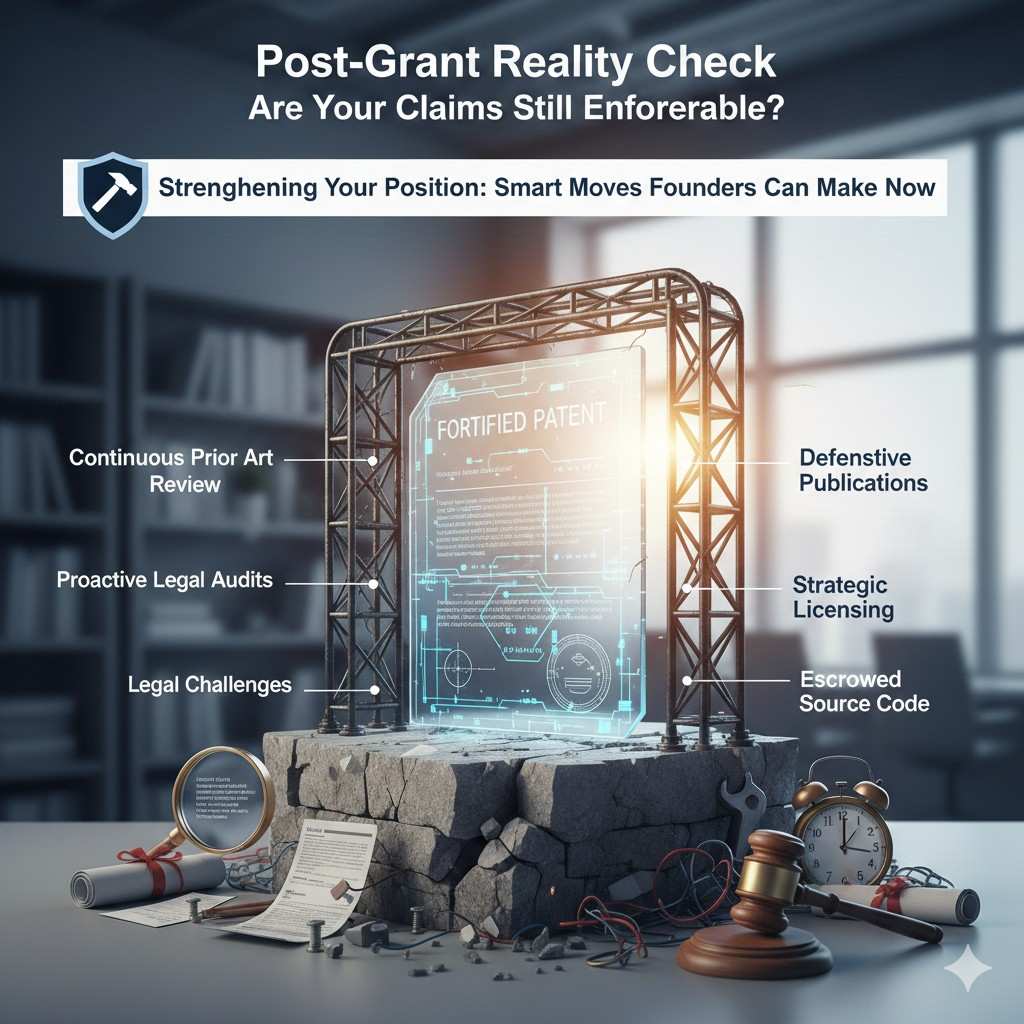
Strengthening Your Position: Smart Moves Founders Can Make Now
If you have made it this far, one thing should be clear. A granted patent is not a trophy. It is a tool. And like any serious tool, it needs tuning, adjustment, and sometimes reinforcement.
The good news is this. If you spot weak points early, you can fix most of them. You still have control. You still have options. The key is to act before pressure hits.
This section is about practical moves you can make right now to turn your patent from “approved” into “battle-ready.”
If you want to build patents this way from day one, with strategy baked in instead of patched later, see how modern startups do it here: https://powerpatent.com/how-it-works
Use Continuations as Strategic Leverage
Many founders do not fully use continuation applications. They file a patent, it gets granted, and they move on. That leaves power on the table.
If you still have a continuation pending, you have flexibility. You can adjust claim scope to match market reality. You can pursue broader claims if your first set was too narrow. You can also pursue narrower claims that are harder to invalidate if prior art risk appears.
This flexibility becomes extremely valuable when competitors enter your space.
Imagine a competitor launches a product that looks close to your invention but avoids one small feature in your claim.
If you have a continuation pending and your original description supports broader coverage, you may be able to pursue new claims that close that gap.
Without a pending continuation, you lose that ability.
A strong move is to treat continuation filings as part of your long-term competitive strategy, not just as paperwork. Keep at least one related application alive while your market is still forming.
Expand Around the Core, Not Just the Edges
Some companies file extra patents, but they focus on side features. That creates noise, not strength.
Instead, expand around the core technical advantage that gives you your edge. If your system trains faster, scales better, uses less power, or produces better results, build protection around that center.
Ask yourself what truly makes your product hard to copy. Then ensure that idea is protected from multiple angles.
You might protect the method. You might protect the system architecture. You might protect the way inputs are processed. You might protect outputs or performance improvements.
The goal is not to create volume. The goal is to create depth.
When competitors look at your portfolio, they should see layers around the main value driver, not scattered filings with weak connection to revenue.
If you are unsure whether your filings truly anchor your core advantage, it may be time for a focused portfolio review with tools and legal insight working together. That is exactly what platforms like https://powerpatent.com/how-it-works are designed to support.
Align IP Reviews With Product Roadmaps
Your engineering team likely works from a roadmap. Features are planned. Improvements are scheduled. Releases are tracked.
Your patent strategy should follow the same rhythm.
Every time a major feature is designed, someone should ask a simple question: is this protectable? If yes, capture it before it becomes public.
After grant, this habit becomes even more important. New features may fall outside the scope of your original claims. If you fail to protect them, you create open territory competitors can enter.
A smart internal practice is to hold short quarterly syncs between technical leads and whoever manages IP. The purpose is not to create legal friction. It is to capture innovation in real time.
When patents are integrated into product flow, protection becomes natural. When they are treated as separate legal events, gaps appear.
Strengthen Technical Depth in New Filings
One reason patents fail under attack is lack of technical detail. If your original filing was rushed or high level, your claims may sit on thin support.
You cannot rewrite history, but you can strengthen the future.
In new filings, go deeper. Include more technical explanation. Provide alternative implementations. Describe edge cases. Explain performance benefits clearly.
The more concrete your description, the stronger your foundation becomes.
This depth does two things. It supports broader claims. And it makes invalidation harder because it shows real technical contribution.
Modern patent drafting tools can help engineers translate complex systems into clear, detailed disclosures without wasting weeks. When paired with real attorney review, the result is both fast and strong. You can explore that model here: https://powerpatent.com/how-it-works
Prepare for Enforcement Before You Need It
Most founders think about enforcement only when a competitor appears. That is late.
Instead, prepare now. Identify which patents are core to your business. For each one, outline how you would show infringement. What public evidence would you rely on? What claim elements are easiest to demonstrate?
This preparation sharpens your understanding of claim strength. It also reveals whether you rely too heavily on hidden processes that are hard to prove.
If you see enforcement challenges, you can adjust strategy through new claims that focus on observable behavior or measurable outputs.
Preparation also increases investor confidence. When you can clearly explain not just that you have patents, but how you would enforce them, your IP becomes more than a line item. It becomes a strategic asset.
Keep an Eye on Competitor Filings
Your competitors are filing patents too. Their applications reveal where they are investing and how they describe similar technology.
Monitoring those filings gives you insight into potential overlap. If you see them claiming territory close to yours, you can adjust your own continuation strategy to protect adjacent ground.
This is not about copying. It is about awareness.
A living portfolio reacts to market signals. It does not sit still.
Build a Culture That Respects IP Without Slowing Innovation
The strongest patent positions come from teams that see IP as part of building, not as a burden.
Engineers should not fear the patent process. They should understand that capturing their work protects the company and increases long-term impact.
When the process is slow, confusing, or heavy with paperwork, teams avoid it. That leads to missed opportunities.
When the process is streamlined, collaborative, and backed by smart tools, innovation flows directly into protection.
This is why the combination of AI-powered drafting and real patent attorney oversight is so powerful. It keeps speed high while maintaining legal strength. You can see how this balance works in practice here: https://powerpatent.com/how-it-works
Turn Your Patent Into a Strategic Asset
At the end of the day, enforceability is not about luck. It is about discipline.
Review your claims. Align them with revenue. Stress-test them against prior art. Keep continuations alive. Expand around your core advantage. Sync protection with product evolution.
When you do these things, your patent stops being a certificate and starts being leverage.
The founders who win long term are not the ones with the most patents. They are the ones with patents that survive challenge and block real competitors.

This is your post-grant reality check. Not to scare you. To sharpen you.
If you want to build and manage patents with this level of clarity and control, explore how PowerPatent helps startups file stronger, smarter protection without slowing down innovation: https://powerpatent.com/how-it-works
Wrapping It Up
A patent grant feels final. It feels official. It feels like protection is locked in. It is not. A granted patent is simply a starting position. It gives you rights, but those rights only matter if your claims can survive pressure. If a competitor challenges you. If investors dig deep. If the market shifts. If new prior art appears. If your product evolves past your original filing.