You can build a great NLP product with clean code, smart models, and strong results, then still lose ground if your patent claims are weak. That is the real issue. In NLP and text processing, the hard part is not only inventing something new. It is claiming it in a way that protects what actually matters. Many founders spend months improving how their system classifies text, ranks outputs, extracts meaning, routes prompts, reduces errors, or speeds up inference. Then the patent ends up saying something broad, vague, or easy to design around. On paper, it looks fine. In real life, it leaves the door open.
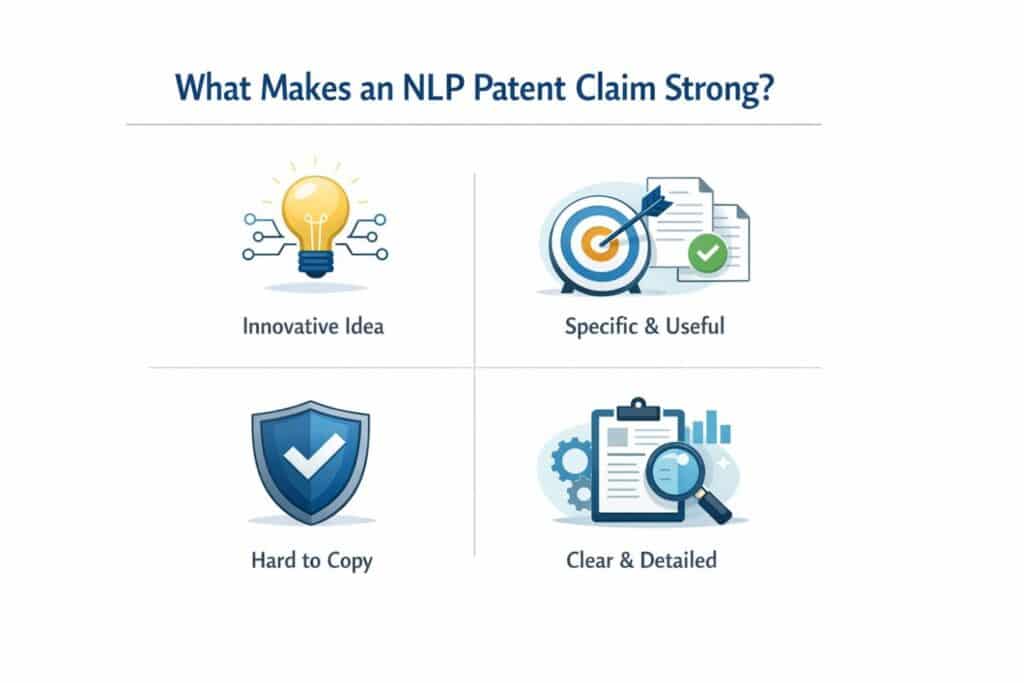
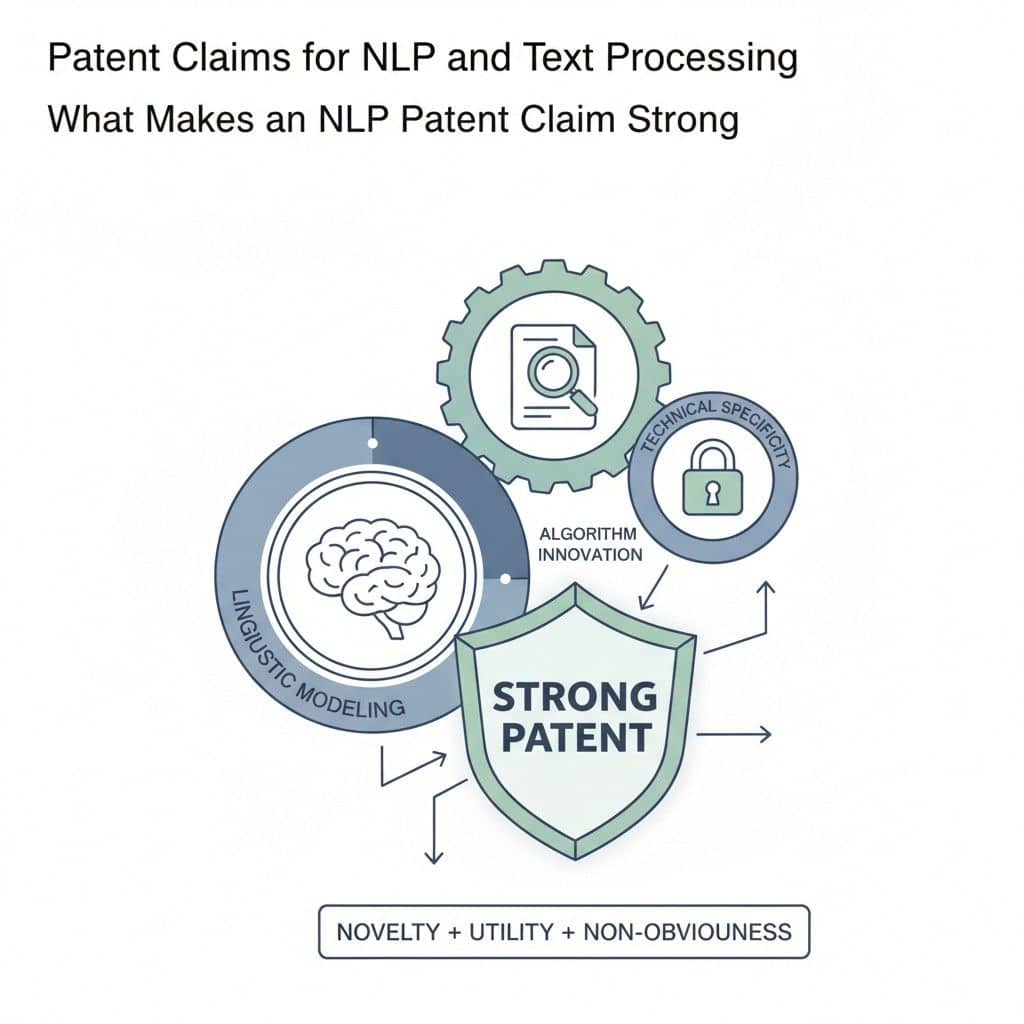
What Makes an NLP Patent Claim Strong
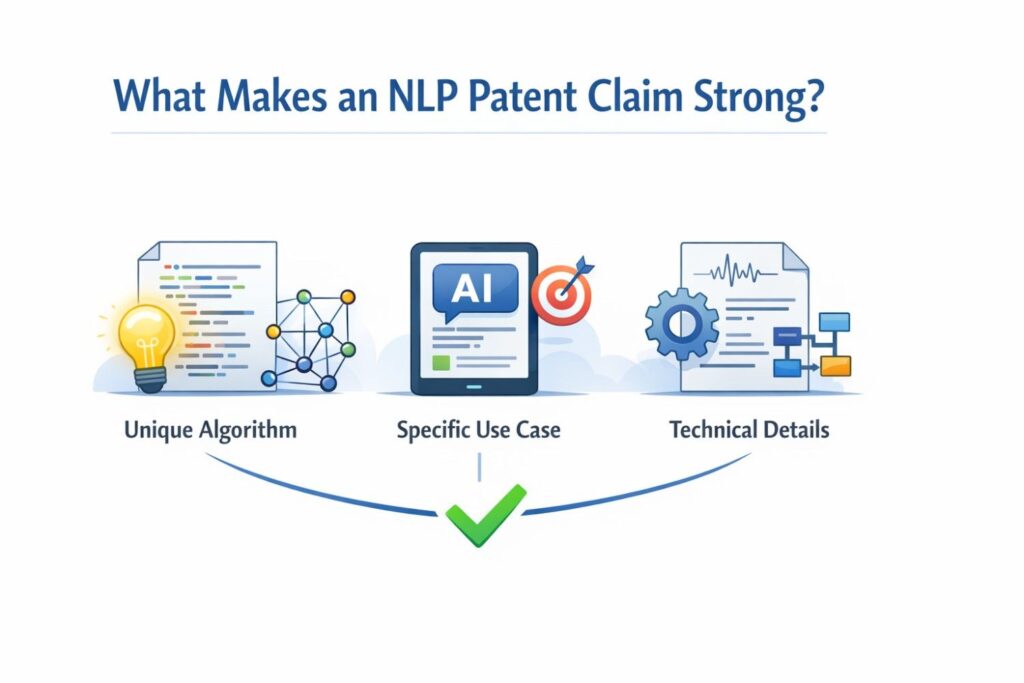
A strong NLP patent claim does not try to sound impressive. It tries to be hard to escape.
That is the difference. In text processing, many teams talk about what their system does at a high level, but strong claims explain the real technical path that creates the result.
For a business, this matters because the goal is not to file something that merely looks complete. The goal is to protect the product edge that took real time, money, and talent to build.
The strongest claims in this area usually come from a very clear view of the invention. That means knowing where the true value sits inside the pipeline.
In some products, the value is in how raw text is cleaned and structured before model use. In others, it is in the way the model handles ambiguity, ranks outputs, uses context, reduces noise, or improves results over time.
A useful claim captures that practical advantage in a way that maps to the actual system, not just the marketing story around it.
For businesses, this is where patent quality turns into business value.
A strong claim can help protect revenue, support fundraising, improve leverage in partnerships, and reduce the risk that a fast follower copies the best part of the product with a few surface changes.
That is why this section matters so much. When you understand what makes an NLP claim strong, you can stop treating patents like paperwork and start using them like a business tool.
Strong claims protect the real engine, not the shiny label
A lot of weak NLP patents fail for a simple reason. They describe the invention as if the title of the feature is enough.
It is not enough to say a system classifies text, summarizes content, extracts entities, routes prompts, or detects intent. Many systems do that. A strong claim goes deeper and protects the specific way your system reaches a better result.
That means the claim should focus on the actual mechanism that gives your product an advantage. Maybe your system handles low-quality text inputs in a more reliable way.
Maybe it uses a special chain of preprocessing, vector generation, rule-based filtering, and model scoring that improves precision in a narrow business setting.
Maybe it reduces hallucinations by forcing a structured retrieval and validation flow before generation. These are the details that often matter.
From a business view, this shift is strategic. If your claim covers only the feature name, a competitor may keep the same commercial outcome while changing a few steps under the hood.
If your claim captures the steps that make the system work better, it becomes much harder for others to build around it without losing performance.
Ask what part a competitor would copy first
One of the best ways to test claim strength is to ask a very direct question. If a smart competitor studied your product and wanted to copy only the part that matters most, what would they take first?
That answer often reveals the true center of value. It may not be the whole model.
It may be the ranking layer, the fallback logic, the training data treatment, the way user feedback is folded into later outputs, or the method for resolving conflicting text sources.
Strong claims often grow from that narrow but valuable core.
This is useful because businesses usually waste claim space on broad descriptions while the real moat lives in a few technical choices. If you want stronger protection, start there.
Describe the system in a way engineers would respect
Another good test is whether your own engineering team would say the claim reflects how the product actually works.
If the technical team reads the claim and feels it is too abstract, too soft, or too detached from the architecture, that is a warning sign.
A strong claim does not need to read like source code. But it should line up with reality. It should reflect the actual system flow, the actual inputs and outputs, and the actual technical improvement.
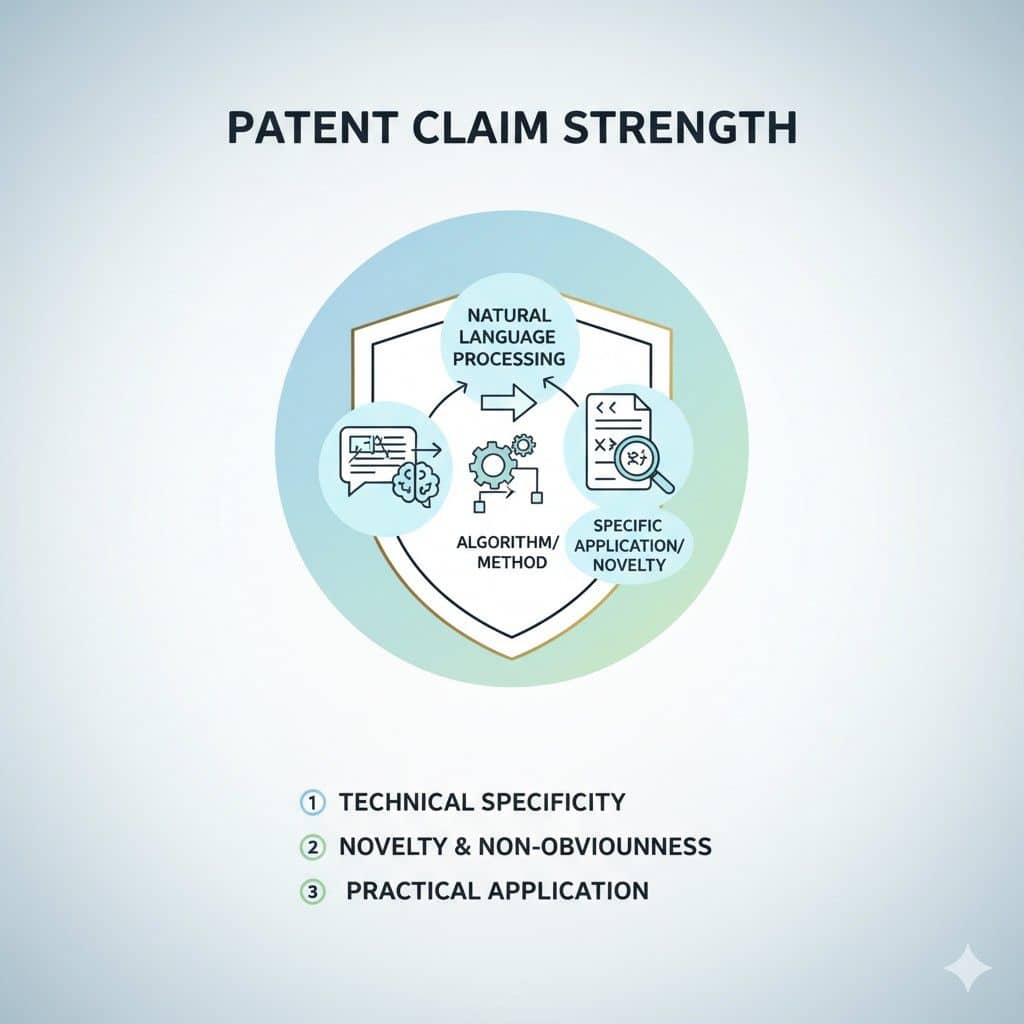
That alignment matters because it gives the patent stronger roots. It is also what makes it easier to defend later.
Strong claims are specific enough to matter and broad enough to scale
This balance is where many patent efforts go wrong. If a claim is too broad, it may look exciting at first but become fragile when tested.
If it is too narrow, it may cover only one exact build and miss future versions of the product. Strong NLP claims sit in the middle. They are precise about what creates the technical result, but flexible enough to cover product growth.
For businesses, this is not just legal style. It is a growth issue. NLP products change quickly.
Models improve. workflows change. Infrastructure evolves. Strong claims need room for the business to move without stepping outside its own patent fence.
Write around the concept, not just the current version
Founders often describe the exact version of the product they have today. That is understandable, but it can trap the claim in the present.
A stronger approach is to identify the core technical concept and express it in a way that covers reasonable variants.
For example, if your product uses one type of embedding model today, the stronger protection may come from claiming the role the embedding step plays in the broader process rather than limiting the claim to one narrow implementation.
The same goes for model families, ranking methods, confidence thresholds, and post-processing logic.
The question is not only how the system works now. The question is what idea should stay protected as the business improves the stack.
This helps a business in two ways. It protects future product versions, and it reduces the chance that others can avoid the patent by swapping one component while keeping the same core method.
Use dependent claims to catch important fallbacks
A practical strategy is to build a strong main claim around the broad technical concept, then support it with narrower follow-on claims that protect important variations. This is often where some of the most valuable protection sits.
In NLP, product teams often have fallback paths, alternate scoring rules, special domain tuning, or different ways to resolve uncertain results.
Those may not belong in the main claim every time, but they can be powerful support in dependent claims.
For a business, this gives layered coverage. It helps protect both the main path and the practical variants that make the system more robust in the market.
Strong claims focus on technical gain, not just business benefit
One of the biggest mistakes in this field is describing an NLP invention in only business language. Faster support. Better search. Smarter workflows. Cleaner knowledge access.
These benefits are real, but they are not enough on their own. A strong claim needs to show the technical gain inside the system.
That gain might be lower error rates, reduced compute use, better handling of noisy text, improved ranking quality, more accurate extraction from unstructured input, or better output consistency across variable language patterns.
The claim should connect the system design to a concrete technical result.
For businesses, this matters because patents become stronger when they are tied to actual system-level improvement rather than a simple business goal. It also forces a useful discipline inside the company.
Teams must identify what the invention truly improves, not just what the sales pitch says.
Tie every claimed step to a real performance reason
When drafting or reviewing an NLP claim, one strong habit is to ask why each step exists. If a step is in the claim, there should be a reason it matters. Maybe it improves signal quality before inference.
Maybe it removes ambiguity before classification. Maybe it reduces irrelevant context before retrieval. Maybe it raises confidence in the final output.
This is highly actionable for businesses because it improves claim quality and product understanding at the same time.
When each step earns its place, the claim becomes tighter and more defensible. It also helps leadership explain why the patent matters in commercial terms.
Do not hide the improvement under vague wording
Phrases like optimized processing, intelligent analysis, adaptive handling, and enhanced results often sound polished but say very little. Strong claims avoid hiding the invention under soft language.
They make the technical improvement visible.
This does not mean the writing should be dense or hard to read. It means the claim should actually show what changed in the system and why that change improves the result.
Clear language usually leads to stronger patents and better internal decision-making.
Strong claims are rooted in the problem your system solves in practice
A useful way to shape claim strength is to begin with the real technical pain point your team solved. In NLP and text processing, that pain point is often very specific.
It may involve unstructured documents, mixed language inputs, inconsistent formatting, domain-specific phrases, contradictory sources, long context windows, sparse training data, or unstable outputs.
A strong claim grows out of that real-world friction. It explains the technical steps used to overcome the problem. That makes the patent more credible and often more valuable because it reflects a pain point that others in the market also face.
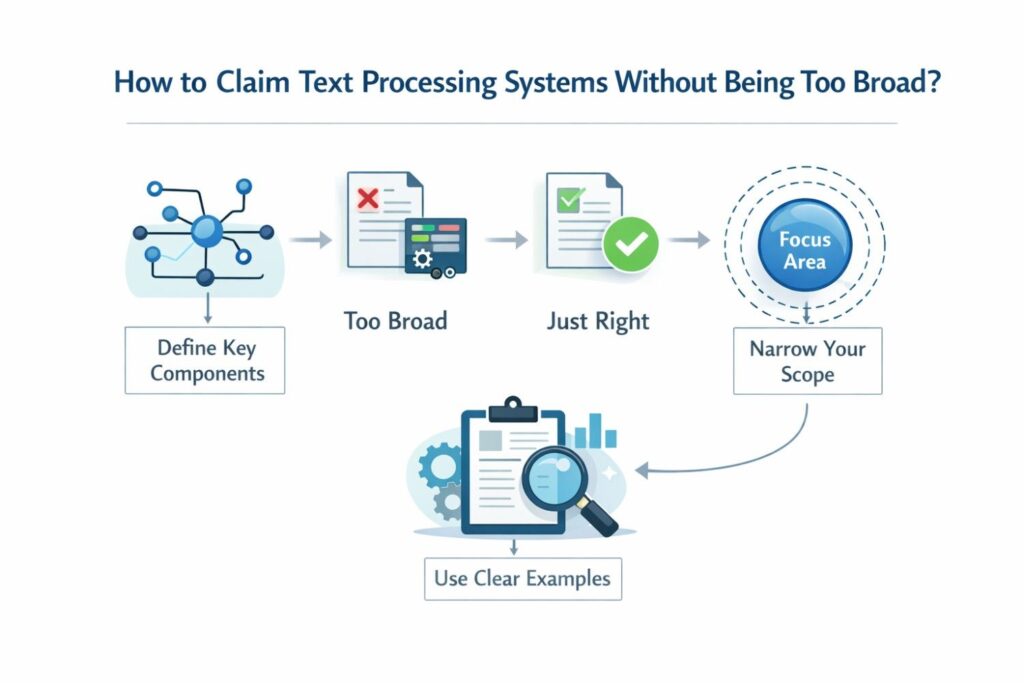
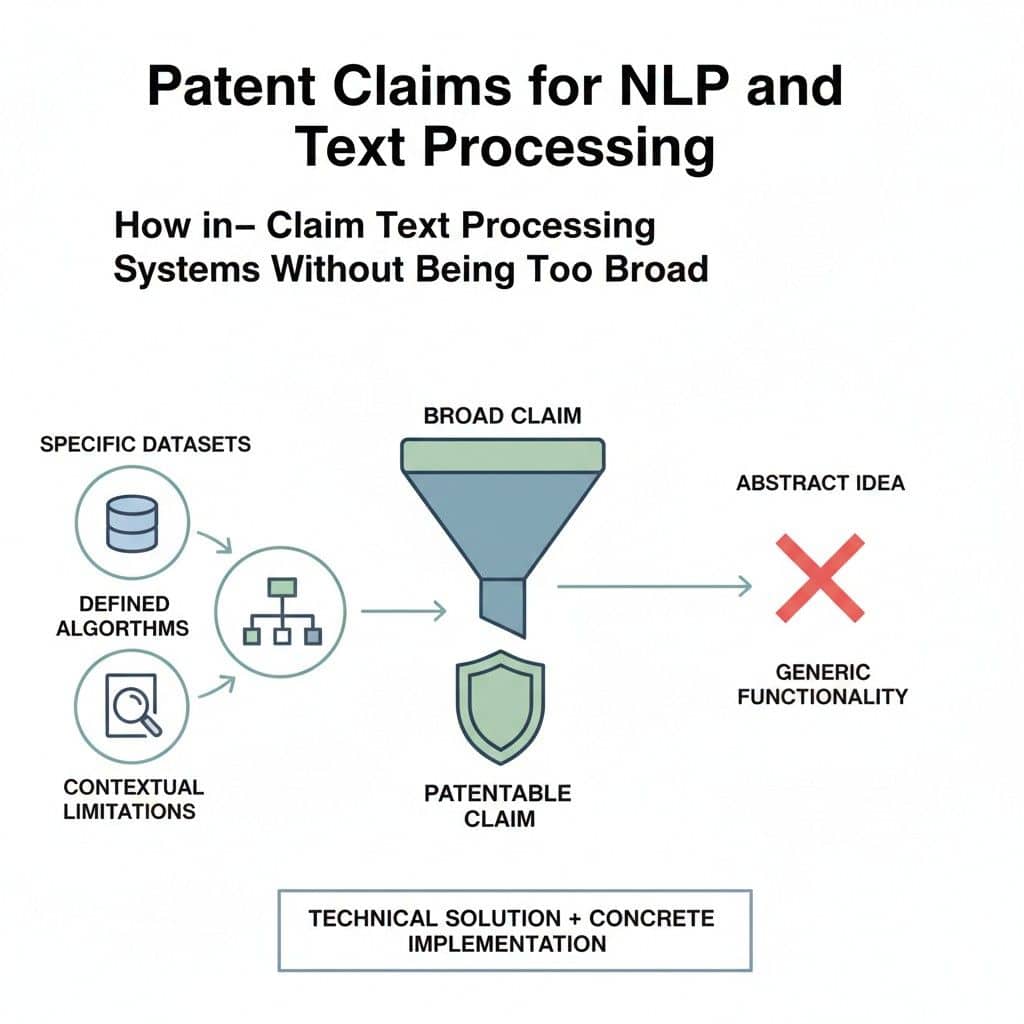
How to Claim Text Processing Systems Without Being Too Broad
Text processing patents often fail in one of two ways.
They either try to cover everything and end up saying almost nothing, or they focus so narrowly on one exact setup that they miss the larger business value. The real goal sits in the middle.
You want a claim that is clear, real, and hard to work around, but still wide enough to protect the product as it grows.
For businesses building in search, document review, compliance, support, knowledge systems, analytics, or AI workflows, this is one of the most important skills in patent strategy.
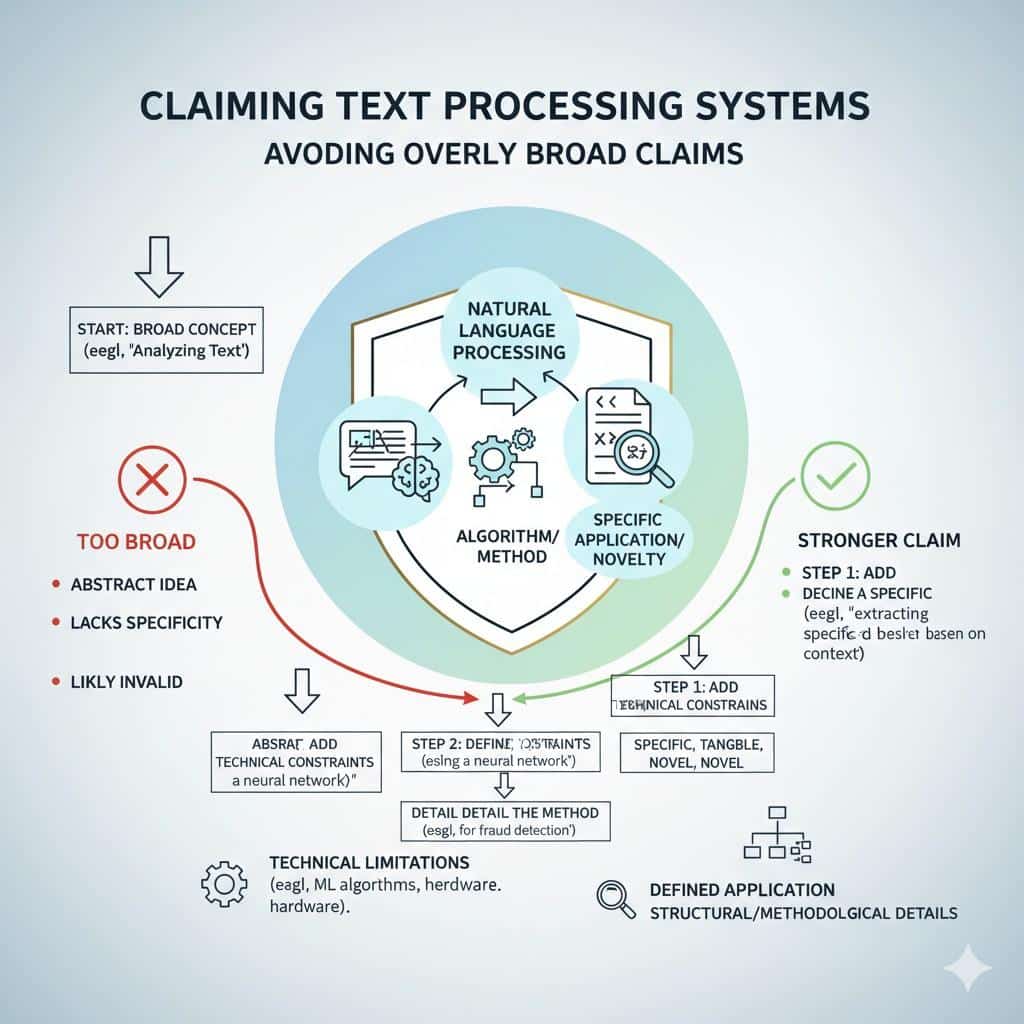
A broad claim may sound strong at first. It may feel like bigger is better. But in text processing, broad words without technical shape often create weak protection.
A claim that simply says a system receives text, analyzes text, and outputs a result does not do much for the business.
It leaves too much room for others to argue that your patent covers a general idea, not a real technical invention.
On the other hand, a claim that locks itself to one exact model, one exact file type, or one exact sequence may become outdated as soon as the product changes. Strong claiming avoids both traps.
Broad is not the same as valuable
Many teams confuse claim width with claim strength. They try to write the biggest possible claim because it feels more ambitious.
But a claim becomes valuable only when it captures the true technical idea in a way that maps to real systems in the market. That means the claim must have enough structure to show what actually makes the text processing method different and useful.
For a business, this distinction matters because the patent is meant to protect commercial advantage, not abstract ambition.
If the claim is so broad that it could describe hundreds of ordinary systems, it becomes easier to challenge and easier to ignore. A better claim is one that covers the right ground, not the most ground.
Start with the narrow technical win inside the system
The easiest way to avoid overbroad claiming is to begin with the exact technical improvement your team created. In text processing, that improvement is often hidden inside the flow.
may be the way the system cleans noisy text before classification. It may be the way it separates useful from useless document sections before downstream analysis.
It may be the method for resolving conflicting matches, handling low-confidence outputs, or combining learned models with deterministic filters.
That narrow technical win is the anchor. Once it is clear, the claim can be built around it in a way that stays meaningful.
This is a strong business move because it protects the part competitors would want most, rather than wasting claim space on generic framing.
Ask where performance changed in a measurable way
A good business test is simple. Ask where the product got better in a measurable way because of the invention.
Maybe processing became faster. Maybe output quality improved on messy documents. Maybe the system needed fewer manual corrections. Maybe it worked better across long text streams or mixed formats.
That answer helps define the claim center. It keeps the patent tied to real engineering value. It also gives the company a much better story for diligence, investor review, and later enforcement.
Claim the method, not the mission statement
A weak text processing claim often reads like a product promise. It says the system improves search, enhances understanding, or automates analysis. Those statements may be true, but they do not explain the method.
A stronger claim explains what the system actually does to create that result.
This is where businesses can gain an edge.
The more the claim reflects a real technical method, the harder it becomes for others to dismiss it as empty language.
It also becomes more useful across product lines because the patent starts protecting the engine of the solution rather than the marketing summary.
Give each step a technical job
Every step in the claim should serve a real purpose in the overall text processing flow. If a step is included only to make the claim sound advanced, it usually weakens the structure.
But if each step has a clear function, the claim becomes much more grounded.
For example, a segmentation step may exist to isolate relevant passages before feature extraction. A normalization step may reduce variation across messy inputs.
A scoring step may rank candidate outputs based on domain-specific confidence signals.
A filtering step may discard low-value text segments before later analysis. When each step has a job, the claim starts to look like a real system, not a broad aspiration.
Remove steps that do not carry the invention
A practical drafting habit is to ask whether the invention still matters if a certain step is removed. If the answer is yes, that step may not belong in the main claim.
This helps businesses avoid accidental narrowing. It keeps the core claim focused on what truly drives the technical improvement.
That does not mean extra details have no value. Often those details belong in narrower follow-on claims. But the main claim should not be crowded with features that are helpful yet not central.
Use functional coverage with technical boundaries
To avoid being too broad, a claim needs limits. But those limits do not always need to come from one exact implementation. In many cases, strong text processing claims use functional language tied to technical boundaries.
That means the claim can describe what a component does within the system, as long as the function is connected to a specific technical role.
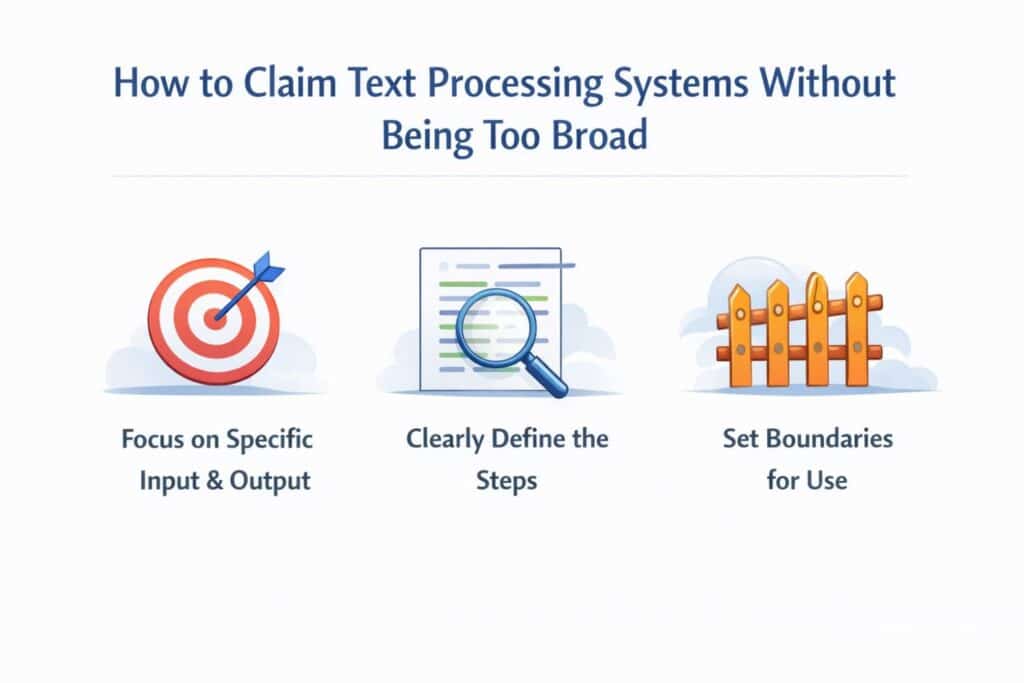
This is useful for businesses because products evolve. A company may switch models, change vendors, update architectures, or redesign pipelines. A claim that is too tied to one narrow build can lose value fast.
But a claim that captures the technical function of a processing stage, while still grounding it in the larger method, can remain useful over time.
Avoid locking the claim to one tool unless the tool is the invention
A common mistake is to describe the current stack as if it is the invention itself.
Teams mention one model class, one vector format, one parser, or one training approach when the real value lies elsewhere. That can make the claim too narrow without making it stronger.
A better approach is to ask whether that exact tool choice is what creates the technical gain. If it does, then it may deserve a place in the claim. If it does not, it may be better to claim the role it plays instead.
This helps protect the business against future shifts in the technical stack while still keeping the patent rooted in real system design.
Write for product change that has not happened yet
Text processing systems change fast. Teams revise the pipeline, tune thresholds, replace models, expand sources, and change how results are generated.
A claim that covers only the exact current build may not fit the business even one year later. That is why smart claiming looks beyond the present version.
This does not mean guessing wildly. It means identifying the stable idea inside the changing system. In many businesses, the stable idea is the way text is prepared, ordered, scored, or validated before a downstream decision.
That concept often survives many product updates, which makes it a better target for protection.
Think in product families, not single features
Founders often file around one feature because that feature is visible. But the stronger move is to ask whether the same core processing concept appears in multiple parts of the product.
Maybe the same segmentation logic supports both classification and retrieval. Maybe the same trust-scoring method supports both workflow automation and document review.
Maybe the same conflict-resolution logic helps across several customer-facing features.
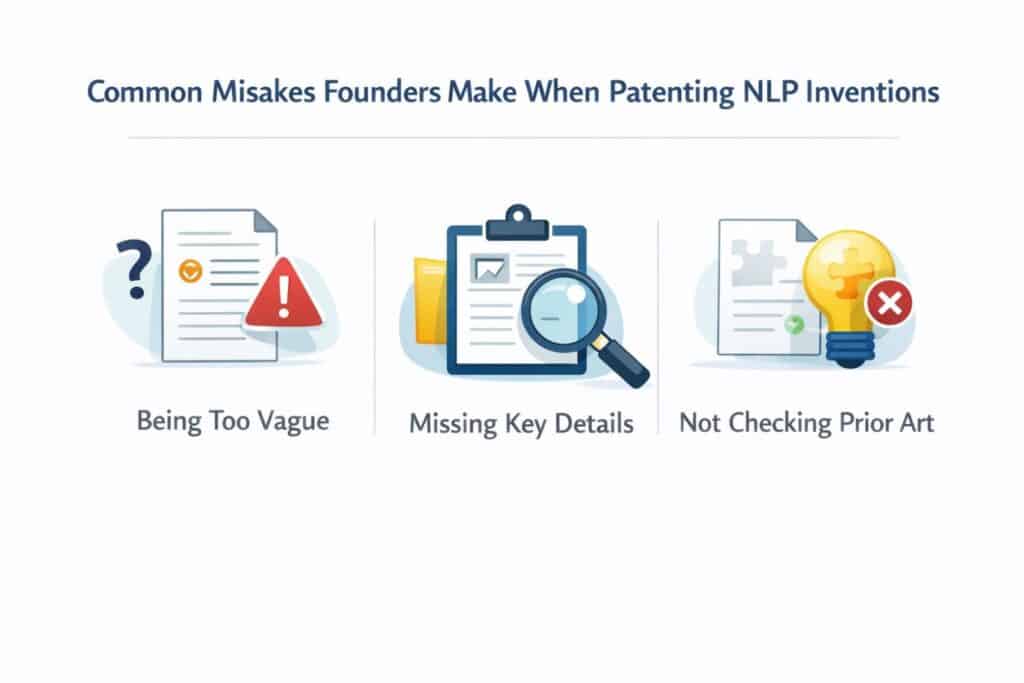
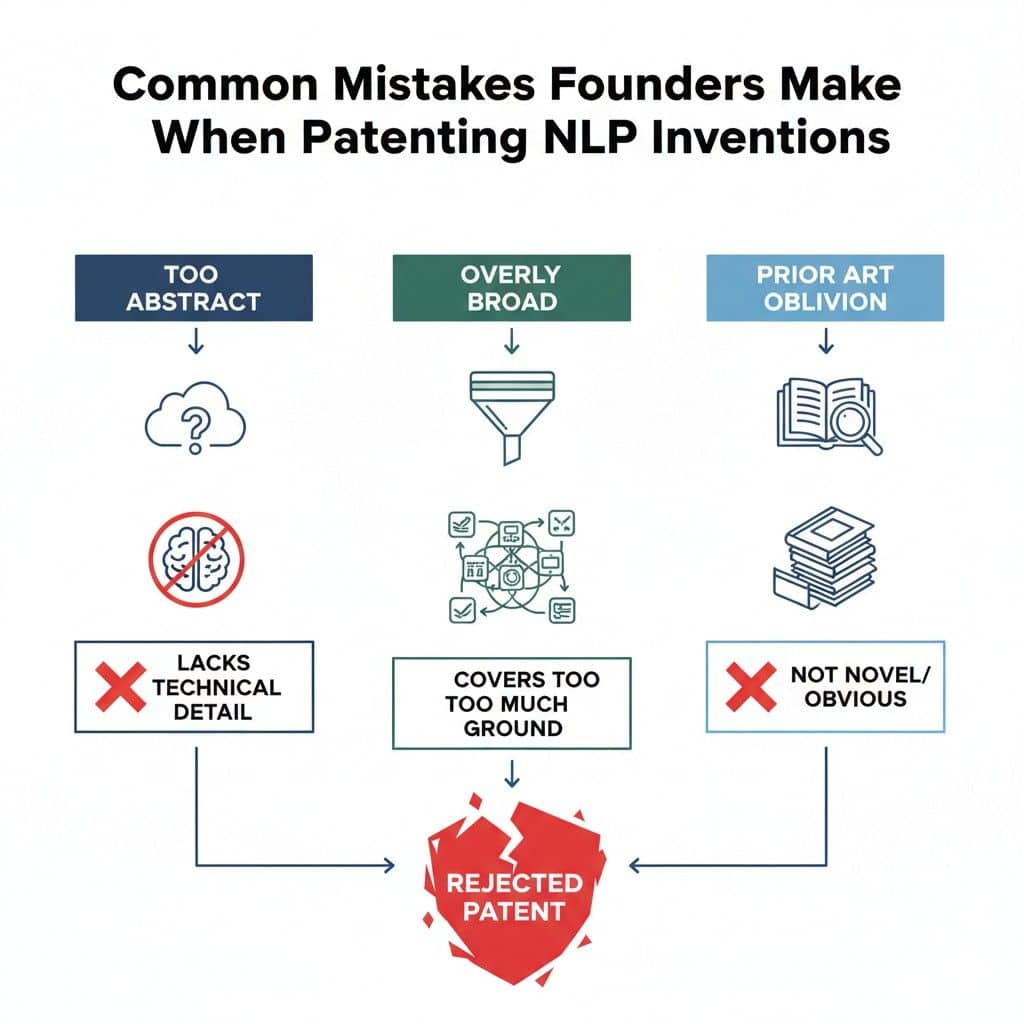
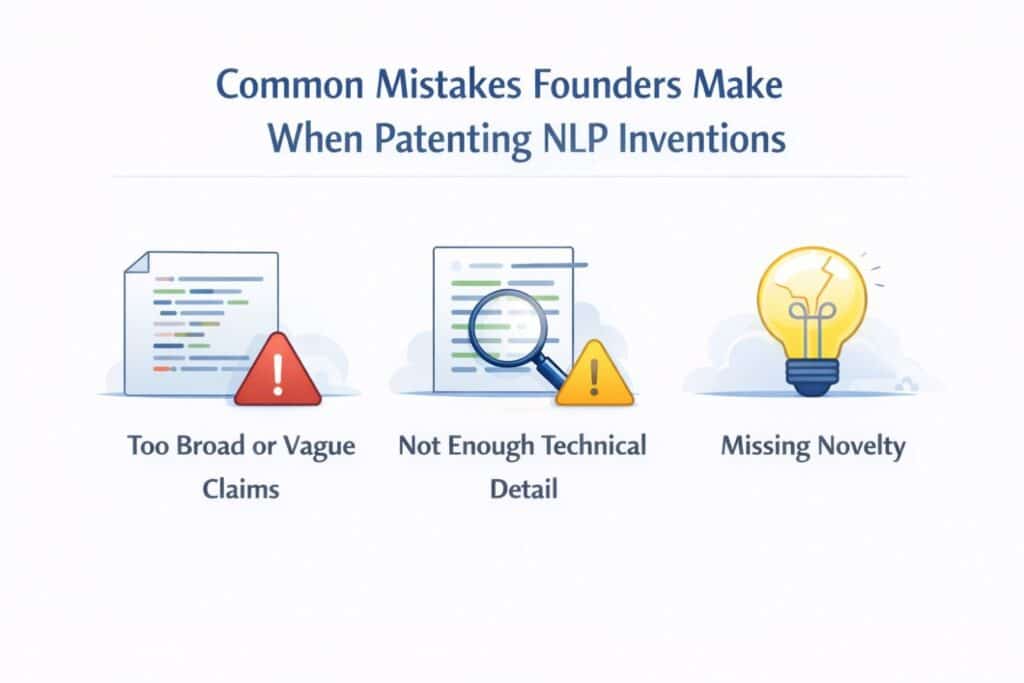
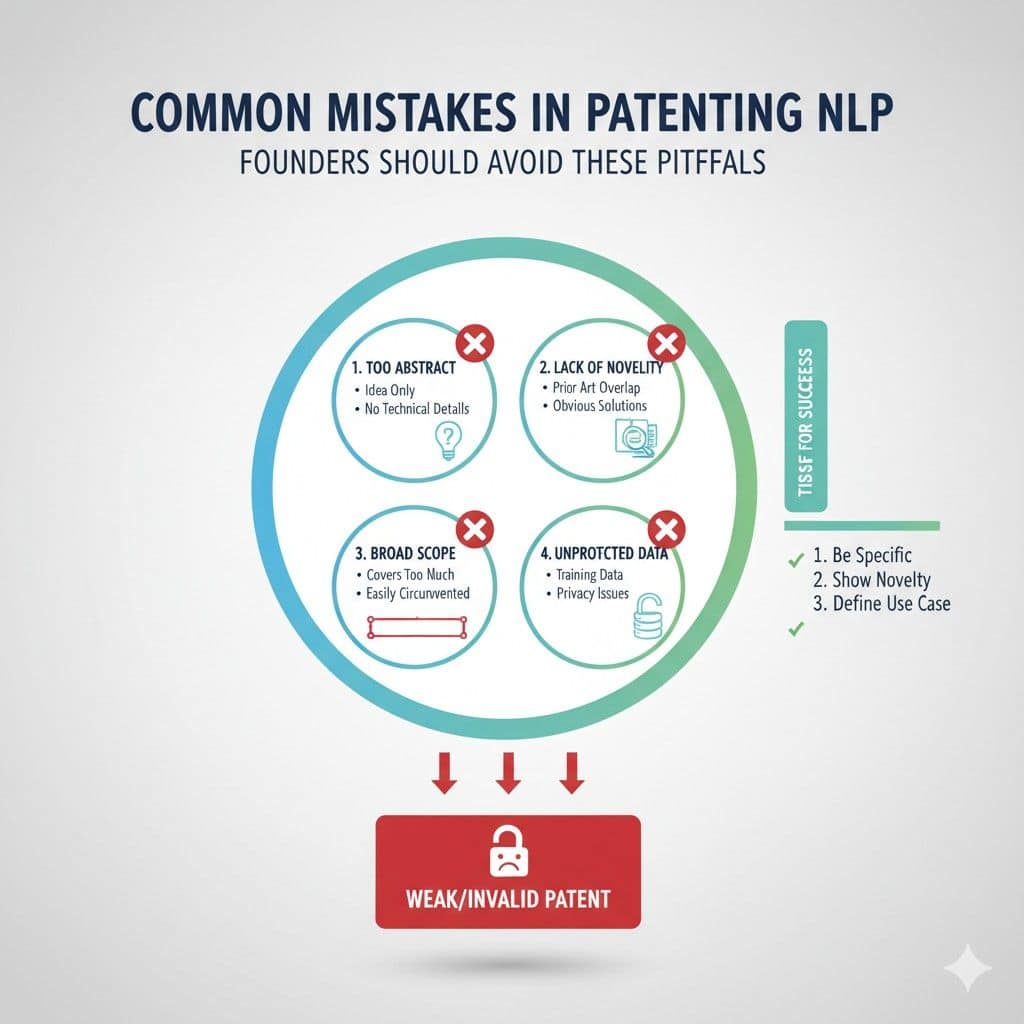
Common Mistakes Founders Make When Patenting NLP Inventions
NLP inventions often look very advanced from the outside. The model works, the demo is strong, the team is proud, and users start to see value fast.
But when it is time to protect that work, many founders make avoidable mistakes. The problem is usually not a lack of intelligence. It is a lack of patent strategy that fits how AI products are actually built and sold.
This matters more than most teams think. In NLP, product value is often buried inside workflow design, data treatment, ranking logic, output controls, and system behavior across edge cases.
If the patent misses those pieces, the filing may exist on paper but fail to protect what the business really depends on. That is why founders need to look at patenting as part of product strategy, not as a side task to clean up later.
Mistaking the model for the whole invention
Many founders assume the invention is the model itself. That is a very common mistake.
They focus too heavily on the architecture, the training setup, or the model label, while ignoring the broader system that turns model output into real business value.
In practice, customers rarely pay for a model in isolation. They pay for the system that makes the model usable.
That may include input preparation, domain-specific filtering, context retrieval, confidence scoring, ranking logic, review workflows, fallback handling, and ways to make outputs more stable.
If the patent focuses only on the model and leaves out the system around it, it may miss the most valuable part of the business.
The moat is often in the workflow layer
A strong NLP product usually wins because it handles a business problem better, not because it merely runs a model.
The system may route text in a smarter way, combine learned and rules-based logic, or handle low-quality inputs with fewer failures. Those details often matter more than the core model family.
Founders should study where the product becomes reliable enough for real use. That point often reveals what should be protected.
Patents should follow customer value, not research pride
Technical teams are often proud of the most advanced part of the stack. That is natural. But a patent should not follow pride alone. It should follow commercial value.
If customers stay because of output quality, speed, explainability, or lower manual work, the patent strategy should reflect the system choices that create those outcomes.
That shift helps businesses protect what drives adoption, not just what sounds impressive in a technical meeting.
Describing the product like a pitch deck
Another mistake is writing the invention in broad product language. Founders say the system improves search, automates review, understands text, or enhances decision-making.
Those ideas may be true, but they are too close to a sales story and too far from the actual technical method.
A patent needs more than a promise. It needs to show how the system gets from input to outcome in a real and structured way. Without that, the filing can become vague and weak.
Marketing language hides the real invention
Words like smart, adaptive, intelligent, seamless, and optimized sound polished, but they often cover up the very details that matter.
A better approach is to explain what the system actually does at each meaningful stage and why those stages improve performance.
For businesses, this is highly practical advice. If a paragraph in the invention description sounds like website copy, it probably needs more technical shape before it becomes a strong patent asset.
Clear technical language improves business leverage
Strong patent writing does not just help with filing. It also helps in diligence, fundraising, and partnerships. When a company can clearly explain the method behind its NLP system, it looks more credible.
Investors and acquirers tend to trust protection that tracks real engineering decisions rather than vague ambition.
That is one reason clear patent work often improves the whole business story.
Waiting too long to file
Many founders delay patent work because they want the product to feel more complete. They wait for better metrics, a cleaner interface, more users, or a fuller roadmap.
By the time they act, they may have already shared too much or missed the best window to protect the early insight.
This is especially risky in NLP because product cycles move fast. Teams publish, demo, pitch, post, and integrate quickly. The invention may already be visible before the company has taken steps to protect it.
The first useful version is often enough to start
A patent does not need the final polished system. It needs a real invention with enough detail to show what is new and useful.
In many cases, the best time to file is when the team can explain the technical problem, the method that solves it, and the result that follows.
That means founders should not wait for perfection. They should capture the invention when the core idea is clear and before the outside world sees too much.
Delay can turn strategy into cleanup
Once a product is already public, patent work becomes more reactive. The team is no longer shaping protection around the invention from the start. It is trying to catch up. That usually leads to weaker coverage and more stress.
Businesses that move early have more control. They can file around the core system while the product is still taking shape.
Claiming the outcome instead of the mechanism
A very common mistake is to focus on what the system achieves without claiming how it achieves it.
Founders say the tool classifies text more accurately, extracts better insights, or creates more reliable summaries. But the claim and the description do not explain the steps that cause that improvement.
This weakens the patent because many systems aim for the same outcomes. What matters is the method. The patent should center on the process, structure, and technical interaction that lead to the result.
Better output alone is not the invention
High accuracy is useful, but it is not enough by itself. Strong patent strategy asks what inside the system causes that gain. Maybe the system segments long text before analysis.
Maybe it resolves conflicting signals using a confidence layer. Maybe it retrieves supporting context before generation. Maybe it filters irrelevant passages before downstream scoring.
Those are the types of details that can support a real moat. Businesses should train themselves to move from result language to mechanism language when thinking about patent scope.
Ask what changed inside the pipeline
A smart internal question is simple. What changed inside the system that made performance improve?
The answer often reveals the patentable idea. It forces the team to point to a real technical adjustment rather than a broad success statement.
That question is also useful in product reviews because it sharpens understanding across engineering, leadership, and legal teams.
Being too broad too early
Some founders think the best patent is the widest one possible. So they describe text input, text analysis, and output generation at a very high level. They try to cover everything in one sweep.
The result often feels large but lacks substance.
Broad claims without enough structure can become fragile. They may fail to capture what is actually special about the system. They may also leave the company with protection that sounds impressive but is easy to work around.
Breadth without shape creates empty coverage
In NLP, many teams are building systems that receive text and produce outputs. That alone is not enough to define a strong invention. The claim needs technical shape.
It must explain the meaningful stages, relationships, or control logic that make the method different.
For businesses, the right goal is not maximum width. It is maximum useful coverage. That is a different standard and a much better one.
Wrapping It Up
Patenting an NLP invention is not about trying to own the whole field. It is about protecting the part of the system that gives your business a real edge. That is the part many founders miss. They focus on the headline feature, the model name, or the result on a demo screen. But the real value often sits deeper in the flow. It lives in how the system handles messy inputs, how it chooses context, how it scores outputs, how it avoids failure, and how it stays useful in real work.