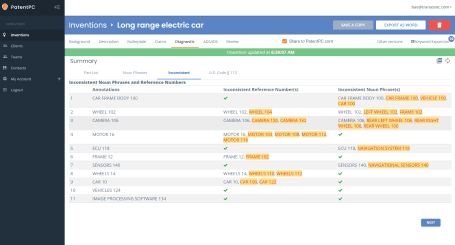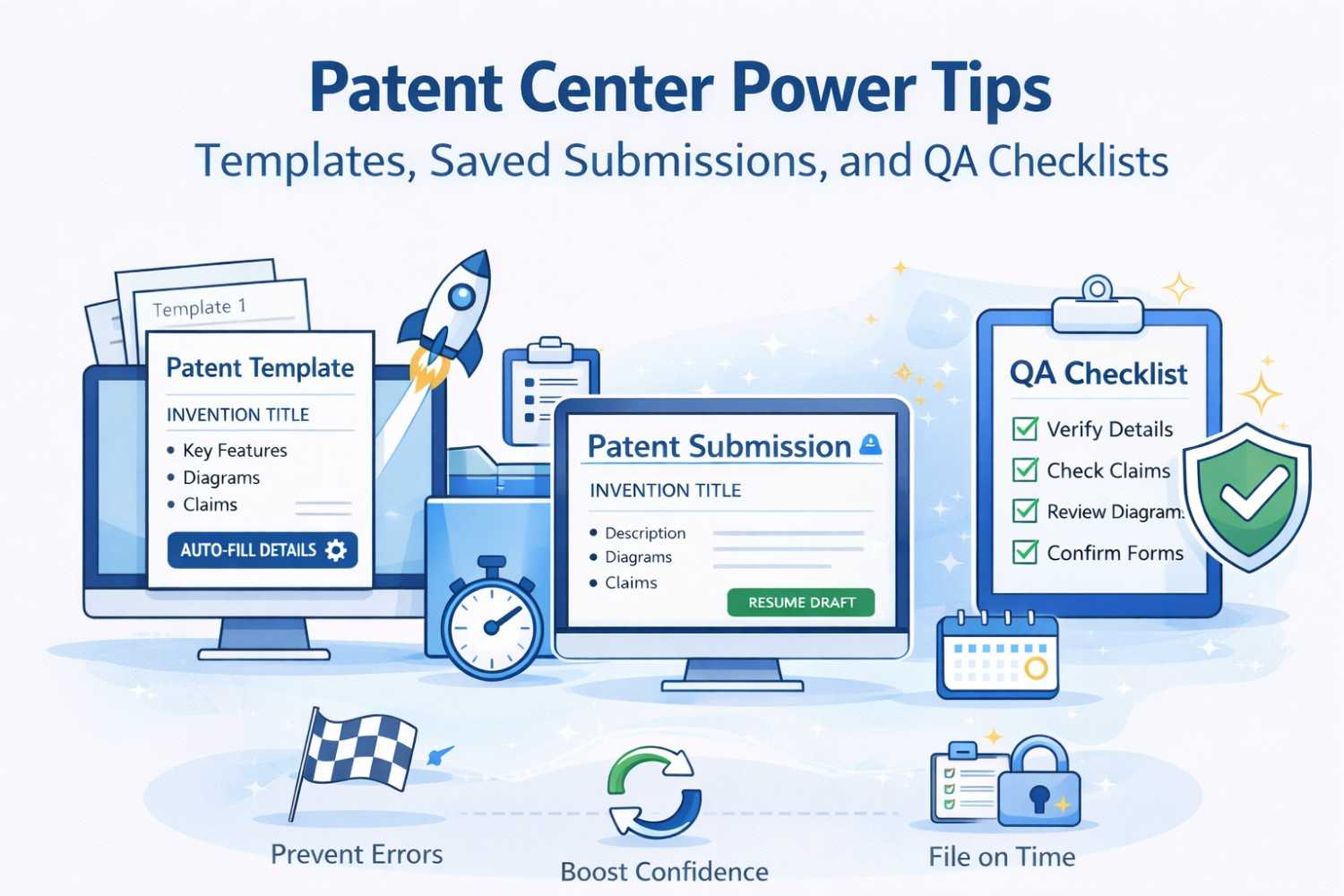
You are building something that matters. Maybe it is code. Maybe it is hardware. Maybe it is a new model that no one else has trained the way you have. You move fast. You ship. You test. But when it comes to patents, things suddenly feel slow, heavy, and confusing. That is where most founders freeze. This guide will show you how to use Patent Center the smart way—using templates, saved submissions, and simple QA checklists so you stay in control, move faster, and avoid costly mistakes. And if at any point you decide you would rather not wrestle with forms and filings alone, you can see how PowerPatent turns your work into strong, defensible patents without the old-school pain here: https://powerpatent.com/how-it-works
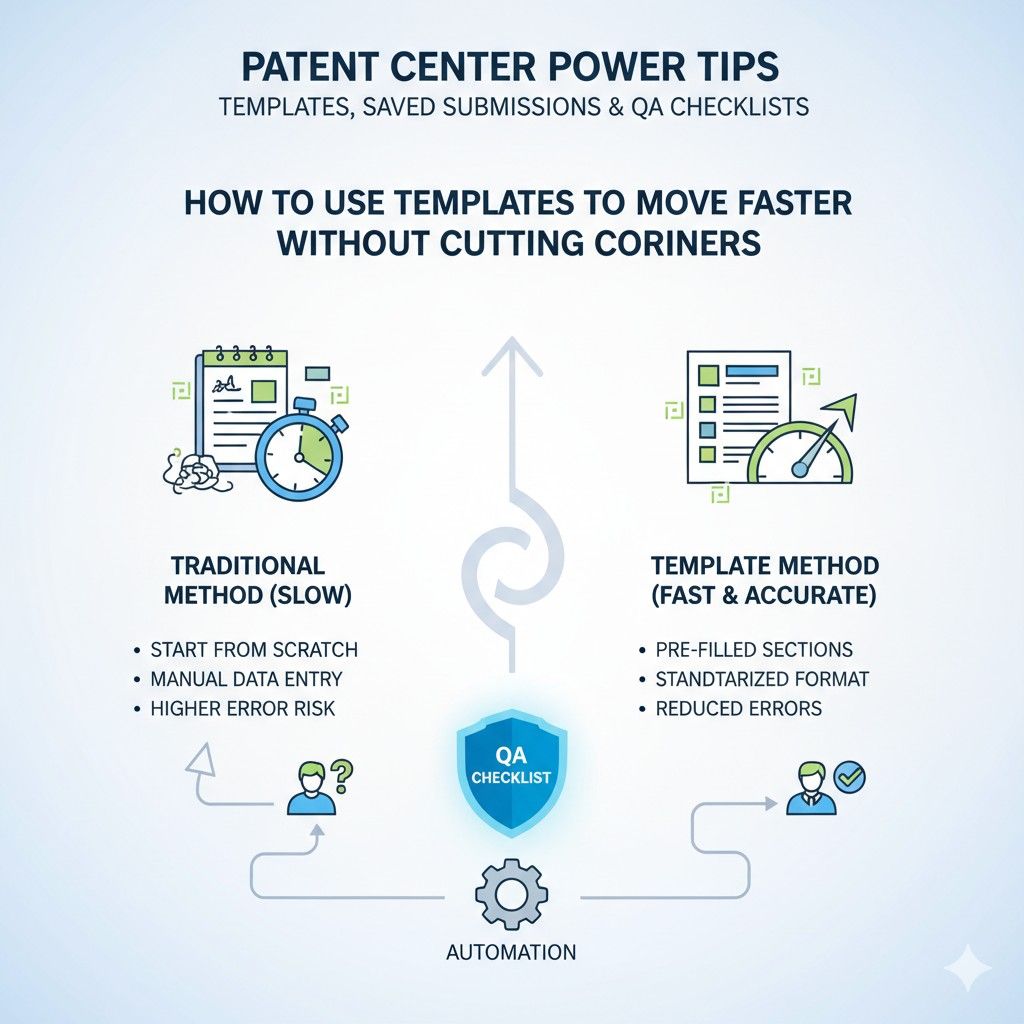
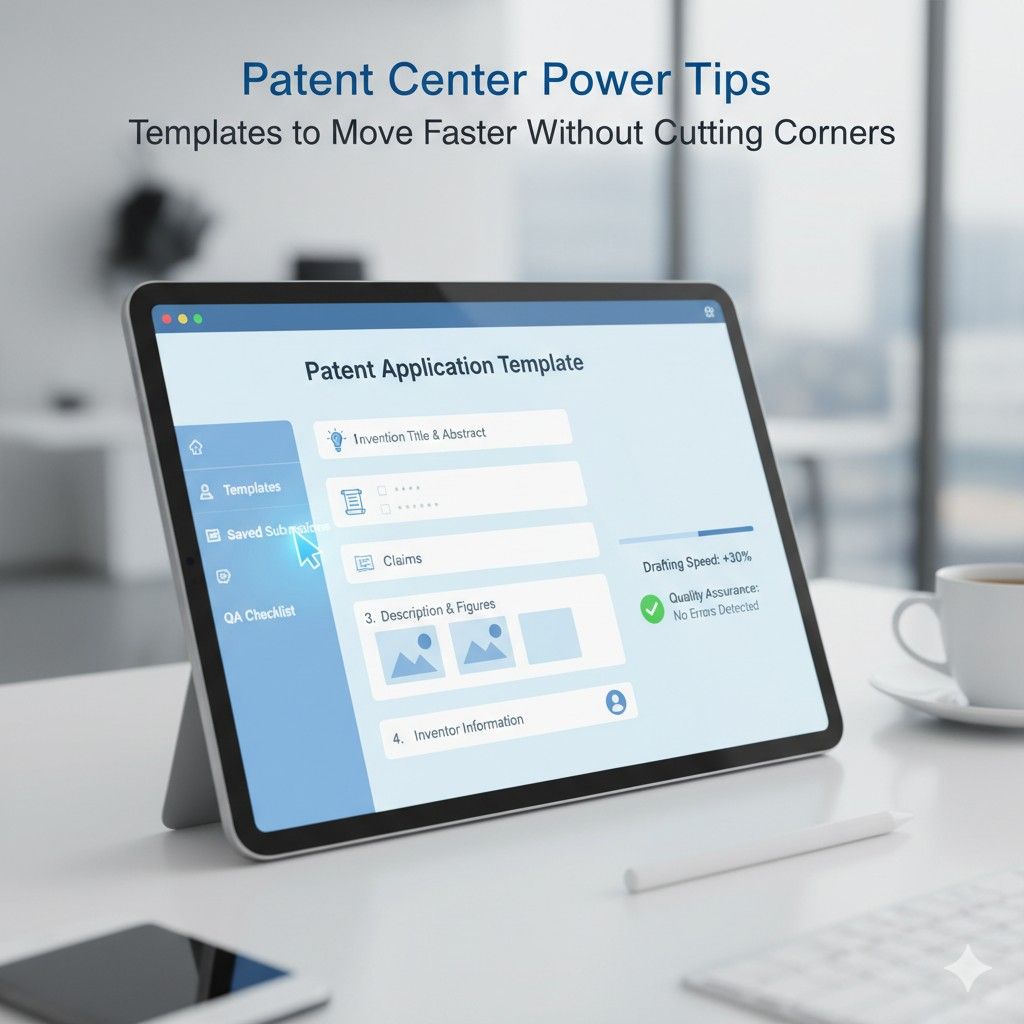
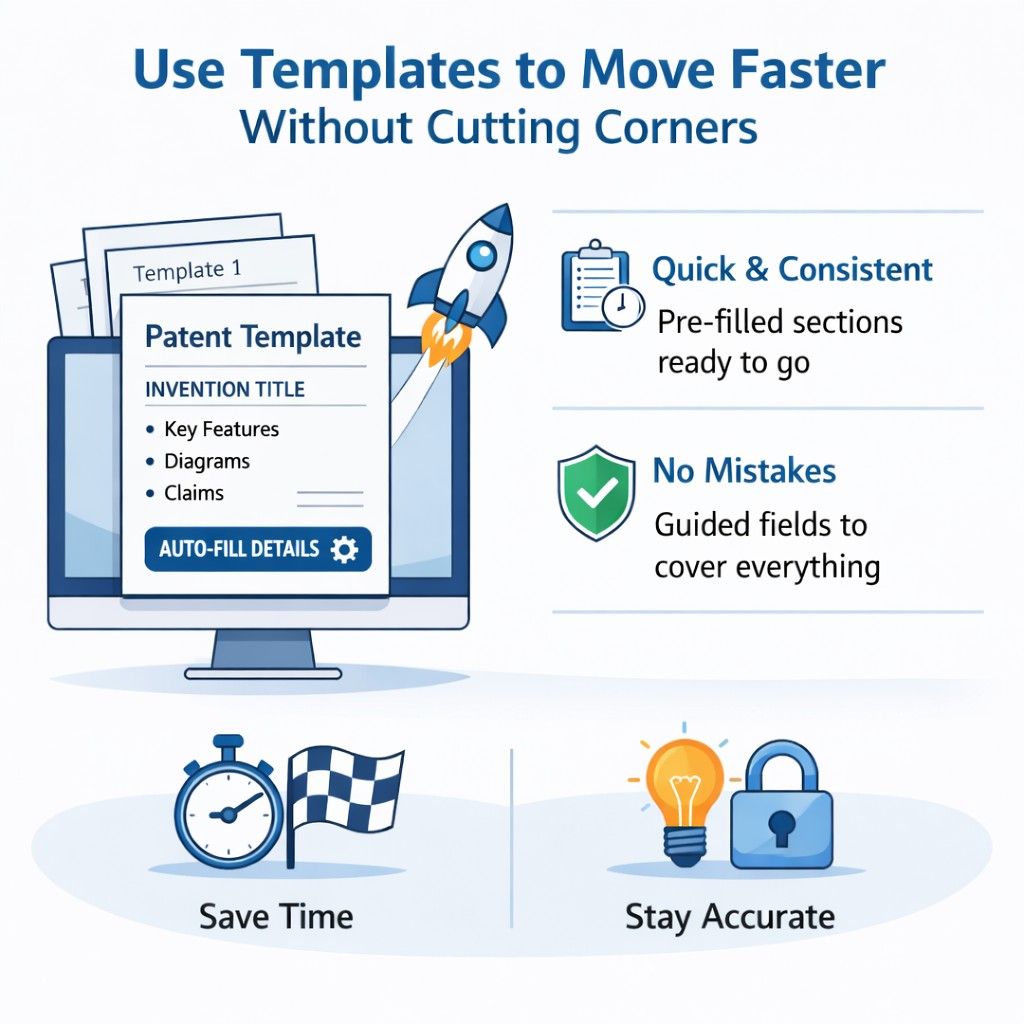
How to Use Templates to Move Faster Without Cutting Corners
When founders hear the word “template,” they often think of something generic or low quality. That is a mistake. A good template does not make your patent weaker. It makes your thinking sharper.
It gives you structure so you can focus on what matters most: clearly explaining what you built and why it is different.
If you are filing through Patent Center, templates can save you hours. But only if you use them the right way. The goal is not to copy and paste. The goal is to build a repeatable system that protects your company every time you invent something new.
Why Templates Are a Strategic Advantage for Startups
Speed alone is not the reason to use templates. The real value is control. When you use a structured starting point, you reduce risk. You make fewer careless mistakes. You avoid missing key sections. You stop reinventing the process each time.
Early-stage companies often treat patent filings like one-time events. That is short-term thinking. If you plan to build multiple products, ship updates, or improve your core system, you need a repeatable filing rhythm. Templates give you that rhythm.
When you combine structured templates with real attorney oversight, the result is powerful. You move quickly without lowering your standards.
That is exactly how PowerPatent approaches filings—smart software to structure the work, real patent attorneys to make sure it is strong. If you want to see how that works in practice, you can explore it here: https://powerpatent.com/how-it-works
Designing a Master Technical Disclosure Template
A strong template begins before you even log into Patent Center. It starts inside your company. You need a master technical disclosure format that every engineer can follow.
The introduction paragraph for this section is simple: if your engineers do not know what to document, you will always struggle at filing time.
Instead of scrambling to gather details weeks later, create a standard internal document that captures how the invention works, what problem it solves, and what makes it different from other solutions.
Do not wait until you are “ready to file.” Document as you build.
When you design this template, focus on clarity. Ask your team to explain the invention in plain words first. Then describe how it works step by step. Then describe alternative ways it could work.
Those variations matter more than most founders realize. They give you broader protection later.
Over time, this internal template becomes your secret weapon. Every new feature, system update, or architecture change can be dropped into the same format. That consistency makes Patent Center filings much smoother.
Creating Claim-Focused Thinking Early
Most founders treat claims as something lawyers handle at the end. That mindset slows you down. A smarter approach is to think in terms of “what are we really trying to protect” from day one.
The introduction paragraph here is about mindset. If you do not define the core idea clearly, your filing will drift.
When building your template, include a section where you answer one hard question: if a competitor copied us, what would we be upset about? That answer often points directly to your strongest claim angle.
Encourage your team to describe the invention at different levels. First at a high level. Then with more detail. Then with even more specific implementation steps.
This layered explanation helps you later when shaping independent and dependent claims.

If you work with PowerPatent, the platform guides you through this kind of structured thinking so you do not miss strategic angles. It is not about filling boxes. It is about capturing the full value of what you built in a way that stands up later.
Building Reusable Sections for Repeated Filings
As your startup grows, patterns emerge. You may reuse the same system architecture. The same data pipeline. The same hardware framework. Rewriting these from scratch every time wastes energy and creates inconsistency.
The introduction here focuses on leverage. Reuse the parts that do not change so you can focus on what does.
Develop standard language that describes your core platform. Keep it updated. When you prepare a new filing in Patent Center, pull from this approved language instead of writing fresh text each time.
This does not mean copying blindly. It means starting from a reliable base and then layering the new invention on top. This protects you from small wording shifts that could accidentally narrow your protection.
It also makes attorney review faster. When your counsel sees familiar, well-structured language, they spend less time fixing basic sections and more time strengthening the new material. That is a better use of time and money.
Avoiding the “Fill in the Blank” Trap
Templates can become dangerous if used lazily. Many founders treat them like forms to complete rather than strategic tools. That approach leads to weak explanations and vague statements.
The introduction paragraph here is a warning. A template is only as strong as the thinking behind it.
Instead of writing short answers just to move forward, force your team to over-explain. Assume the reader knows nothing about your system. Spell out the steps. Describe edge cases. Explain why certain design choices were made.
Patent examiners do not sit inside your product meetings. They do not understand your roadmap. They only see what you submit. A rushed template answer can limit your protection in ways that are hard to fix later.
This is one reason many deep tech founders choose a guided platform like PowerPatent. The structure helps, but the attorney oversight ensures that what you write is not just complete, but defensible.
Turning Templates Into a Filing Workflow
A template by itself is just a document. The real power comes when it becomes part of your operating system.
The introduction paragraph here focuses on process. Without a workflow, even great templates gather dust.
Decide who owns the first draft. Decide who reviews it. Decide how often you review new inventions for filing potential. Build this into your product cycle.
For example, at the end of every major sprint, ask one question: did we build something new that is worth protecting? If yes, drop it into your disclosure template immediately.
When it is time to use Patent Center, you are not starting from zero. You are refining an already organized body of work. That reduces stress and shortens timelines.
This discipline compounds. After a year, you will not just have one patent. You will have a portfolio strategy forming in the background.
Aligning Templates With Business Goals
A patent is not just a technical document. It is a business asset. Your template should reflect that.
The introduction paragraph here brings everything back to strategy. Protection without direction is wasted effort.
In your template, include a short section that explains why this invention matters to the company. Does it protect core revenue? Does it block competitors? Does it strengthen your position for fundraising?
This forces leadership to think beyond features. It aligns legal protection with growth strategy.
Investors care about defensible advantages. Acquirers care about strong intellectual property. When your filings clearly tie to business value, they become more than paperwork. They become leverage.
If you want help building filings that match your growth plans, not just your codebase, you can see how PowerPatent supports that here: https://powerpatent.com/how-it-works
Making Templates a Living System
The final idea in this section is evolution. Your first template will not be perfect. That is fine. What matters is that you improve it over time.
The introduction paragraph here is about iteration. Treat your patent process like your product.
After each filing, ask what slowed you down. What questions came up from your attorney? What feedback did you receive from examiners? Update your template based on real-world experience.
Over time, your internal documentation becomes sharper. Your filings become stronger. Your team becomes more comfortable with the process.
That is how you move fast without cutting corners. Not by rushing. Not by skipping steps. But by building smart systems that protect your innovation at the same speed you create it.
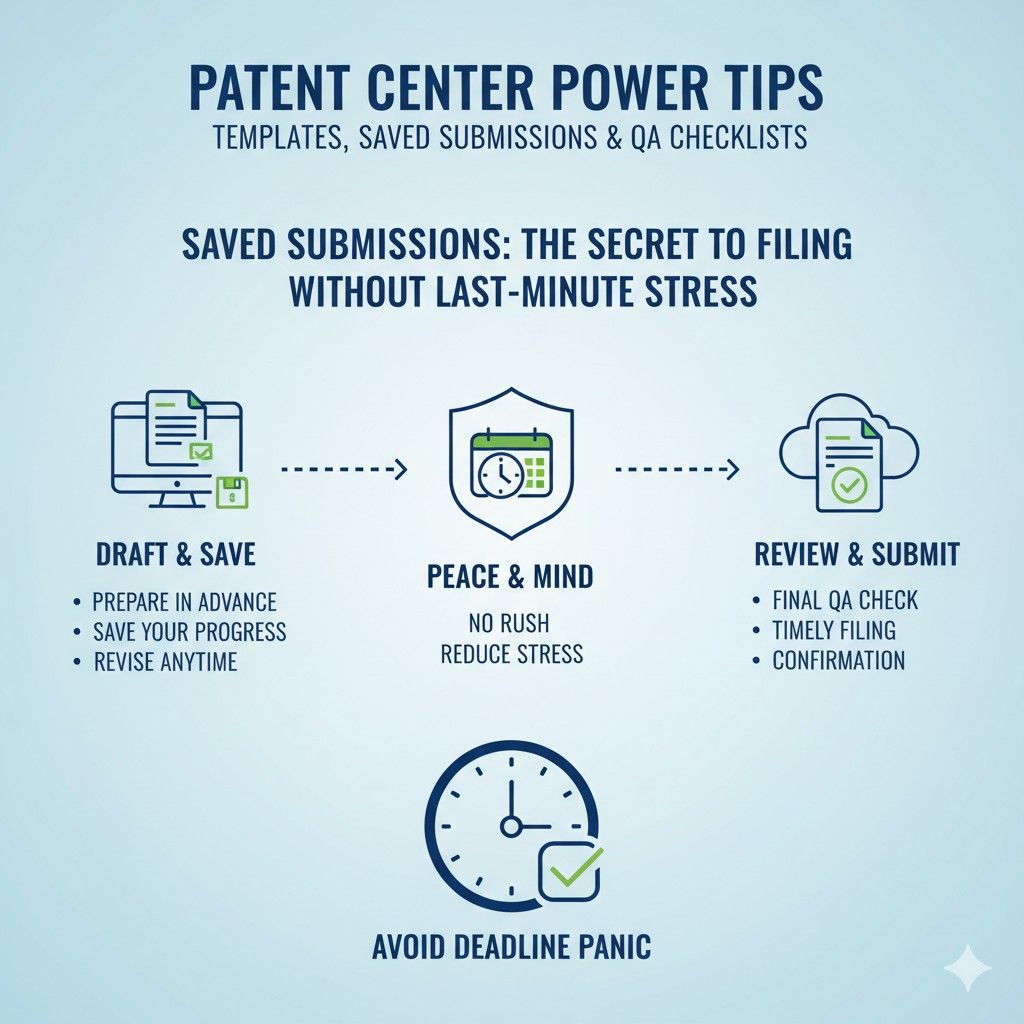
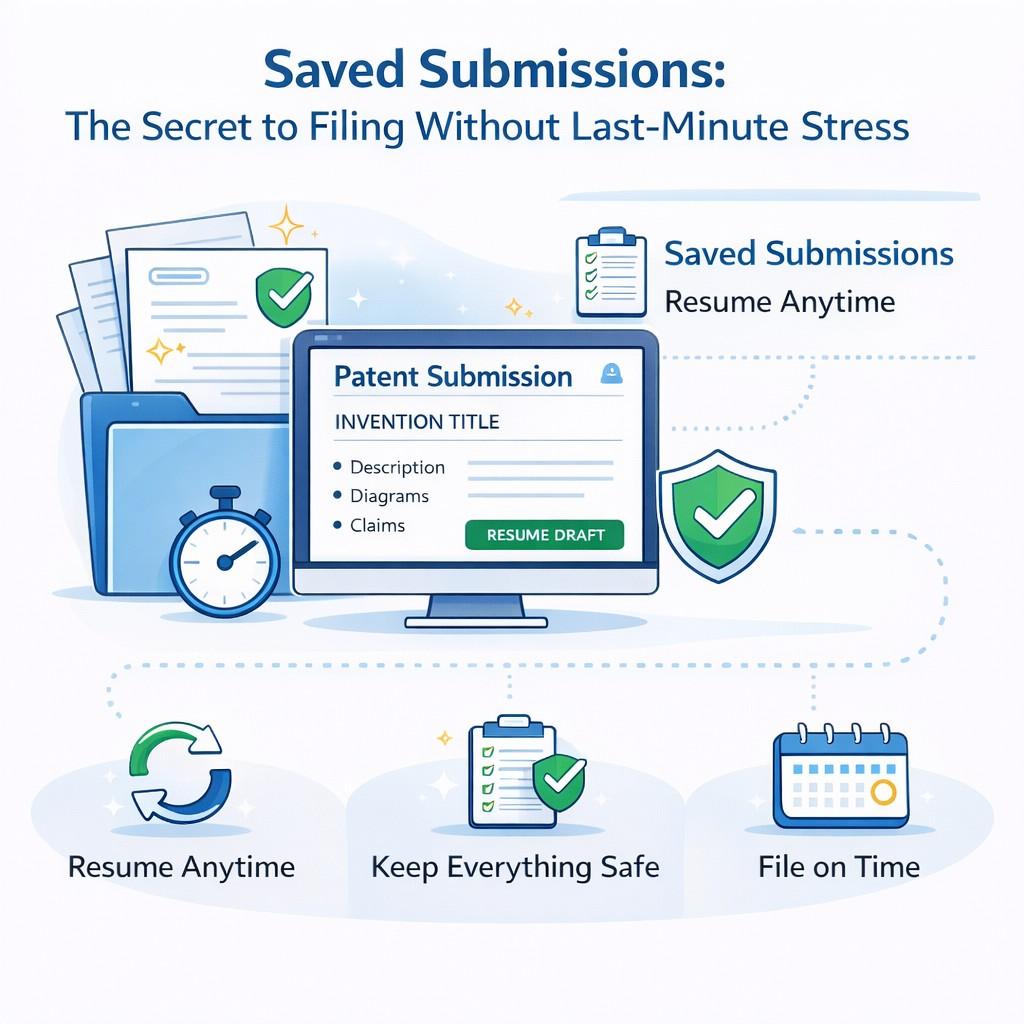
Saved Submissions: The Secret to Filing Without Last-Minute Stress
Filing through Patent Center can feel heavy if you treat it like a one-shot event. Many founders wait until the deadline is close, then rush to upload files, enter data, and fix errors in one sitting.
That pressure leads to small mistakes that can cause delays or extra fees. Saved submissions solve this problem.
Saved submissions are not just a convenience feature. They are a risk control system. When used well, they turn filing from a stressful sprint into a calm, staged process. That shift alone can protect your company from costly errors.
Why Rushing Is So Dangerous in Patent Filings
Deadlines in patent work are real. Miss one, and you may lose rights. That is why founders panic near filing dates. But the real danger is not the deadline itself. The real danger is last-minute editing.
When you rush, you are more likely to upload the wrong version of a document. You may forget a required form. You might miss a small data field that triggers a rejection.
These are not big dramatic errors. They are small oversights that add friction.
Saved submissions allow you to break the process into stages. Instead of doing everything at once, you can upload documents early, review them later, and submit only when you are confident. That buffer protects you.
If you are working with PowerPatent, much of this staging is handled through structured workflows and attorney review before submission. You are not left alone guessing whether everything is complete.
You can see how that works here: https://powerpatent.com/how-it-works
Treating Saved Submissions Like a Staging Area
Think of a saved submission as a staging area, not a draft you ignore. It is a controlled environment where you can test completeness before you go live.
The key is to enter the system earlier than you think you need to. Even if your specification is still being refined, create the submission shell. Add placeholder documents if needed.
This forces you to see the full checklist inside Patent Center.
When you see every required field early, you reduce surprises. You give yourself time to correct issues without panic. The filing becomes predictable.
This approach mirrors good software deployment practices. You would not push untested code directly to production. You use staging. Patent filings deserve the same discipline.
Building a Two-Phase Internal Review
Saved submissions make it easy to separate content review from submission review. These are two different tasks, and mixing them creates confusion.
In the first phase, your team reviews the technical content. Are the diagrams correct? Does the description fully explain the system? Are variations included?
This review has nothing to do with forms or payment details. It is about substance.
In the second phase, once documents are uploaded into Patent Center as a saved submission, someone reviews only the filing details. Are all required forms attached?
Are inventor names correct? Is the entity status accurate? Is the application type correct?
By separating these phases, you reduce mental overload. Each review has a clear purpose. This structure makes mistakes far less likely.
PowerPatent builds similar layers of review into its process. Software helps catch structural gaps, and real attorneys review substance. That combination gives founders peace of mind.
Using Saved Submissions to Coordinate Teams
As your startup grows, more people touch the patent process. Engineers draft disclosures. Product leaders review strategy. Founders approve final filings. Attorneys refine language.
Without a clear coordination point, emails and document versions get messy. Saved submissions can serve as that coordination anchor.
Once a submission is created, treat it as the single source of truth. Instead of sending multiple file versions through chat or email, update documents inside the saved submission environment and notify the team to review there.
This reduces version confusion. It also ensures that what you review is exactly what will be filed. Too often, founders approve one version while another gets uploaded by mistake.
Centralizing around the saved submission closes that gap.
Creating Internal Filing Deadlines Before Official Ones
One of the smartest ways to reduce stress is to create an internal deadline that is earlier than the real one. Saved submissions make this easy to manage.
For example, if you plan to file before a public launch, do not aim for the day before launch. Aim for two weeks earlier. Upload everything as a saved submission by that internal deadline.
Then use the buffer period for final review and corrections. If issues appear, you still have time. If everything looks good, you submit early and move on.
This simple habit changes the tone of patent work inside your company. It becomes proactive instead of reactive.
Founders who use structured platforms like PowerPatent often experience this shift naturally because the workflow is guided and paced. You are less likely to scramble at the last minute.
Catching Data Errors Before They Become Official
Once you hit submit, errors become harder to fix. Correcting inventor names or entity status can require extra filings and fees. Some errors may even raise questions later during enforcement or due diligence.
Saved submissions allow you to slow down and double-check critical data. Verify legal names. Confirm addresses. Ensure ownership details match company records. Make sure the correct entity size is selected.

These details may seem small, but they matter deeply when investors or acquirers review your portfolio. Clean filings signal discipline.
By reviewing these data fields calmly inside a saved submission, you protect the long-term value of your patents.
Aligning Saved Submissions With Fundraising and Product Milestones
Patent filings should not exist in isolation. They should align with your business timeline. Saved submissions give you flexibility to manage timing strategically.
If you are approaching a funding round, you may want to have key filings submitted before investor meetings. By preparing saved submissions in advance, you can control exactly when you press submit.
If you are planning a public product demo, you can prepare everything early and file just before launch to secure priority.
This level of control gives founders confidence. You are not guessing whether paperwork will be ready in time. You can see it sitting there, complete, waiting for final approval.
Platforms like PowerPatent are built with this founder reality in mind. Speed matters, but so does precision. When software and attorneys work together, you get both.
Reducing Emotional Stress Around Filing
There is also a human side to saved submissions. Filing a patent can feel intimidating, especially for first-time founders. The system screens, the formal language, the finality of submission all create pressure.
By working in saved mode first, you remove the emotional weight. You can explore the interface. You can check entries. You can log out and return later.
This lowers the barrier to engagement. Founders who feel less intimidated are more likely to build a steady patent habit instead of avoiding the process.
And when you combine this calm workflow with expert oversight, you eliminate the fear of “did I do this right?”
If that peace of mind sounds valuable, it is worth seeing how PowerPatent blends structured software with real attorney review: https://powerpatent.com/how-it-works
Turning Saved Submissions Into a Strategic Habit
The final shift is mindset. Do not treat saved submissions as optional. Treat them as a mandatory stage in every filing.
Never aim to complete and submit in one sitting. Always create, pause, review, and then submit.
This habit compounds over time. Your filings become cleaner. Your team becomes more confident. Your company builds a reputation for disciplined intellectual property management.
Strong patents do not come from chaos. They come from controlled systems. Saved submissions are one of the simplest tools to create that control.
Next, we will dive into the final piece that ties everything together: building a simple QA checklist that protects you from costly mistakes.
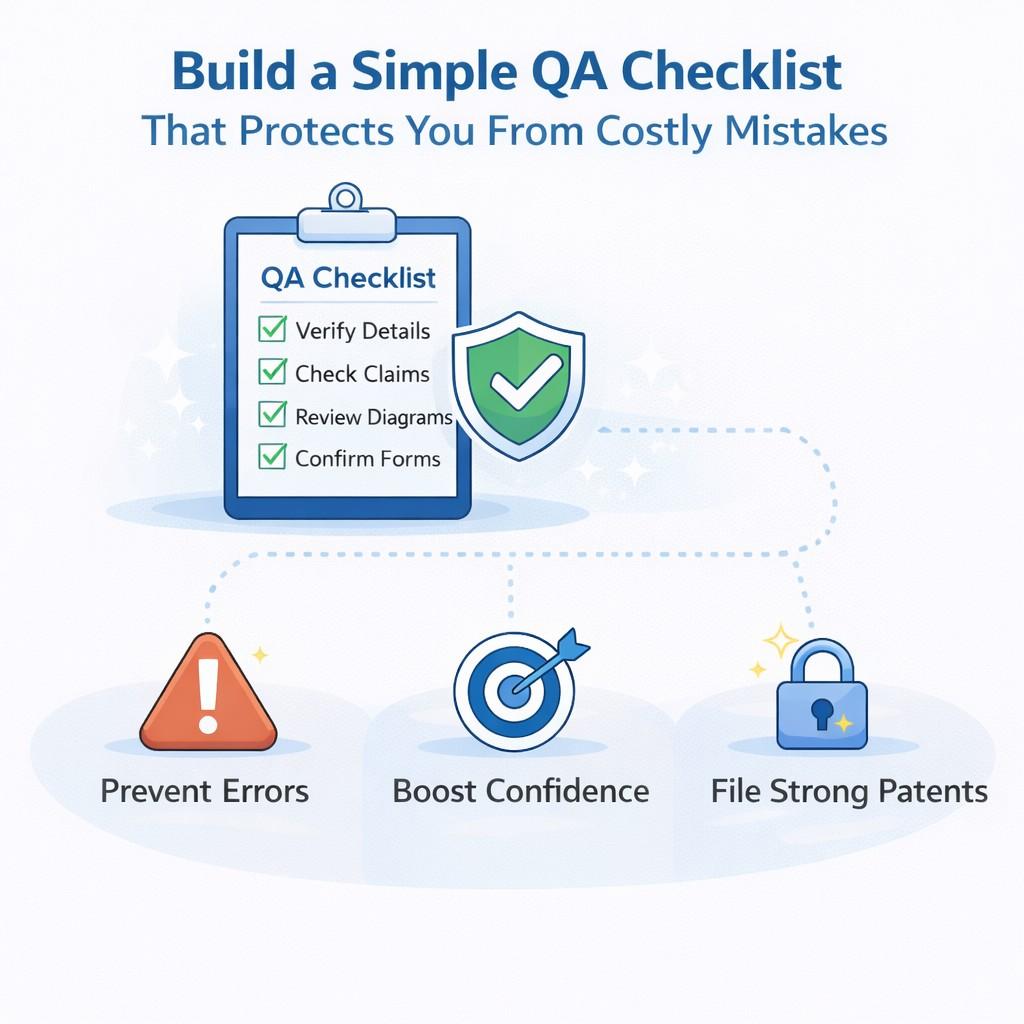
Building a Simple QA Checklist That Protects You From Costly Mistakes
A patent filing is not just a document. It is a permanent record. Once it is submitted, it becomes part of your company’s foundation. Investors will read it. Competitors may study it.
Examiners will analyze every word. If something is unclear or incomplete, you may not get a second chance to fix it cleanly.
That is why a quality check system matters so much.
A simple QA checklist can be the difference between a strong asset and a weak filing that creates problems later. This is not about adding red tape. It is about building a safety net that protects the value of what you have created.
Why Smart Companies Never Skip Final Review
Even the best engineers make small mistakes. Even experienced founders overlook details. When you are deep inside the invention, it is hard to see gaps.
A QA checklist forces you to step back.
It shifts your role from creator to reviewer. You stop asking, “Did we write something?” and start asking, “Would a stranger fully understand this?” That small shift changes the quality of the outcome.
Large tech companies run multiple review layers before filing. Early-stage startups rarely do. Not because they do not care, but because they do not have a system. A simple checklist gives you that system without slowing you down.
If you work with PowerPatent, structured reviews and attorney oversight are built into the process so you are not relying on memory alone. But even then, internal review makes your filings stronger.
You can see how that structure works here: https://powerpatent.com/how-it-works
Reviewing for Technical Completeness
The first layer of QA is technical completeness. This is not about grammar. It is about coverage.
Ask yourself whether someone skilled in your field could build your invention based only on your description. If key steps are missing, that is a red flag. If diagrams do not match the text, that is a red flag.
Go section by section and imagine you are a competitor trying to find a loophole. Could you design around the description easily because something was too narrow? Did you only describe one version when multiple variations exist?
Strong filings describe the invention broadly and then narrow down with specific examples. If your description focuses only on your current implementation, you may be leaving value on the table.
This is where many startups make quiet mistakes. They protect what they built last month, not the full concept that could power their business for years.
Checking Alignment Between Claims and Description
One of the most common weaknesses in patent filings is misalignment between claims and the main description.
Claims define the legal boundary. The description supports those claims. If the claims are broader than what the description explains, examiners may reject them. If the claims are too narrow, you limit your protection.
During QA, read each main claim slowly. Then check whether the description clearly explains every element in that claim. If you see a term in the claim that barely appears in the body, that is a problem.
On the other side, look at valuable features described in detail but missing from the claims. Ask whether those features deserve protection as dependent claims.

This type of cross-check is powerful. It forces coherence. It ensures that your filing is not just long, but strategically tight.
Platforms like PowerPatent help structure this thinking, but founders who understand this alignment gain a huge advantage.
Verifying Inventorship and Ownership Details
Technical quality is only half the equation. Legal details matter just as much.
Incorrect inventorship can create serious issues later. During fundraising or acquisition, investors may review whether the correct people were named. If someone who contributed significantly is missing, disputes can arise.
Your QA checklist should include a deliberate review of who contributed to the inventive concepts. Not who worked on the project in general, but who contributed to the specific ideas claimed.
Also verify ownership details. Make sure assignments are clear and properly documented inside your company records. A clean ownership chain increases confidence during due diligence.
These details may feel administrative, but they directly affect the value of your patent portfolio.
Reviewing Drawings With Fresh Eyes
Drawings are often treated as secondary. They should not be.
Examiners look closely at figures. So do competitors. If diagrams are unclear or inconsistent with the text, they weaken your filing.
During QA, print the drawings or view them separately from the description. Ask whether each figure is labeled clearly. Make sure reference numbers in the drawings match the numbers in the text.
Look for missing components that are mentioned in the description but not shown visually. Check that alternative embodiments are represented if they are important.
Clear drawings signal professionalism. They also reduce confusion during examination.
Stress Testing the Filing Against Future Growth
A powerful QA step is to imagine your company three years from now.
Will this patent still cover your core product? Or is it locked to a version that may soon evolve?
If your startup works in software or AI, your system will likely change quickly. During QA, ask whether the language is flexible enough to cover updates and improvements.
Avoid tying the invention too closely to one programming language, one data source, or one hardware configuration unless absolutely necessary.

This does not mean being vague. It means describing concepts at a level that survives iteration.
This forward-looking review transforms your filing from a snapshot into a strategic shield.
Running a Pre-Submission Simulation
Before final submission, simulate the full experience as if you were an examiner seeing this for the first time.
Read the abstract alone. Does it clearly describe what is new?
Read only the independent claims. Do they stand on their own?
Scan the background section. Does it set up the problem without admitting too much about prior art weaknesses?
This simulation helps you catch tone issues, unclear framing, or unintentional limitations.
Many founders skip this step because they are eager to submit. But a single focused review session can dramatically improve clarity.
When combined with the structured review inside a platform like PowerPatent, this type of simulation builds deep confidence. You are not guessing. You are verifying.
Making QA a Cultural Habit
The most valuable part of a checklist is not the document itself. It is the culture it creates.
When your team knows that every filing goes through structured review, they write more carefully from the start. Engineers document more clearly. Product leaders think more strategically about protection.
QA becomes part of how you build, not just how you file.
Over time, this discipline compounds. Your patent portfolio grows stronger. Your filings become more consistent. Investors notice the difference.
Strong intellectual property is rarely an accident. It is the result of simple systems followed consistently.
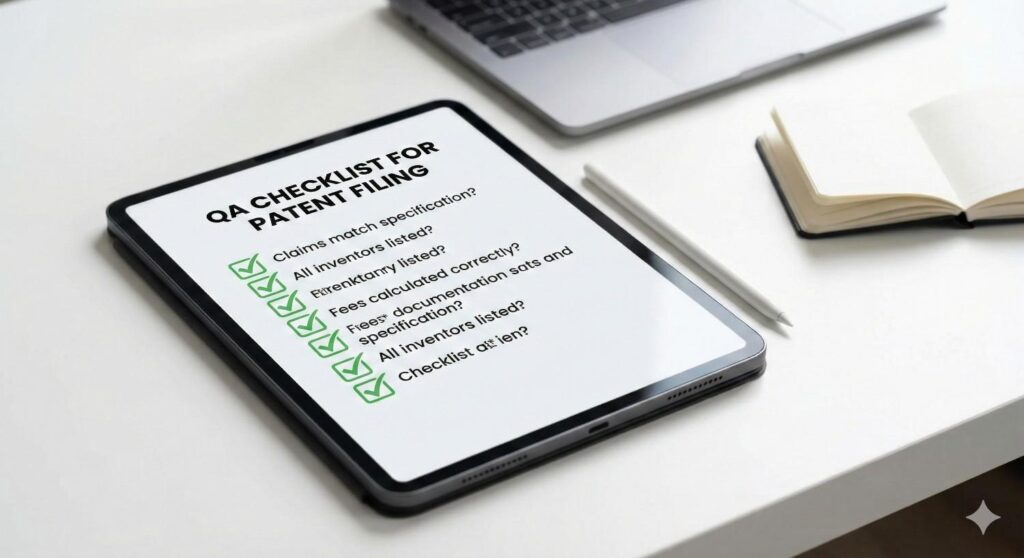
If you want a faster path to that kind of discipline, without building every process from scratch, you can see how PowerPatent combines software structure with real attorney review to help startups file better patents, faster: https://powerpatent.com/how-it-works
You now have the three core pillars: smart templates, staged saved submissions, and disciplined QA review. Together, they turn Patent Center from a confusing portal into a controlled system that works for you.
Would you like me to now expand the article further toward a full 5000-word complete draft and begin
Wrapping It Up
At the end of the day, Patent Center is just a tool. Templates are just documents. Saved submissions are just features. A QA checklist is just a sheet of questions. None of these things matter on their own. What matters is the system you build around them. When you use templates the right way, you stop starting from zero every time you invent something new. You capture ideas clearly. You think in terms of protection early. You document variations before they disappear from memory. That alone puts you ahead of most startups.