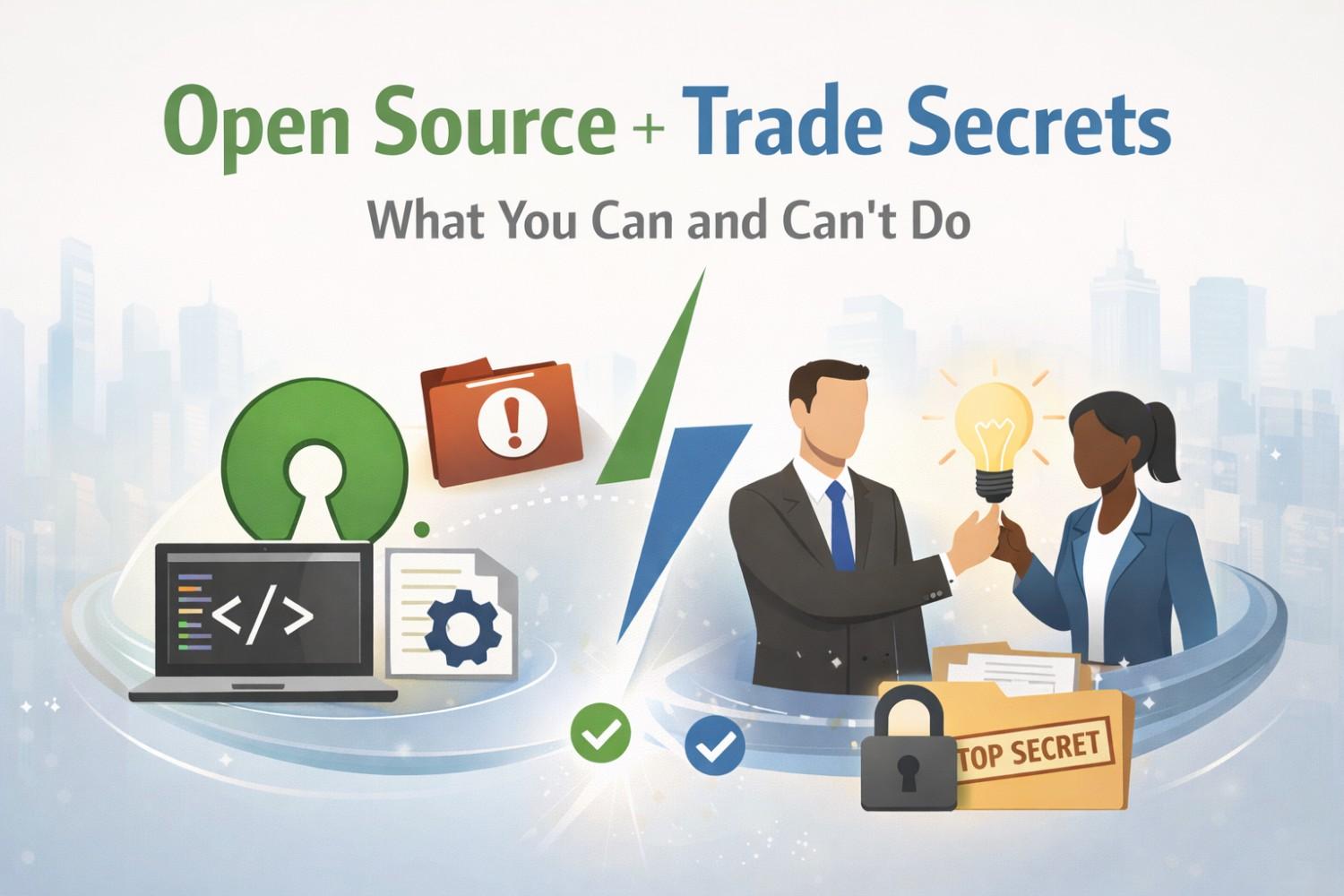
Most founders build fast by using open source. Most founders also assume some parts of what they build should stay secret. That is where things quietly break. Open source and trade secrets can work together. But only if you understand the rules. If you get them wrong, you do not just risk a lawsuit. You can lose ownership of the most valuable part of your company without realizing it. This is not about fear. It is about control. If you are an engineer or founder, you are already making decisions every day that affect whether your work can stay protected or becomes public forever. The problem is that no one explains these rules in plain language. They are usually buried in legal talk or ignored until it is too late.
Why Open Source and Trade Secrets Clash More Than Founders Expect
Open source feels safe to most founders. Trade secrets feel safe too. The clash happens because each one follows a different set of rules, and those rules do not care about your intent.
They only care about what you did, when you did it, and who can see it.
Many teams believe they are being careful simply because they never post their full product online.
That belief is where most damage starts. The conflict between open source and trade secrets is not loud or obvious. It is quiet, slow, and often invisible until value is already gone.
Open Source Is Built to Spread, Not Protect
Open source exists to be shared. That is its purpose. When you pull in open source code, you are stepping into an ecosystem designed for openness, reuse, and visibility.
Trade secrets depend on the opposite. They only exist if the information stays hidden and controlled.
This is where founders get confused. They assume that because only part of their system is open source, the rest stays protected by default. That is not how the world works.
If your secret relies on how open source code is used, modified, or connected, you may already be exposing more than you think.
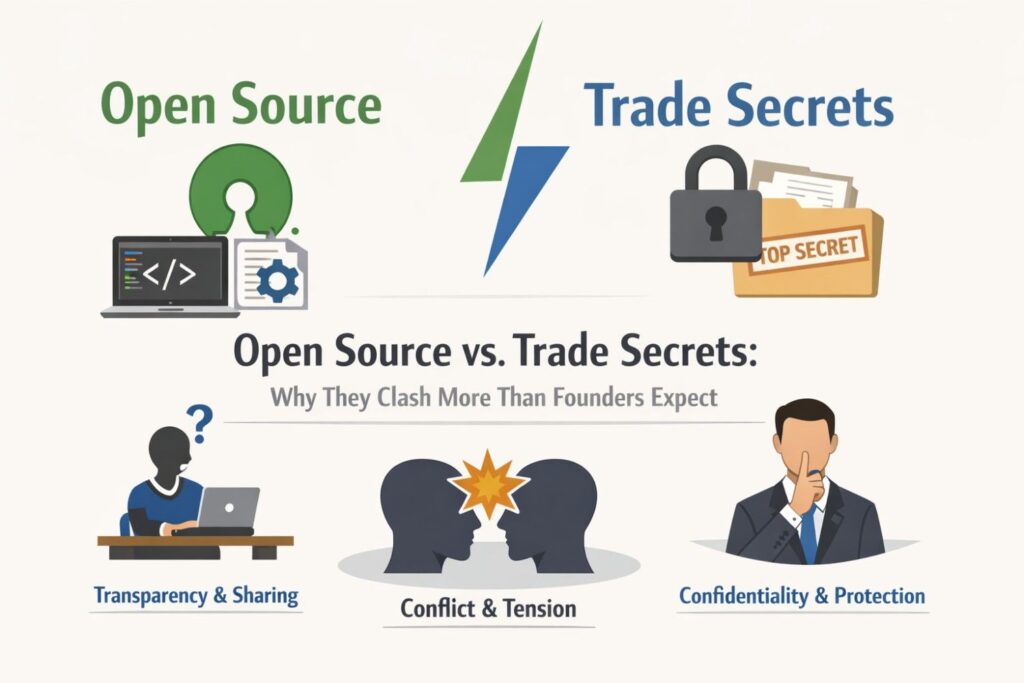
A good mental test is simple. Ask whether a smart engineer could rebuild your key advantage by reading public code, public docs, or public repos and then filling in small gaps. If the answer is yes, you may not have a real trade secret.
Licenses Quietly Change Ownership Rules
Most people treat open source licenses like fine print. They skim them or ignore them completely. That is dangerous. Licenses decide what you must share and when.
Some licenses require you to publish changes. Some require you to open related code. Others seem harmless but create gray areas that investors and acquirers hate.
The clash happens when founders assume secrecy is a business choice, not a legal condition. Trade secrets are only protected if you take real steps to keep them secret.
Using code that forces disclosure, even indirectly, can cancel that protection without warning.
This is why smart teams decide early which parts of their system must stay secret and then design boundaries around those parts. They do not let license terms accidentally define their IP strategy.
Your Architecture Can Destroy Secrecy Without Any Sharing
You do not need to post code online to lose trade secret protection. Architecture alone can do the damage.
If your secret logic lives inside open source components, plugins, or exposed layers, secrecy may already be broken.
Many founders build fast by extending open source tools directly. Over time, the line between what is yours and what is shared becomes blurry. That blur is deadly for trade secrets.
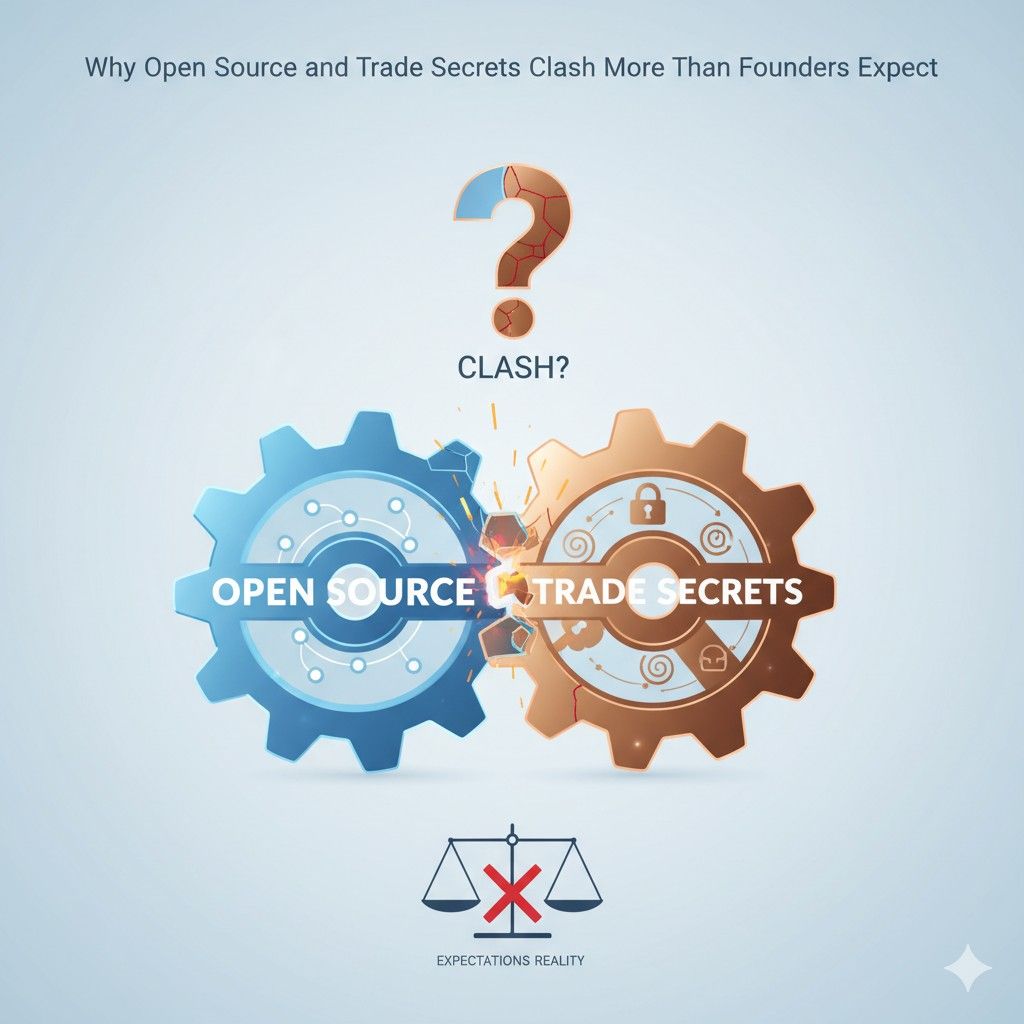
Courts and investors look for clean separation. If your core value is mixed into open code paths, it becomes hard to argue that it was ever truly secret.
The most effective teams design systems where secrets live in isolated services, internal tooling, or private layers that never touch public codebases. This is not about paranoia. It is about clarity.
Team Behavior Matters More Than Code Choices
Even perfect technical separation can fail if your team treats secrets casually. Open source culture encourages sharing, explaining, and teaching. Trade secrets demand restraint.
Mixing these mindsets without guidance leads to leaks that no one notices.
Engineers might explain too much in a pull request. Founders might overshare in a demo. Marketing teams might publish technical blogs that feel harmless but reveal process details. Each action chips away at secrecy.
Companies that succeed here do something simple but rare. They explain, in plain words, what must stay private and why. They do not rely on instinct. They create habits that protect secrets without slowing work.
Speed Can Trick You Into Risky Shortcuts
Startups move fast. Open source helps with that. Trade secrets require patience and discipline. The clash happens when speed becomes the excuse for skipping structure.
Founders often say they will clean things up later. Later rarely comes. By the time traction hits, code has spread, contractors have touched it, and documentation has leaked context.
At that point, calling something a trade secret is more hope than reality.
The strategic move is to decide early which advantages matter long term. Protect those first. Everything else can stay flexible.
PowerPatent often helps founders identify these boundaries early, before speed creates irreversible exposure. You can see how that works here: https://powerpatent.com/how-it-works
Investors See This Clash Before You Do
Sophisticated investors look closely at how you use open source. They are not anti-open source. They just want to know what you actually own. If your answers sound vague, confidence drops.
When trade secrets and open source are tangled, due diligence becomes painful.
Deals slow down. Valuations suffer. Sometimes acquisitions fall apart completely. This is not theory. It happens often, and usually the founder is surprised.
Teams that win here can clearly explain what is open, what is closed, and why. They do not pretend everything is proprietary. They show control, intention, and understanding.
The Real Problem Is Assumption, Not Law
Most founders do not fail here because they ignore the rules. They fail because they assume the rules are flexible. They are not. Open source does not bend for startups. Trade secret law does not care about good intentions.
Once you accept that these systems follow strict logic, the strategy becomes clearer. You can use open source aggressively and still protect your edge. But only if you design for it from day one.

This clash is not a reason to slow down. It is a reason to build smarter.
The Hidden Ways You Accidentally Give Away Your Secrets
Most founders do not lose trade secrets in one big moment. They lose them slowly, through small actions that feel normal, harmless, and even smart at the time.
This section is about those moments. Not the obvious mistakes, but the quiet ones that happen while you are building, hiring, selling, and growing.
The danger is not bad intent. The danger is comfort.
Oversharing During “Harmless” Conversations
Founders talk a lot. To investors, customers, advisors, partners, and other founders. Talking is how startups grow. But trade secrets do not disappear only through code leaks. They disappear through words.
Many founders explain their product too deeply when they are excited. They walk through how the system works, why it is better, and what makes it hard to copy. In doing so, they often reveal the very thing they should protect.
The mistake is assuming that because there is no written record, the information stays safe.
Trade secrets do not work that way. If information is shared without clear limits, it becomes harder to argue it was ever truly secret.

Smart teams learn how to explain value without explaining mechanics. They practice saying just enough. This is not about being vague. It is about being intentional.
Technical Blogs That Reveal More Than You Think
Engineering blogs build trust. They help hiring. They show credibility. But they are one of the fastest ways to kill a trade secret.
Founders often approve posts that explain architecture decisions, system design, or performance tricks. Individually, each detail feels safe. Together, they form a blueprint.
Competitors do not need your full code. They need patterns, logic, and rationale. A few blog posts can give them exactly that.
The fix is not to stop writing. It is to decide what stories you are allowed to tell. Share outcomes, not methods. Share lessons, not internals. Companies that do this well still build strong brands without exposing their edge.
Git Repositories That Are “Mostly” Private
Private repos feel safe. Until they are not.
Access expands over time. Contractors join. Advisors get added. Former employees keep credentials longer than they should. Each access point weakens secrecy if it is not tightly controlled.
Another common issue is moving code between private and public repos. Even short exposure can matter. Once something is public, secrecy is gone. There is no undo button.

Founders who care about trade secrets treat access like a living system. They review it regularly. They remove people quickly. They document who can see what and why.
Demos That Cross the Line
Sales demos are dangerous. Especially technical ones.
When customers ask how something works, founders want to impress. They screen share dashboards, configs, internal flows, and sometimes even raw data. It feels like transparency. It can be fatal for secrecy.
Trade secrets depend on controlled disclosure. Showing internal tools or logic to outsiders, even under friendly conditions, can weaken protection.
Strong teams design demos carefully. They decide in advance what is safe to show. They build demo environments that never touch real systems. This takes effort, but it pays off.
Internal Docs That Are Too Detailed
Documentation is good. Over-documentation can be risky.
Many teams write internal docs as if they will never leave the building. In reality, people leave, laptops get lost, and files get shared accidentally. Detailed explanations of core logic can escape without warning.
This does not mean you should stop documenting. It means you should separate what explains how to use something from what explains why it works.
The most sensitive logic should live in places with the highest control, not in shared wikis or onboarding docs.
Contractors and Vendors as Blind Spots
Startups rely on outside help. Designers, developers, data teams, and consultants touch sensitive systems all the time. Founders assume contracts handle the risk. Often they do not.
Even with agreements in place, sharing too much too early can weaken trade secret claims. Especially if access is broad and not clearly limited.

The smartest approach is need-based exposure. Share only what is required for the task. Keep core logic abstracted. Review what outsiders can see and remove access when work ends.
Assuming “Common Knowledge” Is Safe
One of the most dangerous assumptions is that something is obvious, so it does not matter if others know it.
Trade secrets are not about whether something is clever. They are about whether it is known and controlled. Even simple ideas can be valuable if they are not widely known and are executed well.
Founders often dismiss protection because the idea feels basic. Later, when competitors copy it exactly, regret sets in.
If something drives real advantage, treat it with care, even if it feels simple.
Waiting Too Long to Get Structure
Many teams plan to “figure out IP later.” By the time later arrives, the damage is done.
Trade secrets are fragile early on. Once exposed, they cannot be recovered. Structure added after the fact rarely fixes past leaks.
This is why early guidance matters. Not heavy legal process, but clear thinking about what matters and how to protect it.
PowerPatent helps founders do this early without slowing product work. You can explore that approach here: https://powerpatent.com/how-it-works
The Pattern Behind All These Mistakes
Every example above shares one trait. The founder did not think they were giving anything away.

That is the real lesson. Trade secrets are lost through normal behavior, not reckless behavior. Protecting them requires awareness, not fear.
How Smart Teams Use Open Source Without Losing Control
Open source is not the enemy of trade secrets. In fact, some of the strongest companies in the world use open source heavily while still protecting their most valuable ideas. The difference is not what they use. It is how they think.
Smart teams treat open source as a tool, not a shortcut. They respect its power and its limits. They make deliberate choices early, long before scale, pressure, or outside money forces rushed decisions.
They Decide What Must Never Be Exposed
Every strong strategy starts with a hard question. What actually matters?
Not everything needs protection. Many founders try to guard everything and end up guarding nothing well.
Smart teams identify the small set of ideas, logic, or processes that truly create leverage. These are usually narrow, specific, and deeply tied to the company’s edge.
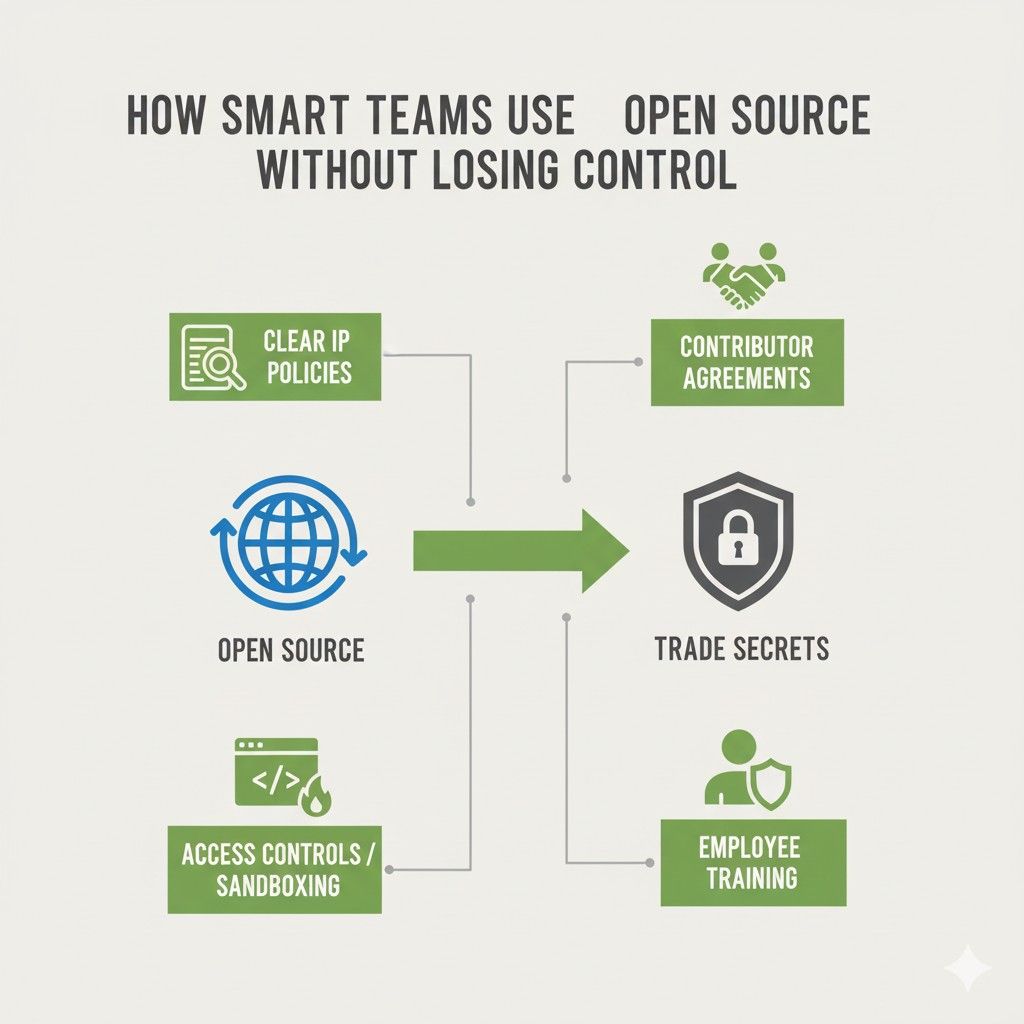
Once identified, these elements are treated differently. They are not discussed casually. They are not embedded inside shared systems. They are not explained in public-facing material.
This clarity alone prevents most accidental exposure.
They Build Clear Boundaries Between Open and Closed
The biggest technical mistake founders make is blending. They mix proprietary logic directly into open source frameworks, extensions, or plugins. Over time, it becomes impossible to separate what is shared from what is owned.
Strong teams design boundaries from day one. Open source lives on one side. Trade secrets live on the other. The connection between them is minimal, clean, and controlled.
This often shows up as internal services, private APIs, or isolated pipelines. The exact shape does not matter. What matters is that the secret does not leak through dependency or structure.
They Treat Licenses as Design Constraints
Instead of viewing licenses as legal noise, smart teams treat them like engineering constraints. Just as memory limits or latency targets shape architecture, license terms shape IP decisions.
Before adopting a tool, they ask a simple question. Does this license force us to share anything we want to keep private, now or later?
If the answer is unclear, they pause. That pause saves months of cleanup and risk down the line.
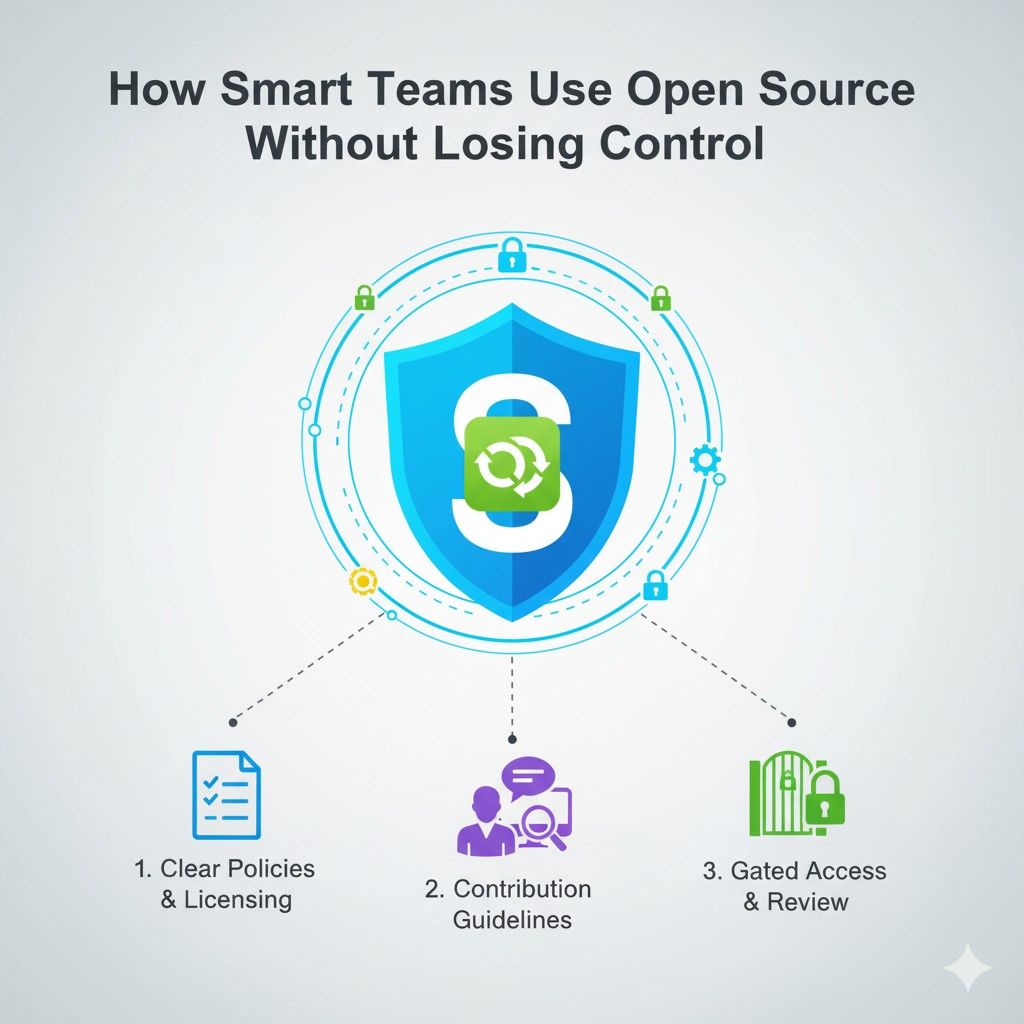
This approach does not slow teams down. It prevents rework. It also makes conversations with investors and acquirers far smoother later.
They Separate Speed From Exposure
Fast teams do not expose more. They expose smarter.
Open source helps speed by handling infrastructure, tooling, and commodity problems. Smart founders use it aggressively in those areas. They do not waste time reinventing basics.
But they slow down around the core. They do not rush those parts into shared spaces. They accept a little friction in exchange for long-term control.
This balance is what allows companies to move quickly without giving away the store.
They Control How Knowledge Moves Inside the Company
Trade secrets are not just code. They are understanding.
Smart teams manage how knowledge spreads internally. Not everyone needs to know everything. That is not secrecy for secrecy’s sake. It is practical risk management.
They design roles so that deep system knowledge is limited to those who need it. They document usage before explanation. They explain outcomes more than mechanisms.
This makes onboarding cleaner and reduces the chance that sensitive logic walks out the door unintentionally.
They Design External Communication With Intention
Marketing, sales, hiring, and community work all require communication. Smart teams do not silence themselves. They sharpen their message.
They decide in advance what stories they will tell. They focus on benefits, results, and vision. They avoid deep technical walk-throughs of core systems.
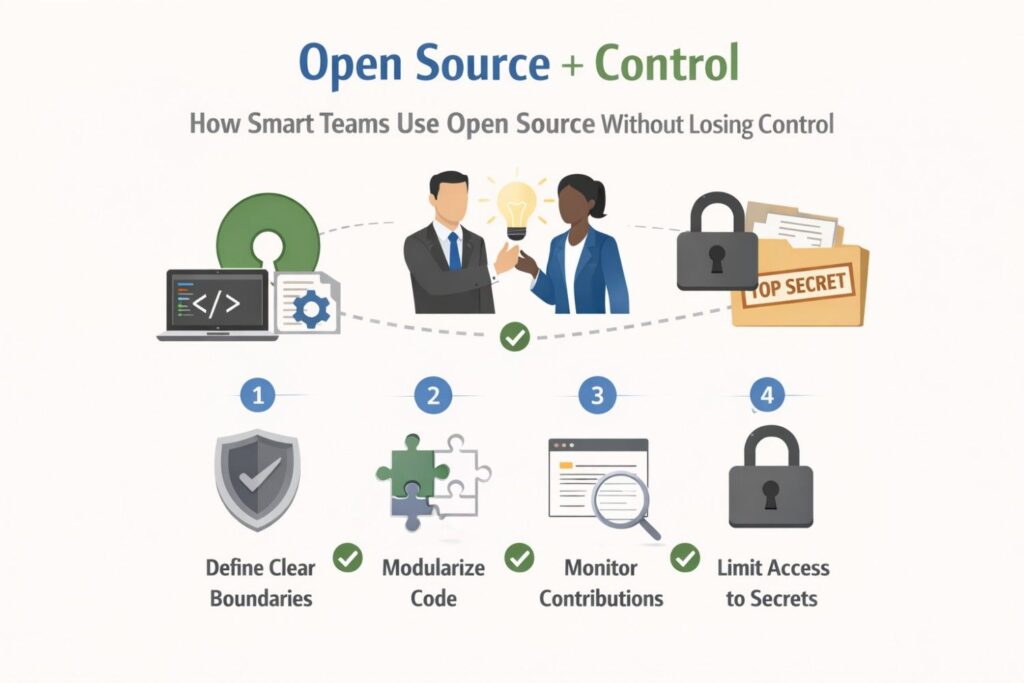
When they do share technical insight, it is chosen carefully and reviewed with protection in mind. This does not make content boring. It makes it disciplined.
They Use Open Source to Hide, Not Reveal
This idea surprises many founders.
Open source can actually help protect trade secrets by drawing attention away from what matters. When much of your stack is familiar and public, outsiders assume the value lies there.
Smart teams let that assumption stand. They keep the real differentiation behind the scenes, quiet and controlled.
In this way, open source becomes a shield. It absorbs attention while the secret stays hidden.
They Prepare Early for Scrutiny
Serious companies plan for due diligence long before it arrives.
They can explain, calmly and clearly, what they own and how they protect it. They can point to clean separation. They can show consistent behavior over time.
This preparation is not paperwork-heavy. It is mindset-driven. When questions come, answers are ready.
PowerPatent was built to support exactly this kind of thinking. It helps founders align open source use, trade secret protection, and future patent strategy without slowing execution. You can see how that works here: https://powerpatent.com/how-it-works
The Real Advantage Is Confidence
Founders who manage this well operate differently. They are not anxious about sharing updates. They are not afraid of demos. They are not defensive in conversations.
They know where the line is. That confidence shows up everywhere.

Open source plus trade secrets is not a contradiction. It is a system. When designed well, it lets you move fast, collaborate widely, and still protect what makes your company matter.
Wrapping It Up
At the end of the day, this is not a debate about open source versus trade secrets. It is a conversation about control. Founders do not lose value because they use open source. They lose value because they give up control without realizing it.
Open source is powerful because it lets you move fast and stand on the shoulders of others. Trade secrets are powerful because they protect the small, quiet advantages that are hard to see from the outside. When these two forces are aligned, they create momentum. When they are mixed without intention, they create leaks.