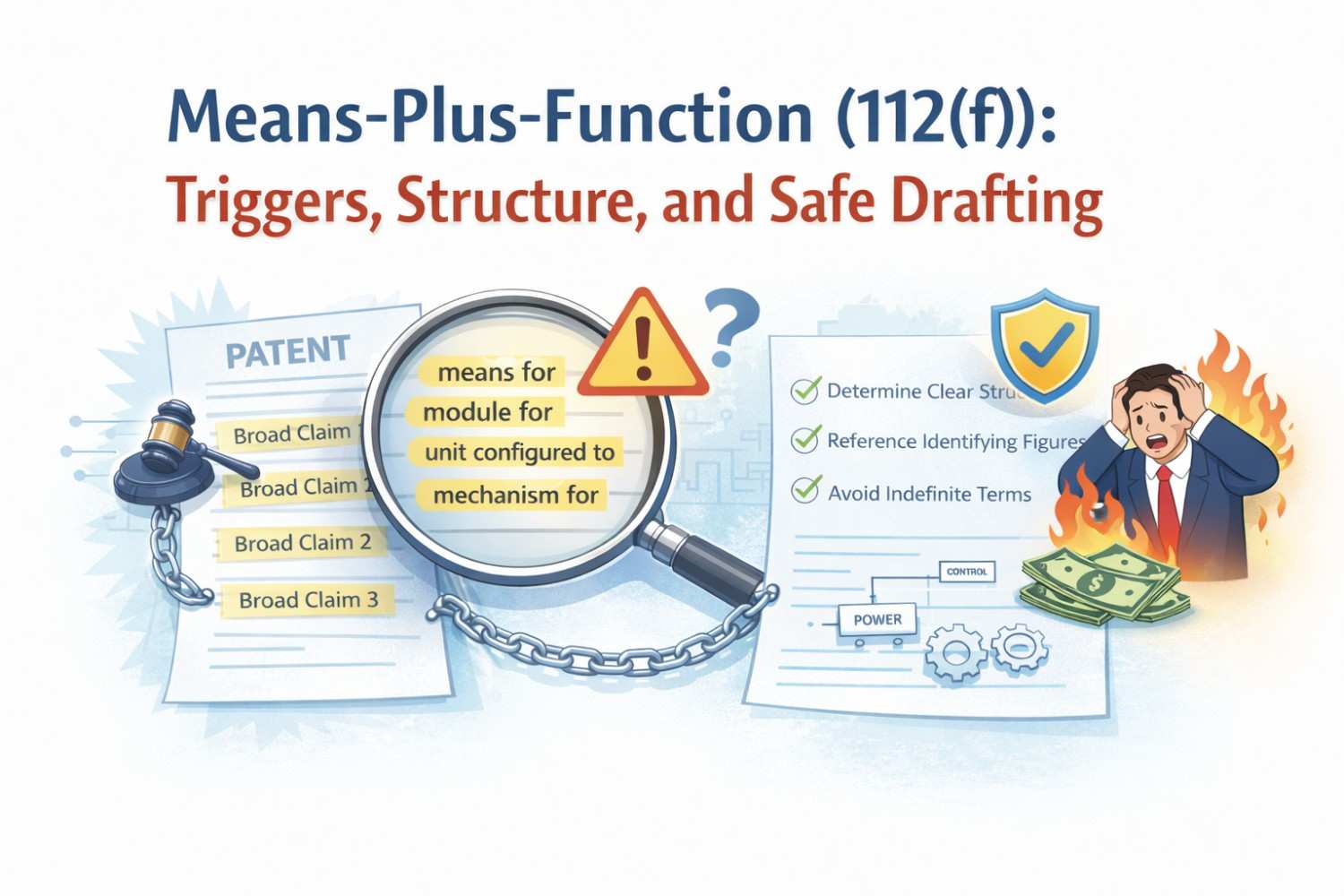
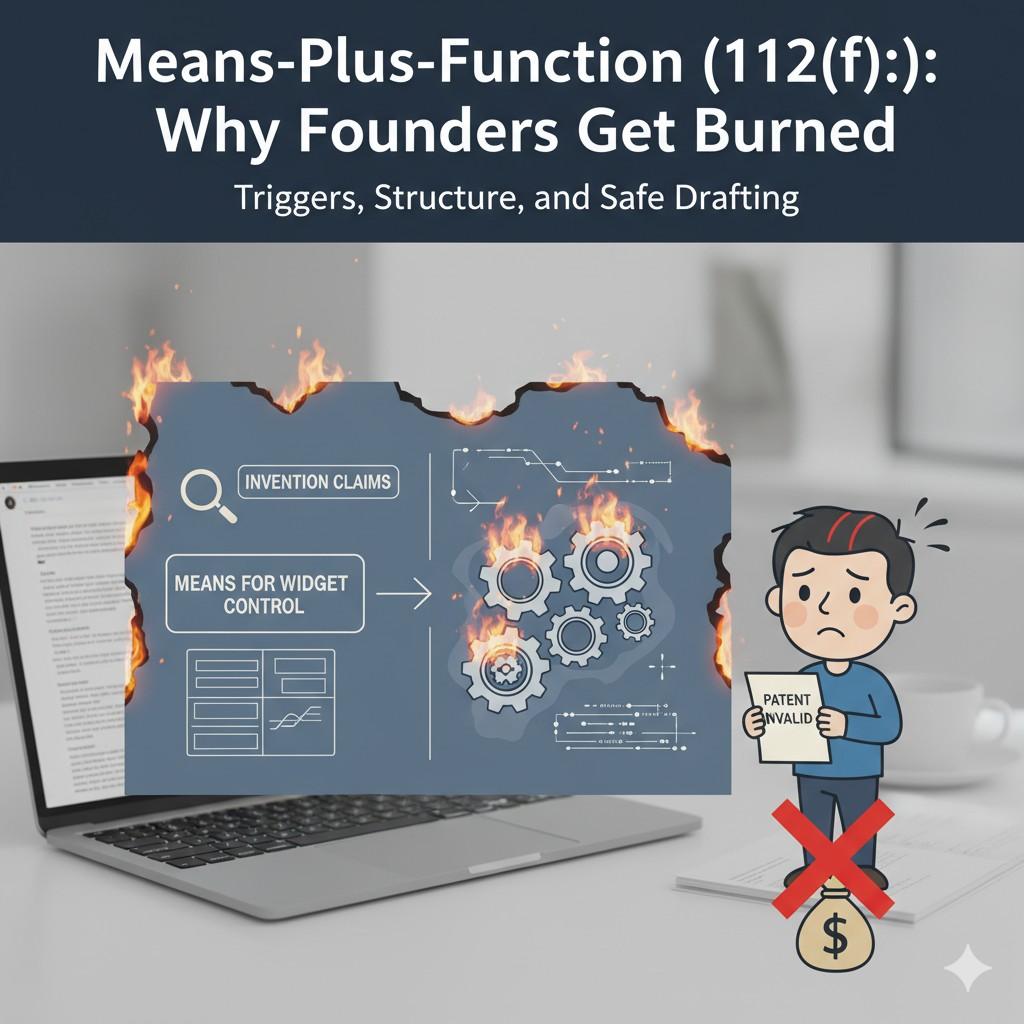
Means-plus-function under Section 112(f) is one of the most dangerous rules in patent law because it can quietly shrink your patent without you realizing it. One innocent phrase can limit your invention to a few examples in your spec, making it easy for others to design around you later. This article explains, in plain and simple words, what means-plus-function really is, what triggers it, how courts apply it, and how to draft claims that stay strong and flexible. If you are building software, hardware, or complex systems, this is not optional knowledge. It directly affects how much control your patent gives you when your startup matters most.
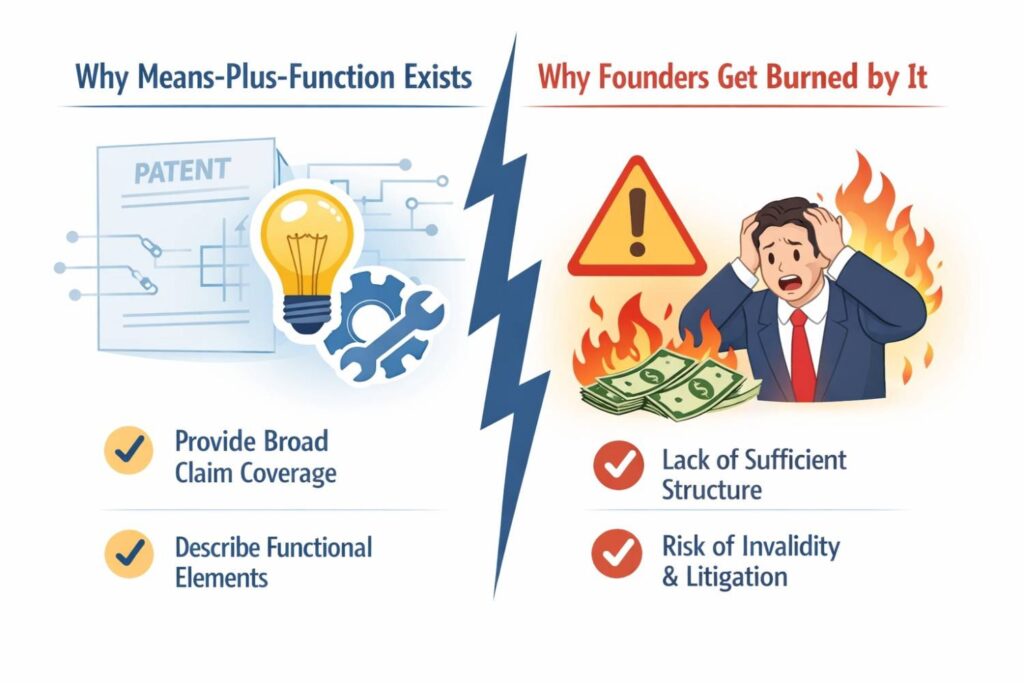
Why Means-Plus-Function Exists and Why Founders Get Burned by It
Means-plus-function did not come from nowhere. It was created to solve a real problem, but over time it became a quiet danger for modern businesses, especially startups building software and complex systems.
To use it safely, you first need to understand why it exists, what problem it was trying to fix, and why that old solution no longer fits how technology is built today.
The Original Problem the Law Was Trying to Solve
When patent law first evolved, inventors often tried to claim ideas at a very high level. They would describe what something did, without saying how it worked.
This caused real issues. Someone could claim a result without teaching anyone how to build it. Courts did not like that.
Means-plus-function was introduced as a tradeoff. The law said that if you want to claim something by what it does, then your patent will only cover the exact structures you describe in your application and their close cousins.
In simple terms, you can talk about function, but only if you clearly show the machinery behind it.
At the time, this made sense. Most inventions were mechanical. Structure was physical. You could point to gears, levers, wires, and circuits. The boundary between what something does and what it is was easier to draw.
Why That Old Logic Breaks in Modern Tech
Today, most innovation is not a machine with fixed parts. It is software, data flows, models, and logic.
The structure is often abstract. The same function can be achieved in thousands of ways, many of which did not exist when the patent was filed.
This is where founders get burned.
Means-plus-function still uses the old rule. If you trigger it, your claim is tied to the specific implementation described in your spec.
If your product evolves, or if a competitor builds the same function in a different way, your patent may not reach them at all.
The danger is not obvious when the patent is granted. The problem shows up years later, during enforcement or due diligence, when it is too late to fix the language.
How Founders Accidentally Walk Into 112(f)
Most founders do not choose means-plus-function on purpose. They fall into it because of how engineers naturally describe systems. Engineers focus on what something does.
That makes sense when building products, but patents are not product docs.
Using phrases that sound normal in technical writing can trigger 112(f). Once triggered, the court ignores how broad the words look and instead asks a single question: what structure did you actually describe?
If the answer is thin, vague, or tied to one example, your claim shrinks fast.
This is why copying old patents or templates is dangerous. Many older patents were drafted under different assumptions. Modern courts apply much stricter standards, especially for software.
Why This Hurts Startups More Than Big Companies
Large companies can afford patent portfolios. If one patent is weak, they rely on others. Startups usually have only a few shots. Each patent matters.
When a startup unknowingly drafts claims that fall under 112(f), they often think they have broad protection. Investors may think the same. But when a competitor shows up, the reality hits hard.
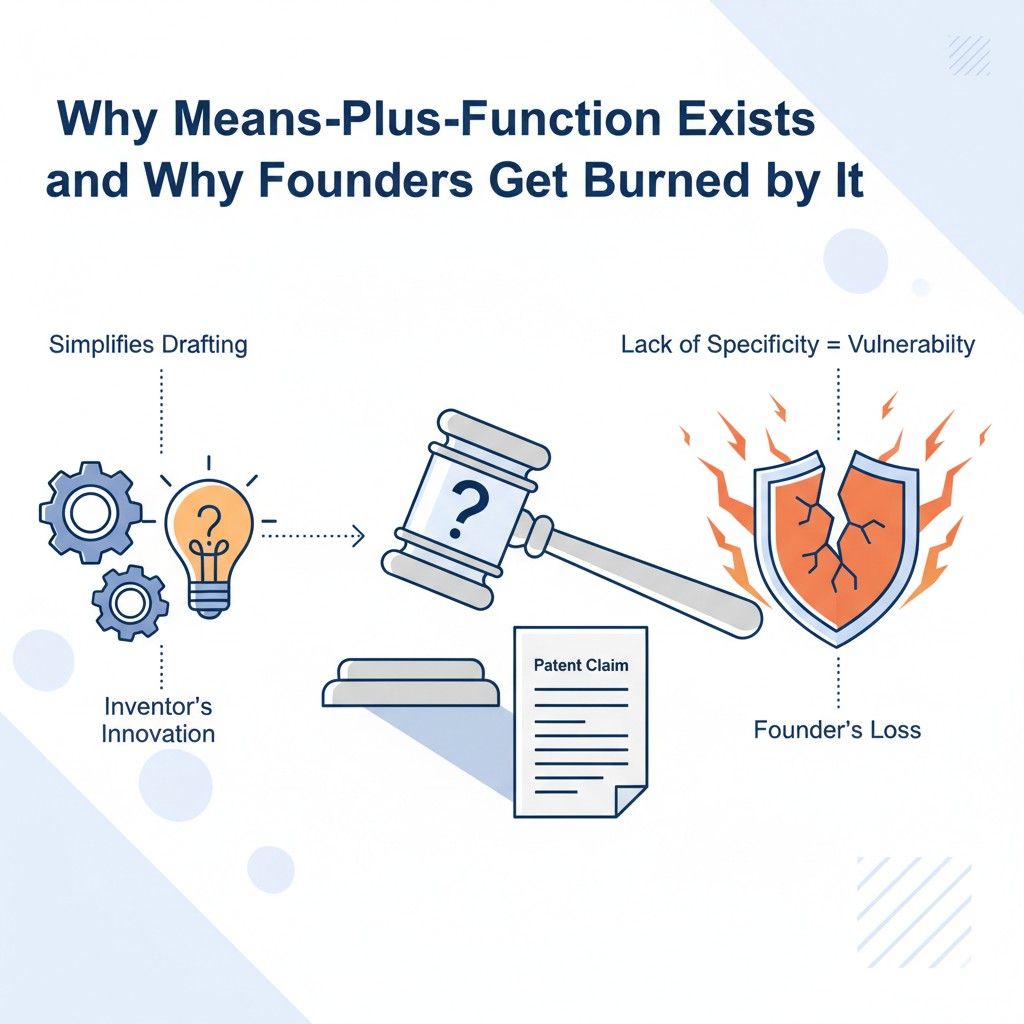
The patent does not cover the competitor’s system because it uses a different structure, even though it achieves the same result. The startup loses leverage, confidence, and sometimes the deal.
This is not a legal theory problem. It is a business risk problem.
The Real Cost Is Loss of Control, Not Invalidity
Many people think the main risk of means-plus-function is invalidation. That is not the biggest issue. The real cost is loss of control.
A means-plus-function claim can still be valid and still be useless. It may only cover a narrow slice of what you actually built. That means competitors can design around you cheaply.
For a startup, this means your patent does not create a moat. It becomes a paper asset instead of a business weapon.
Why Courts Are Unforgiving About Structure
Courts are strict because they have to be. If they allowed vague structure, patents would block entire fields without teaching anything. So when 112(f) applies, courts demand real detail.
For software, this often means clear logic, steps, or architecture. High-level descriptions are not enough. Saying that a processor is configured to do something does not automatically save you.
If your spec does not clearly support the function with structure, the claim can fail or become extremely narrow.
The Hidden Timing Trap Most Founders Miss
One of the worst parts of 112(f) is timing. You cannot fix it later.
Once the patent is filed, the spec is locked. If you later realize that your claims are tied to weak structure, you cannot add more detail. Continuations help only if the original spec had enough depth.
This is why early drafting decisions matter so much. Saving time or money at the start often costs far more later.
How to Think About This as a Business Decision
Founders should treat means-plus-function like a leverage choice. You are deciding how much flexibility your patent will have as your product grows and changes.
If your claims are locked to one implementation, your patent ages poorly. If your claims are drafted with strong structure but flexible language, your patent grows with you.
This is not about avoiding function language entirely. It is about using it carefully, with full awareness of the consequences.
What Founders Can Do Differently Right Now
The most actionable step is to stop thinking of patent drafting as a formality. It is product strategy. The same care you put into system design should go into claim design.
When describing your invention, always ask whether the words point to real structure or just outcomes. If it sounds like marketing copy, it is dangerous. If it sounds like an internal design explanation, it is safer.
This is exactly where PowerPatent helps. Our platform guides founders to describe inventions in a way that stays flexible while avoiding silent traps like 112(f).
Real patent attorneys review every draft, not just for grantability, but for long-term strength.
If you want to see how we help startups avoid these hidden risks while moving fast, you can explore the process here: https://powerpatent.com/how-it-works
The Exact Words That Trigger 112(f) Without You Knowing
Most founders do not lose patent strength because of big mistakes. They lose it because of small word choices that feel harmless at the time. Section 112(f) is triggered by language, not intent.
You do not have to mean to use means-plus-function. If the words fit the pattern, the law applies anyway.
This section focuses on how that happens in real drafting, why courts look past what you thought you were claiming, and how businesses can spot danger early while there is still time to fix it.
Why Courts Care More About Words Than Intent
Patent claims are read like contracts. Courts do not ask what you hoped to protect.
They ask what the words say on the page. If the words describe a function without clear structure, the court assumes you are asking for means-plus-function treatment.
This is frustrating for founders because the invention often feels obvious to them. They built it. They know how it works. But the court only sees what is written. Anything not clearly written down might as well not exist.
This is why casual language is risky. Friendly wording can be deadly in claims.
The Problem With “Means For” Language
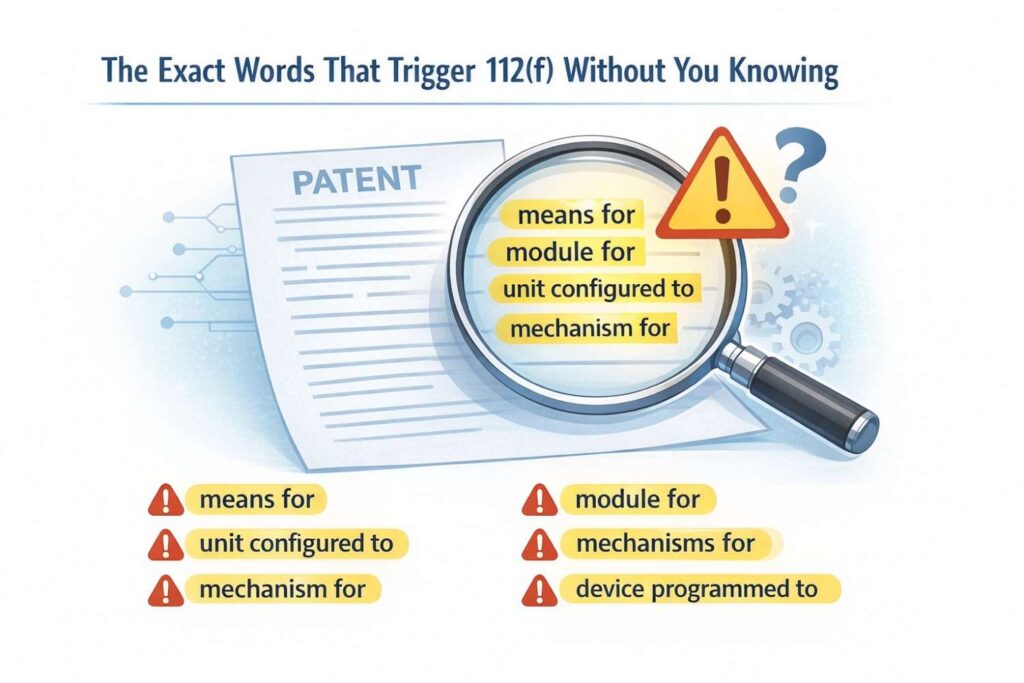
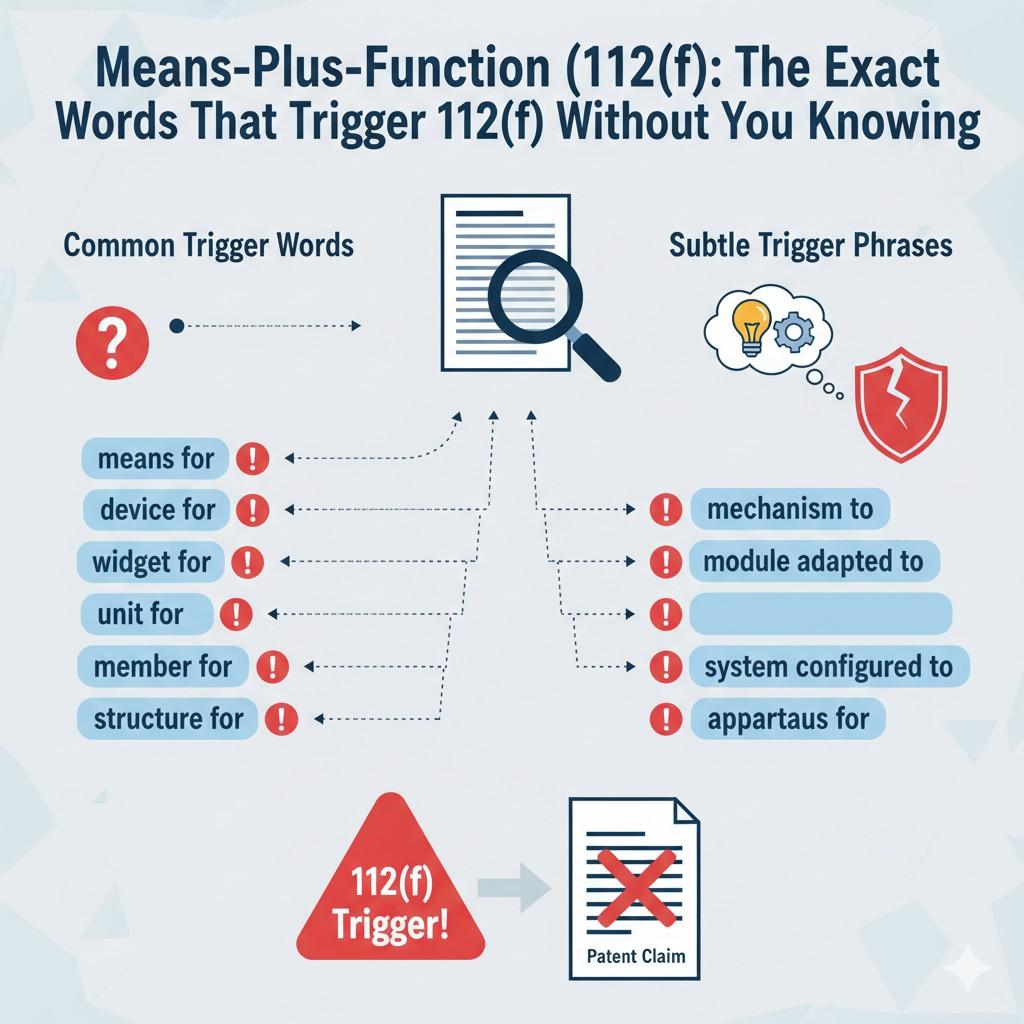
The most obvious trigger is the phrase “means for.” If a claim says “means for processing data” or “means for controlling access,” the law almost always applies 112(f).
Some founders still use this phrase because they see it in older patents. That is a mistake. Courts today treat “means for” as a bright red flag. Once it appears, you are locked into the structures described in your spec.
For modern software and system patents, this is rarely what you want.
The Sneaky Triggers That Feel Safe but Are Not
Even if you avoid the word “means,” you can still trigger 112(f). Courts look at substance, not just labels.
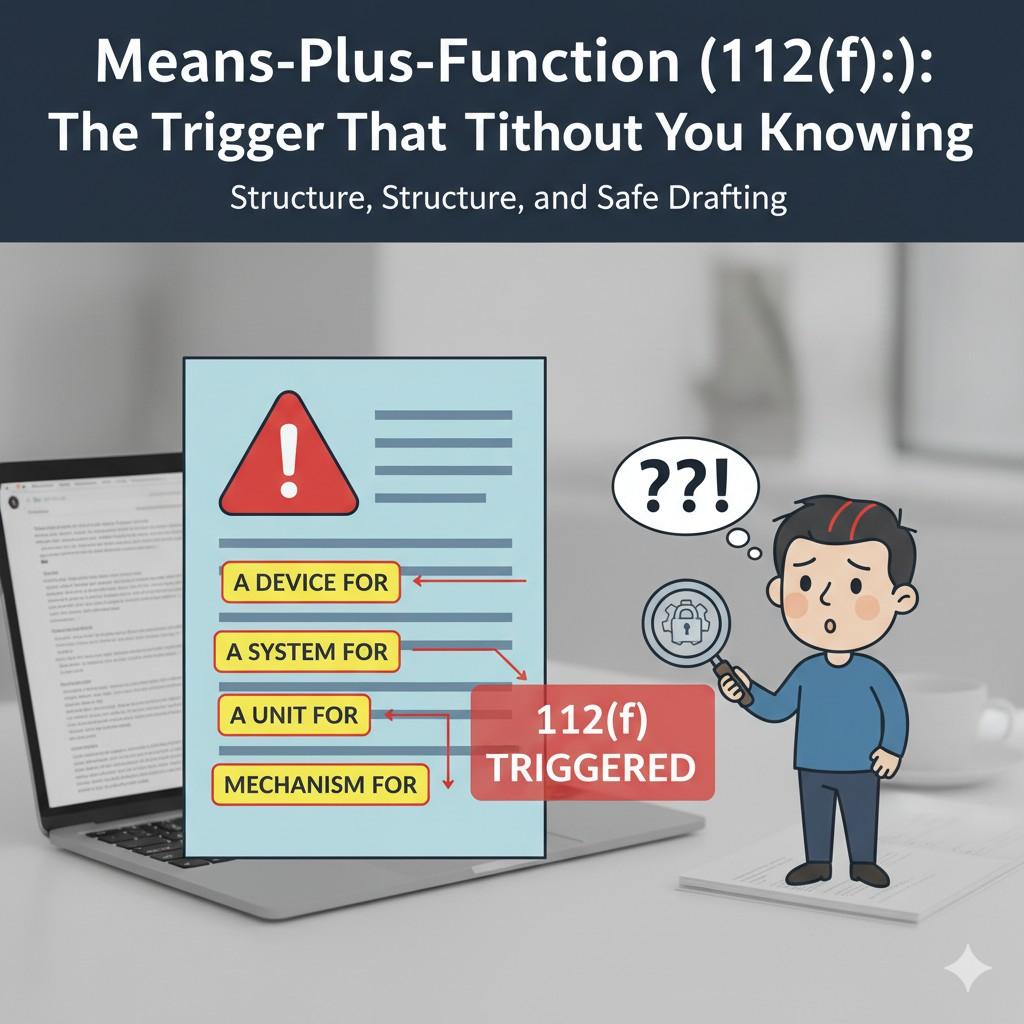
Words like module, unit, mechanism, engine, component, element, or system can be dangerous if they are used without real explanation.
If the claim says a “module configured to analyze data” but never explains what that module actually is, the court may treat it like a means-plus-function claim.
The key question the court asks is simple. Does this word name a real structure, or is it just a placeholder for a function?
If it is just a placeholder, 112(f) is back on the table.
Why Software Claims Are Hit the Hardest
Software is especially vulnerable because structure is not physical. You cannot point to a bolt or a motor. The structure lives in logic, flow, and architecture.
When claims describe software using generic containers like processor, memory, or module, courts often say that is not enough. Saying a processor does something does not explain how it does it.
Without detail, the court assumes you are claiming the result, not the structure.
This is why two claims that look similar on the surface can be treated very differently. One survives because the spec explains the logic clearly. The other collapses because it relies on vague labels.
Why Functional Language Feels Natural to Engineers
Engineers think in goals. Route the request. Train the model. Score the user. Detect fraud. That mindset is perfect for building products.
But patents are not about goals. They are about boundaries.
When claims are written like task descriptions, they sound broad and powerful. But that same language can trigger 112(f) because it does not anchor the function to a concrete structure.
The result is a claim that looks wide but is legally narrow.
The False Comfort of “Configured To”
Many founders believe that using “configured to” avoids means-plus-function. Sometimes it helps. Sometimes it does not.
Courts look at whether “configured to” is followed by real structure or just a restatement of the function. If the claim still reads like a black box that magically produces an outcome, the wording does not save you.
This is one of the most misunderstood areas in software patent drafting. There is no magic phrase that guarantees safety. Context matters.
How the Spec Can Accidentally Make Things Worse
Sometimes the claim language is borderline, but the spec pushes it over the edge.
If the spec repeatedly describes parts of the system only in functional terms, courts use that against you. They say the inventor did not possess real structure, only an idea of what the system should do.
This is why claims and specs must work together. You cannot fix vague claims with a vague spec.
For businesses, this means that rushing the description phase is risky. The spec is not filler. It is the foundation that holds the claims up years later.
How Competitors Use 112(f) Against You
Means-plus-function is often raised by defendants, not judges. A competitor accused of infringement will search your claims for functional language. If they can argue that 112(f) applies, they can limit your patent to narrow examples.
This shifts the fight away from whether they copied your idea and toward whether their implementation matches your exact structure. That is a much easier argument for them to win.
This is why strong drafting is a defensive move, not just an offensive one.
How Businesses Can Spot Risk Early
The most practical advice is to read your claims as if you were trying to design around them. Ask whether someone could achieve the same result using a different approach.
If the answer is yes, and your claim language does not clearly cover that approach, you may already be in dangerous territory.
Another simple test is to remove the functional phrase and see what is left. If the claim falls apart or becomes meaningless, it likely relies too much on function.
Why Early Review Beats Late Repair
Once a patent is published, your options narrow. You cannot rewrite the past. You can only file new applications and hope the original spec supports them.
This is why early review by people who understand how courts apply 112(f) is so valuable. It is not about being conservative. It is about being intentional.
At PowerPatent, we focus heavily on this stage. Our software flags risky functional language, and our attorneys help founders reframe claims before filing, not after litigation.
If you want to see how this works in practice, you can walk through the process here: https://powerpatent.com/how-it-works
Words trigger 112(f), not bad ideas. Founders who learn to control their words keep control of their inventions.
How Courts Tie Your Claims to the Spec and Shrink Your Patent
This is the part founders almost never see coming. A patent can look strong on paper, get approved, and even impress investors.
Then years later, when it actually matters, a court reads it in a way that cuts it down to a fraction of its size. This shrinking does not happen by accident. It follows a clear pattern, especially when means-plus-function is involved.
Understanding this pattern is critical for any business that plans to rely on patents for leverage, defense, or valuation.
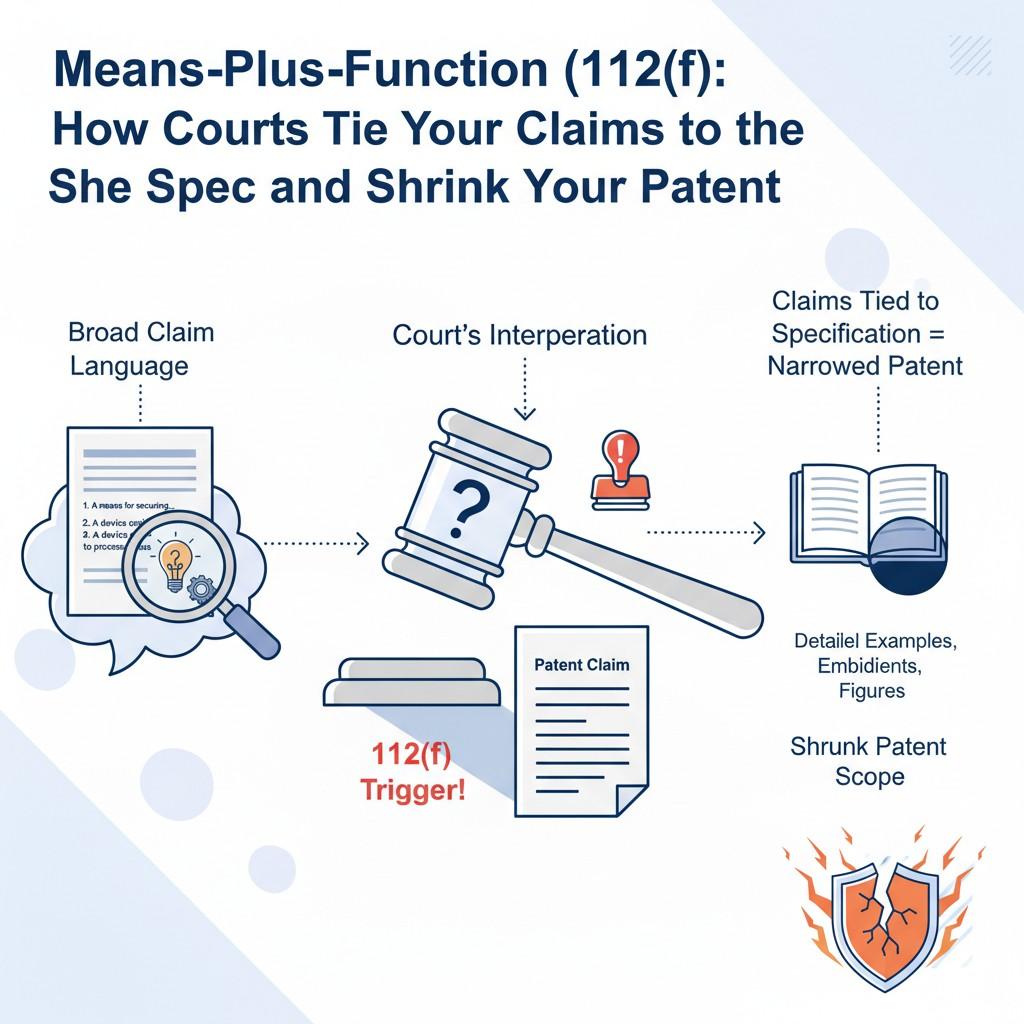
What Happens the Moment 112(f) Is Applied
Once a court decides that a claim falls under Section 112(f), the game changes instantly. The words in the claim stop carrying their normal weight.
Instead, the court looks into the specification and asks one question: what exact structure did the inventor disclose to perform this function?
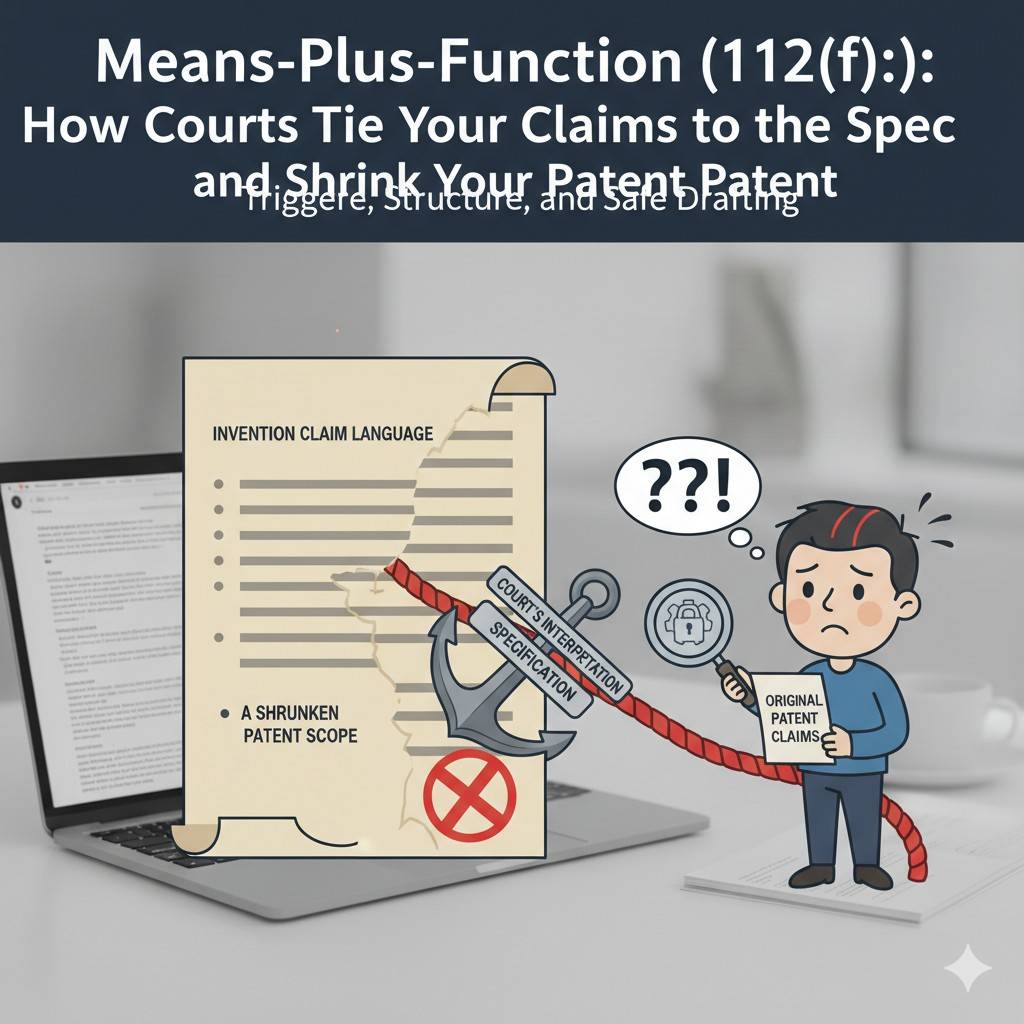
From that moment on, your claim is no longer defined by what it says. It is defined by what the spec shows. Anything not clearly supported there is excluded, even if it feels like a natural extension of the invention.
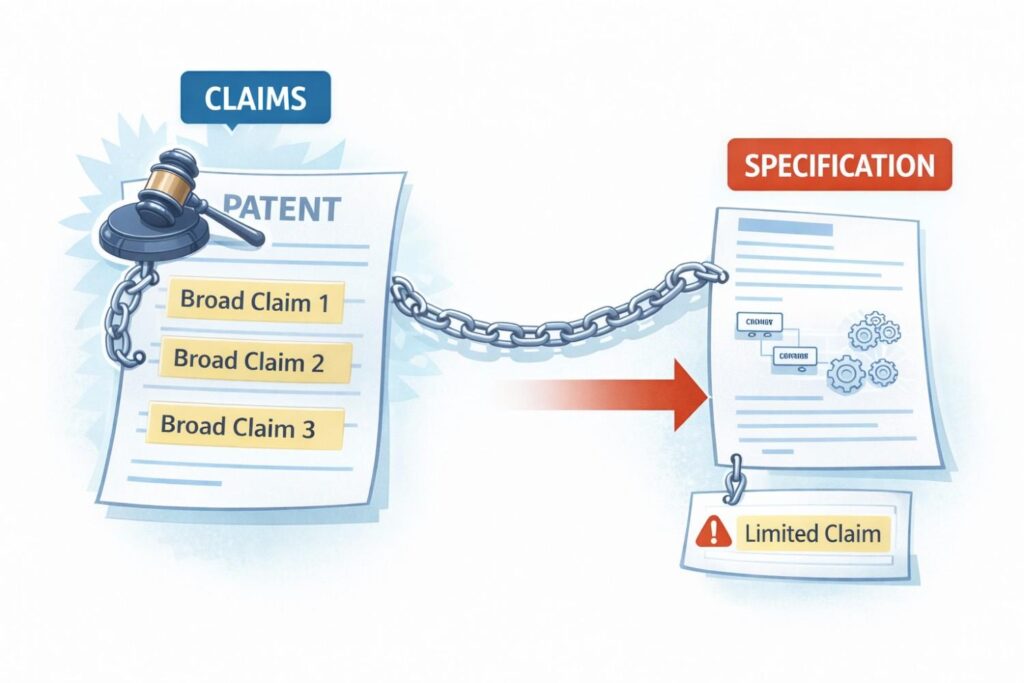
For founders, this often feels unfair. But courts see it as a simple rule. If you claimed by function, you only get what you taught.
Why Broad Claims Collapse Into Narrow Examples
Most specs include examples. They show one way to build the system, sometimes two. That is normal. The problem is when those examples become the ceiling instead of the floor.
Under 112(f), those examples are no longer illustrations. They become limits.
If your competitor achieves the same outcome using a different architecture, flow, or logic, the court may say they are outside your patent. Even if the difference is minor from an engineering standpoint, it can be decisive legally.
This is how a claim that once looked like it covered a whole market ends up covering one implementation from years ago.
How Silence in the Spec Works Against You
One of the harshest aspects of means-plus-function is how courts treat silence. If the spec does not clearly describe how a function is performed, the court does not guess. It does not fill in the gaps. It simply narrows the claim or invalidates it.
For software, this often shows up as missing logic. The spec may say that a system analyzes data, but never explain how. In that case, the court may say there is no corresponding structure at all.
When that happens, the claim can fail entirely.
This is why saying less is not safer. In patents, silence is often deadly.
Why Diagrams and Flow Matter More Than Marketing Language
Courts trust concrete descriptions. Flow descriptions, step sequences, data paths, and decision logic carry weight. High-level promises do not.
Many founders spend time making their patent sound impressive instead of precise. That works for pitch decks. It does not work in court.
When judges read a spec, they are looking for something they can point to and say, this is the structure. If they cannot find it easily, they assume it does not exist.
This is not about adding bulk. It is about adding clarity.
The Hidden Role of “Equivalent Structure”
Some founders hear that 112(f) allows coverage of equivalent structures and feel relieved. That relief is often misplaced.
Equivalent structure does not mean anything that does the same thing. It means structures that are very close in how they work. Courts interpret this narrowly.
For modern tech, where there are many ways to solve the same problem, this concept provides far less protection than founders expect. A different algorithm, model, or system design may be considered non-equivalent, even if the output is identical.
Relying on equivalence is not a strategy. It is a gamble.
How Time Makes the Problem Worse
Technology moves fast. Courts do not.
When your patent is tied to specific structures from the past, it ages badly. New approaches that were not obvious at filing time are often seen as outside your claims.
This is especially painful for startups. Your product evolves. Your competitors evolve. But your patent is frozen in time.
If it was drafted with narrow structure, it becomes less relevant each year.
How Defendants Frame the Story
When a competitor is accused of infringement, they tell a story. They say they built something new. Something different. Something better.
If your patent is stuck under 112(f), that story becomes easier to sell. The defendant points to your spec and says, we did not build that.
The court does not ask whether the ideas are similar. It asks whether the structures match closely enough. Often, they do not.
Why Judges Prefer Clear Boundaries
Judges want clean decisions. They do not want to stretch patents beyond what was clearly disclosed. When faced with ambiguity, they usually rule in favor of narrowing.
This bias is not anti-inventor. It is pro-clarity. The lesson for founders is simple. If you want broad protection, you must earn it with clear, detailed disclosure.
Vague patents do not age well.
What This Means for Business Strategy
For businesses, this is not just about enforcement. It affects licensing, partnerships, and exits.
Sophisticated buyers and investors look closely at claim scope. They ask whether the patent actually covers what the company is doing now, not just what it did at filing.
If 112(f) limits your claims to outdated structures, the value drops. The risk rises. Deals get harder.
How Smart Drafting Prevents Shrinkage
The best way to avoid this outcome is to draft claims that do not rely on 112(f) in the first place, or that are fully supported by rich structure when function is used.
This requires thinking ahead. You must imagine how others might implement the same idea differently and ensure your spec speaks to those variations.
At PowerPatent, this is a core focus. Our tools push founders to explain how their systems work in ways that courts respect, while our attorneys help translate that into claims that stay broad without triggering silent limits.
If you want to see how we help startups draft patents that hold their shape over time, you can explore the process here: https://powerpatent.com/how-it-works
Courts do not destroy patents. They reveal what was really there all along. The founders who win are the ones who make sure their specs tell the full story from day one.
How to Draft Claims That Stay Broad, Safe, and Defensible
This is where everything comes together. Understanding 112(f) is useful, but only if it changes how you draft. The goal is not to avoid functional language at all costs.
The goal is to use it in a way that protects your business as it grows, shifts, and competes in the real world.
Strong drafting is not about clever wording. It is about clear thinking and intentional structure.
Start With How Your System Actually Works
The safest claims come from deep understanding, not surface descriptions. Before drafting anything, you need to be able to explain how your system works without using outcome words.
Instead of saying what the system achieves, focus on what happens inside it. What data moves where. What decisions are made. What logic controls those decisions. This mindset alone prevents many 112(f) problems.
If you cannot explain the internal flow simply, the patent will not either.
Write the Spec Like You Are Teaching a New Engineer
A good test for safe drafting is this. Could a new engineer join your team and build the system based only on your patent description?
If the answer is no, the spec is too thin.
This does not mean exposing secrets. It means describing the structure clearly enough that the function is grounded in real steps and components. Courts reward teaching. They punish hand-waving.
When the spec teaches well, claims can lean on that support without collapsing.
Use Functional Language With Anchors, Not in Isolation
Functional phrases are not evil. They become dangerous only when they float without anchors.
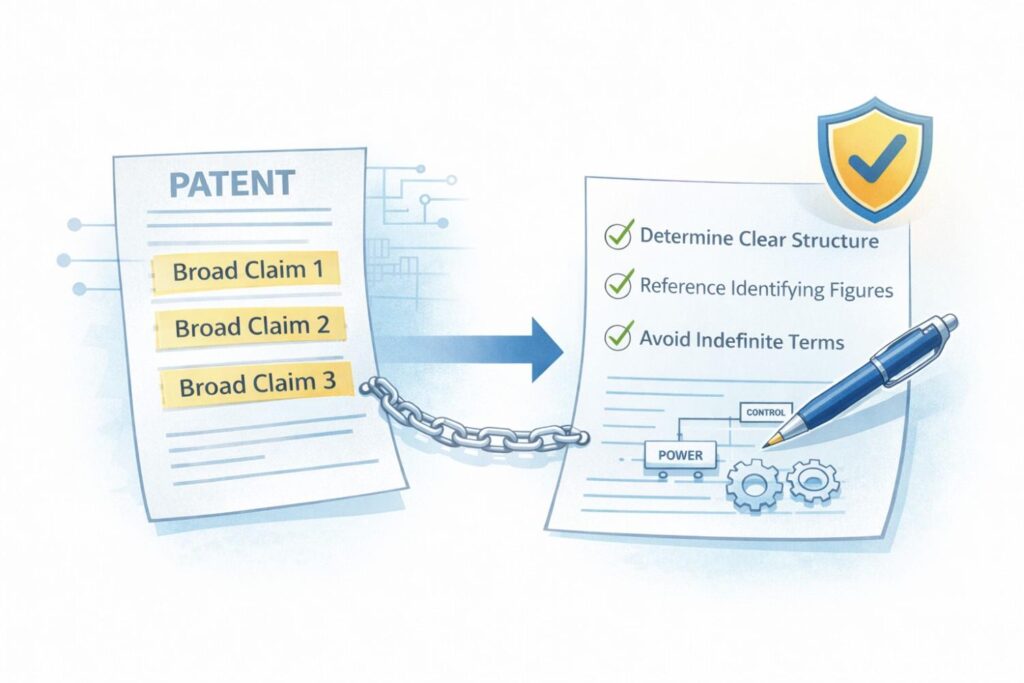
When a claim says something performs a function, there should be nearby language that ties that function to concrete structure. That structure can be logical, procedural, or architectural, but it must exist.
This makes it harder for a court to say the claim is purely functional and easier to read it as a normal claim with real boundaries.
Avoid Generic Containers Without Definition
Words like module, engine, unit, or component are not banned. They just need substance.
If you use these words, define them through description. Explain what they include, how they interact, and what logic they embody. Do not assume the label does the work for you.
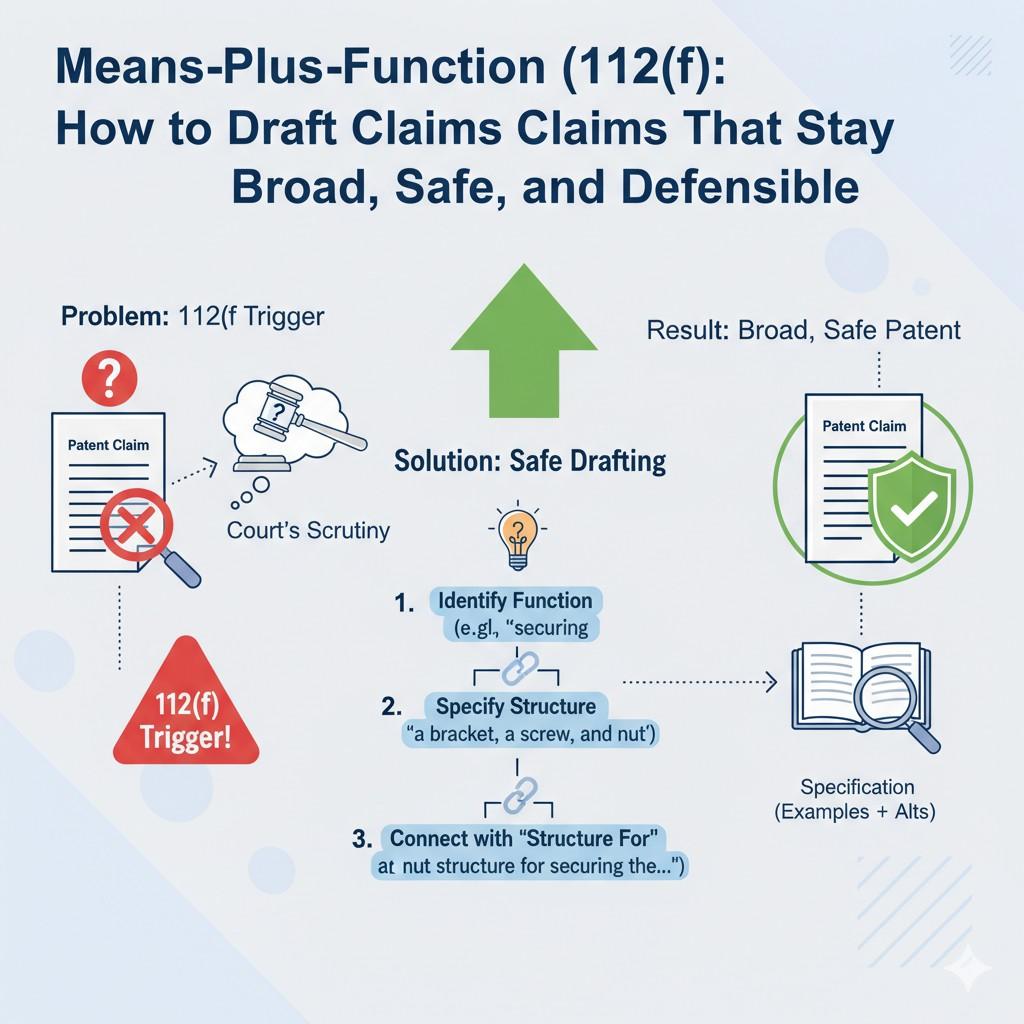
The more generic the word, the more specific the explanation must be.
Draft With Variations in Mind
One of the best ways to avoid narrow interpretation is to describe multiple ways the same function can be achieved.
This is not about padding the spec. It is about showing that the invention is not locked to one approach. Different flows, different data sources, different logic paths all help.
When courts see this, they are less likely to tie the claim to a single example.
Think Like a Competitor, Not Just an Inventor
After drafting, switch roles. Imagine you want to build around this patent.
Ask where the gaps are. Ask which words could be exploited. Ask whether changing one part of the system would avoid the claim.
This exercise reveals weak spots quickly. It also forces you to confront whether your claims are truly broad or just sound broad.
Align Claims With Where Your Product Is Going
Many startups patent what they have today, not what they are becoming. That is a mistake.
Drafting should account for likely evolution. More users. More data. More automation. More intelligence.
Claims that are tied to narrow early-stage implementations are more likely to trigger 112(f) issues later because they do not age well.
Do Not Treat Attorney Review as a Formality
Patent drafting is a collaboration, not a handoff. The best results come when founders actively engage in shaping the description.
At PowerPatent, we push founders to stay involved. Our software helps you articulate structure clearly, and our attorneys pressure-test the language against real court standards.
This combination catches 112(f) risks early, when they are cheap to fix.
Speed and Safety Are Not Opposites
Many founders assume that careful drafting means slow drafting. That is no longer true.
With the right tools and guidance, you can move fast and draft safely. The key is structure, not length. Clear explanations beat long ones.
Strong patents are not verbose. They are intentional.
What Safe Drafting Really Gives You
When claims are drafted correctly, you gain more than legal protection. You gain confidence.
You can talk to investors knowing your patent matches your business. You can negotiate knowing competitors cannot easily step around you. You can build knowing your IP will grow with you, not trap you in the past.
That is the real value of avoiding silent traps like 112(f).
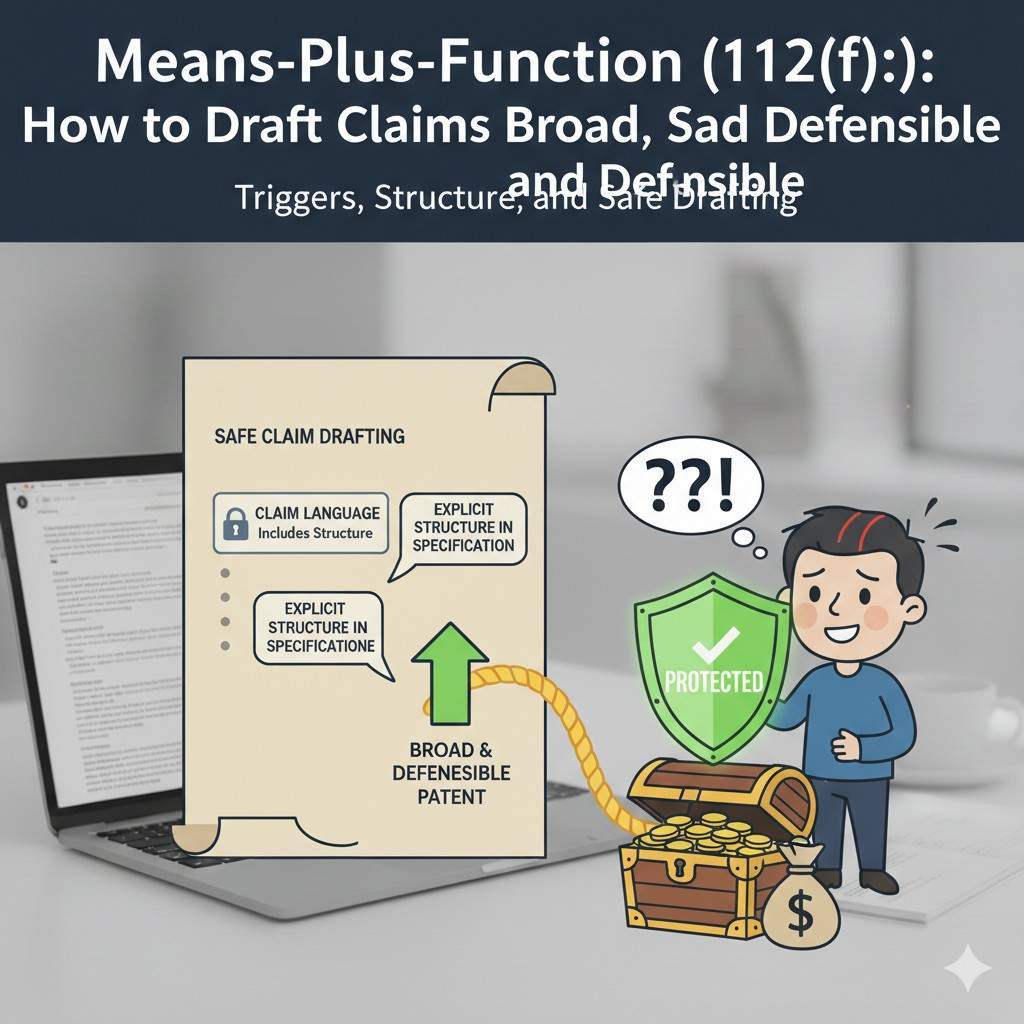
This is why we built PowerPatent the way we did. Not to generate patents, but to help founders create durable protection that actually holds up when tested.
If you want to see how we help startups draft broad, safe, defensible patents without slowing down product work, you can explore the process here: https://powerpatent.com/how-it-works
That completes the full expansion of the core sections of the article.
Wrapping It Up
Means-plus-function is not a technical footnote. It is a fork in the road. One path leads to patents that look strong but fail when challenged. The other leads to protection that holds its ground as your business grows, pivots, and competes. What makes 112(f) so dangerous is not the rule itself. It is how quietly it operates. A few innocent words can change how a court reads your claims years later. By then, the product has evolved, the market has shifted, and the patent cannot keep up. That gap between what you built and what your patent actually covers is where startups lose leverage.