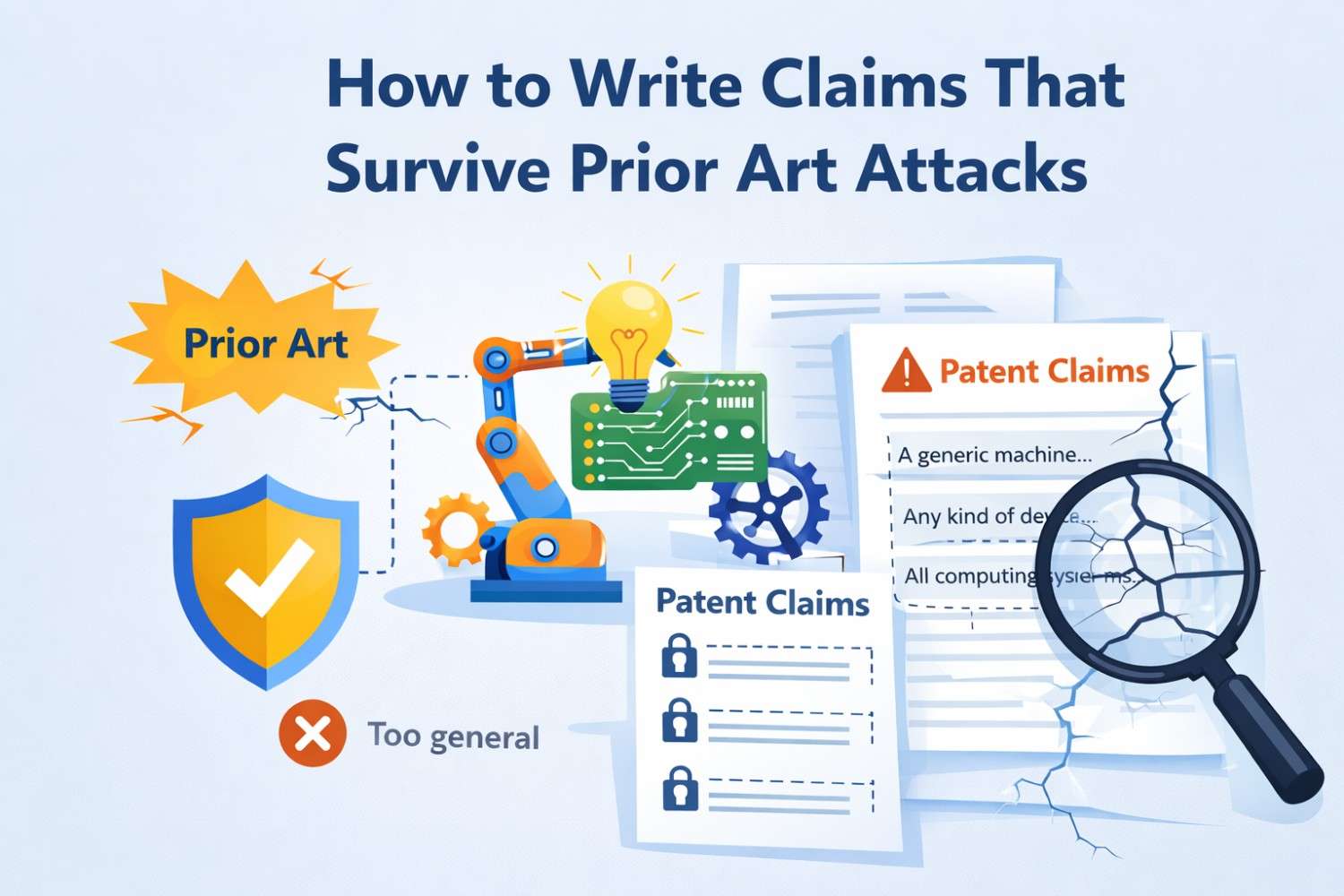
If your patent claims are weak, the rest of your patent will not save you. That is the hard truth many founders learn too late. You can spend months building a real product, solving a hard problem, and writing a long patent draft. Then prior art shows up. A patent examiner finds old papers, old patents, old products, or old public posts that look close enough to what you made. If your claims are broad in the wrong way, vague in the wrong place, or missing the real point of your invention, they can fall apart fast.
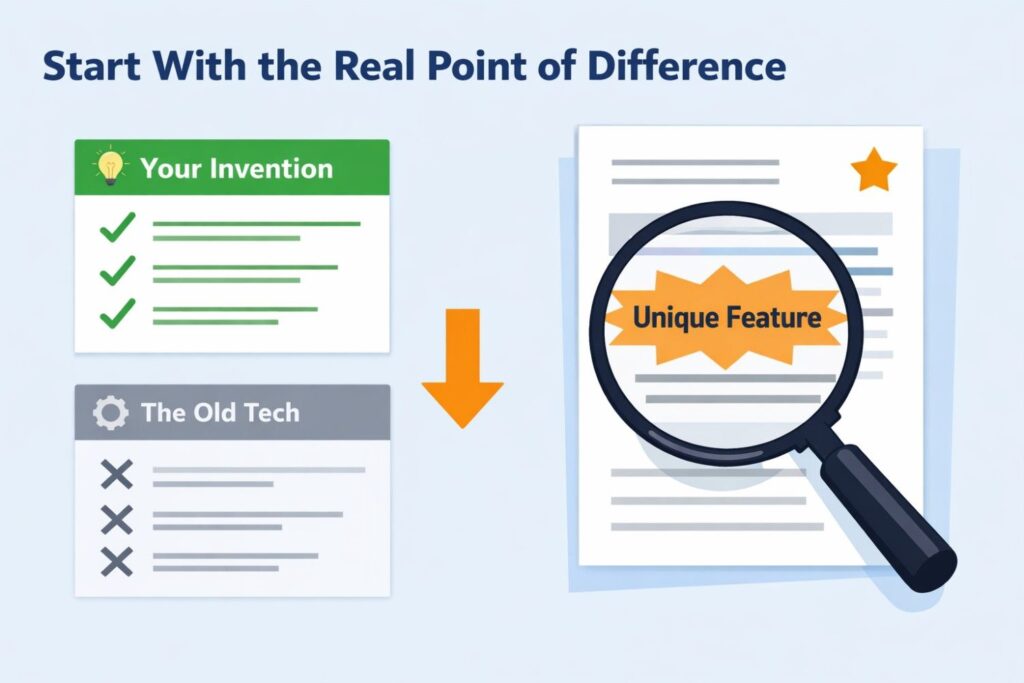
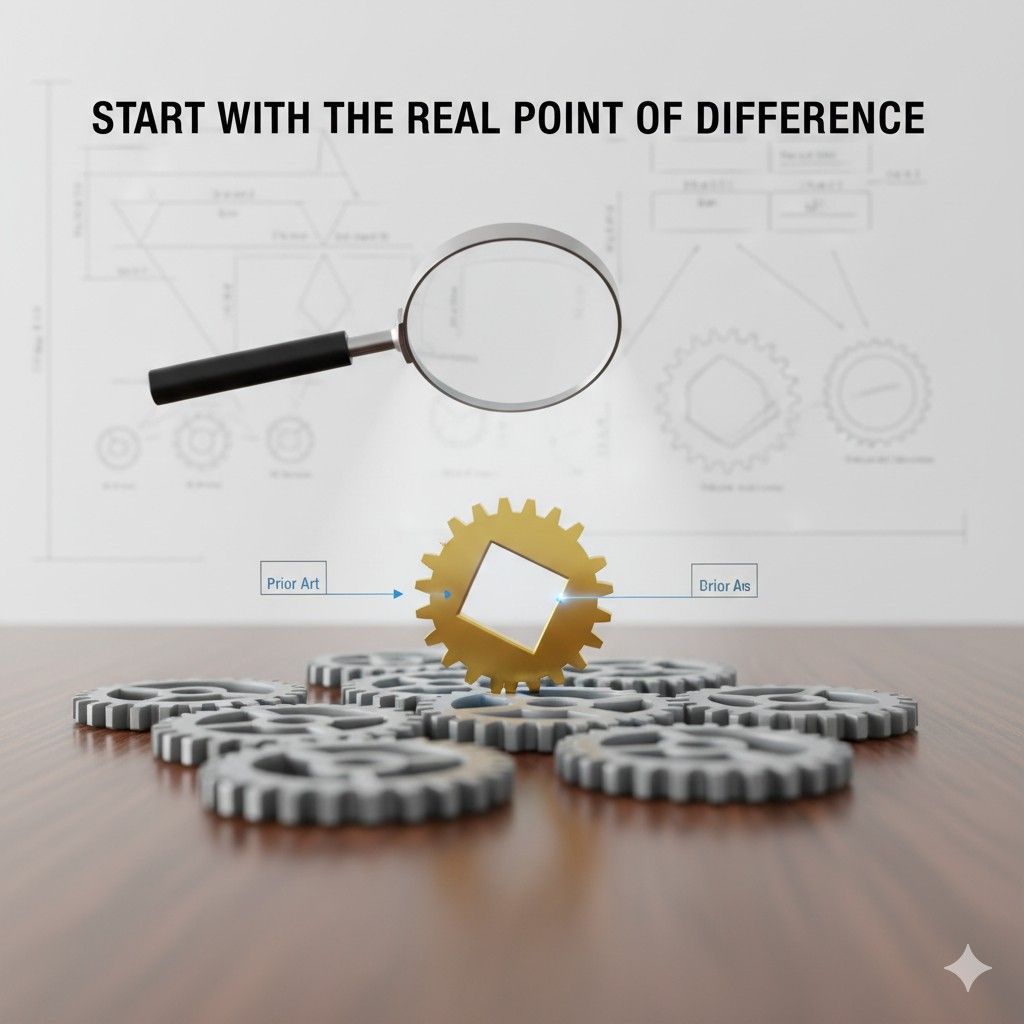
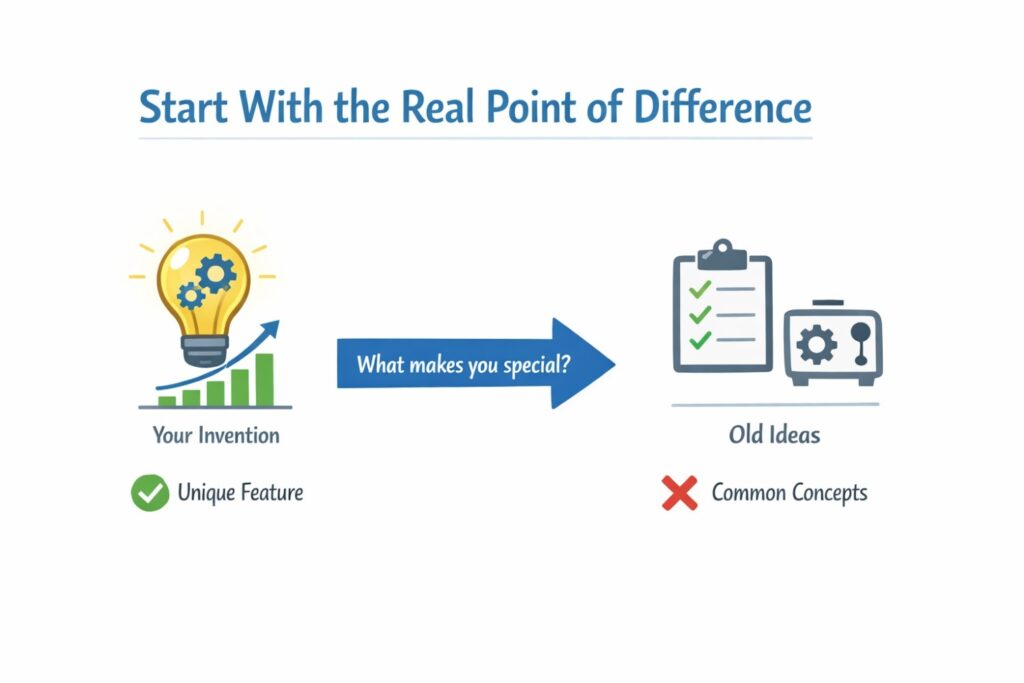
Start With the Real Point of Difference
The biggest mistake teams make at the claim stage is starting with what their product does instead of starting with what truly makes it different. That sounds small, but it changes everything.
A lot of products solve the same broad problem. A lot of systems produce the same end result. What matters in a patent claim is not that your tool helps users move faster, spend less, or get better outputs.
What matters is the specific technical move that makes your result happen in a way older systems did not.
If you miss that point, your claims can sound impressive and still be weak. They can look broad but collapse the moment prior art shows up. If you find that point clearly, though, your claims become much harder to attack because they are tied to the part of the invention that actually carries weight.
For a business, this is where patent value starts. Strong claims do not just help you get a patent. They help you protect the part of the product that gives you leverage in the market.
Stop Describing the Whole Product
Many founders try to protect the full product story in one shot. They describe the platform, the workflow, the dashboard, the outputs, the users, the business model, and the customer benefit all at once.
That feels complete, but it usually hides the invention instead of showing it.
A strong claim does not need to tell the whole story. It needs to capture the thing that makes the story possible.
That is a very different job. When you are drafting, force yourself to separate the full product from the narrow technical shift that matters most.
In many cases, the claim-worthy part is not the app, not the service, and not the end screen. It is the hidden logic, the sequence, the control step, the model handoff, the data treatment, or the system rule that changes how the machine behaves.
That shift in thinking is useful for businesses because it keeps the patent focused on defensible ground. Competitors can change branding, design, and user flow.
They can change surface details very fast. If your claim is built around those surface details, it is easy to design around.
If your claim is built around the core technical move, the one the competitor would likely need in order to match your performance, then the claim has real business teeth.
Find the Move That Changes the Outcome
A real point of difference is usually a move, not a theme.
That move may be how data is filtered before a model sees it. It may be how a control system decides when to switch modes. It may be how a device reduces delay during one narrow step.
It may be how separate components share state without causing failure. It may be how a process handles edge cases that older systems ignored. The key is that the move changes the outcome in a meaningful way.
This is where many teams need to slow down. Ask what your system does differently at the step level.
Ask what exact decision, transformation, timing rule, or system arrangement gives you the edge. When a patent examiner brings prior art, your claim will be tested at this level. You want to be ready before that happens.
A useful business habit is to ask your engineers one direct question: what is the one thing we do under the hood that others are least likely to guess from the outside?
That answer often points to the real point of difference. Another useful question is this: if a rival copied our product result, what part would they most likely need to recreate to get the same performance? That answer often points to the claim core too.
Do Not Confuse Features With Distinctions
A product can have many features and still have only one or two real distinctions worth claiming first.
This matters because founders often fall in love with feature count. They assume more features make the invention stronger. In claim writing, that can lead to clutter.
A claim packed with ordinary features does not become stronger. It becomes easier to reject because each extra piece creates another opening for prior art to match part of the claim.
The better path is to identify which feature is actually doing defensive work. Not which feature looks nice in a demo. Not which feature sales talks about most.
The real distinction is the one that creates technical separation from what came before.
For business teams, this is more than a drafting tip. It is a portfolio decision. If you start by protecting the real distinction, you create a stronger first filing.
Later, you can build around it with follow-on claims, continuation strategy, and narrower coverage for product variants.
That sequence is far smarter than spending your best filing space on weak or obvious features that add noise but not protection.
The Best Claim Starting Point Often Feels Smaller Than Expected
Many valuable claims begin with something that feels too narrow at first glance.
That can make founders nervous. They worry the claim will not look big enough. They worry investors will not be impressed. They worry competitors will step around it.
But starting narrow in the right place is often how strong patents are built. A precise claim around the real technical difference is far more useful than a grand claim around a general product idea.
The goal is not to sound big. The goal is to survive attack and still matter commercially.
A small but essential system move can support a powerful claim strategy. Once that core is protected, you can build outward. You can draft broader versions where support exists.
You can draft dependent claims that cover useful variations. You can shape future filings around adjacent improvements. But none of that works well if the first claim misses the real center of gravity.
Look for Technical Friction, Not Marketing Language
The strongest points of difference usually show up where the engineering work felt hard.
Marketing language smooths everything out. It says your product is faster, smarter, simpler, automated, real-time, seamless, or intelligent. None of that tells you much about the invention.
Those are result words. They are useful for selling. They are weak for claim drafting unless they connect to a concrete technical path.
Technical friction is where the better signal lives. Look at the parts of development that caused debate, redesign, failed tests, late-night fixes, or special architecture choices.
Look at the areas where your team had to invent a new method because the old method broke down. That pain is often where the novelty sits.
For businesses, this is especially helpful because it aligns patent work with product truth. The more your claims grow out of actual engineering friction, the more likely they are to map onto durable advantage.
That is what you want when you are investing in IP.
You want the patent to guard a real choke point, not just describe a polished version of the company story.
Trace Back From the Customer Benefit
A customer sees the result. A strong claim traces backward to the mechanism.
This is one of the cleanest ways to find the real point of difference. Start with the outcome users care about. Then ask what specific technical reason makes that outcome possible.
Keep asking until you land on a system step that is concrete and defensible.
If your platform produces faster answers, what made that possible? Was it the way tasks were split and routed? Was it the way memory was stored and retrieved? Was it a filtering step that cut wasted compute?
Was it a fallback rule that kept the system stable? Keep going until the answer becomes structural.
This exercise is strategic for businesses because it keeps claims tied to value. A patent does not help much if it covers something technically true but commercially minor.
By tracing back from the customer benefit, you increase the chance that your claim core protects something a competitor would actually need in order to win the same customers.
Separate Novelty From Importance
Something can be new without being important. Something can be important without being new. You need both.
That balance is where many patents either become weak or become irrelevant. If you claim a tiny new detail that does not matter to product value, your patent may survive but fail to matter in the market.
If you claim a very important business outcome without a new technical basis, prior art can crush it quickly. The sweet spot is a technical distinction that is both different and tied to business value.
This is why claim writing should not happen in a vacuum. The patent team needs to understand what actually drives adoption, margin, speed, reliability, or product lock-in.
Once that is clear, you can test whether the technical difference supporting that value is truly distinct from what came before.
That is also one reason many startups move faster and make fewer mistakes with a system like PowerPatent.
When smart software is combined with real attorney review, it becomes easier to capture both sides of the equation: what is technically new and what is worth protecting for the business. You can see how that works here: https://powerpatent.com/how-it-works
Ask What Prior Art Would Most Likely Cite Against You
A smart way to find the real point of difference is to think like the attack first.
Imagine an examiner or competitor looking for the easiest reference to use against your claim. What would they point to? What part of your product would look familiar from old systems?
Where are you most exposed if the claim is drafted too generally?
This pressure test is powerful because it strips away wishful thinking. It forces you to move past broad language and into concrete distinction.
If an older system already collects the same kind of data, then that is probably not your point of difference. If an older system already produces similar outputs, then that is probably not enough either. Keep narrowing until you reach the step where the comparison starts to break.
For a business, this attack-first mindset is very useful during filing. It helps you spend budget on the right words.
It also lowers the chance that your first office action turns into a long and expensive fight over a claim that was shaky from the start.
Watch Out for Accidental Sameness
Sometimes a team has a new invention but describes it in old language.
This happens all the time in software and deep tech.
A company creates a fresh way to handle a hard problem, but when it is time to draft, the method gets described using broad old labels like matching, classifying, optimizing, transmitting, storing, or authenticating.
Those words may be true, but they flatten the difference. They make the invention sound more ordinary than it is.
Your job is to describe the change in a way that makes the distinction visible without boxing yourself in too tightly.
That means using enough detail to show what is different, but not so much unnecessary detail that the claim becomes fragile. This is part art, part strategy, and part pattern recognition.
Businesses should take this seriously because wording shapes value. Two claims can point to the same product and still produce very different outcomes during examination and enforcement.
The better claim is usually the one that reflects the invention in its real shape instead of squeezing it into old generic language.
Use Internal Product Language Carefully
Founders often have internal words for the thing they invented. Those words can help, but they can also hide the real point.
Inside your company, everyone may know what a certain engine, layer, pipeline, scoring unit, or control mode means. But those labels often bundle many actions into one name.
A patent claim cannot rely on internal shorthand. It has to unpack what the system is actually doing.
That does not mean your internal terms are useless. In fact, they can be clues. If your team keeps talking about one component as the key to performance, that component deserves closer attention.
But the claim should then translate that component into the specific functional or structural steps that make it special.
This is helpful at the business level too. When leadership, product, and engineering align on what the special component really is, patent strategy becomes more focused.

The company stops treating the filing as a general legal document and starts using it as a tool to protect the hardest-to-copy part of the product.
Write Claims Around What Makes Your Invention Hard to Copy
A strong patent claim does not try to cover every part of your product. It focuses on the part a competitor would struggle to avoid if they wanted the same result. That is the part with leverage.
That is the part that matters most when the market gets crowded. If your claims are built around features that are easy to swap out, rename, or remove, then your patent may look good on paper but offer little real protection.
The better path is to write claims around the technical choices that are most likely to stay necessary when someone tries to copy your advantage.
Hard to copy does not mean hard to understand
Many founders think a hard-to-copy invention must be deeply complex. That is not always true. Some of the best claim targets are actually simple once you see them clearly.
What makes them powerful is not that they are confusing. What makes them powerful is that they sit at the center of the product’s value and cannot be changed without harming performance, speed, cost, reliability, or accuracy.
When you draft claims, your goal is not to make the invention sound advanced for the sake of it.
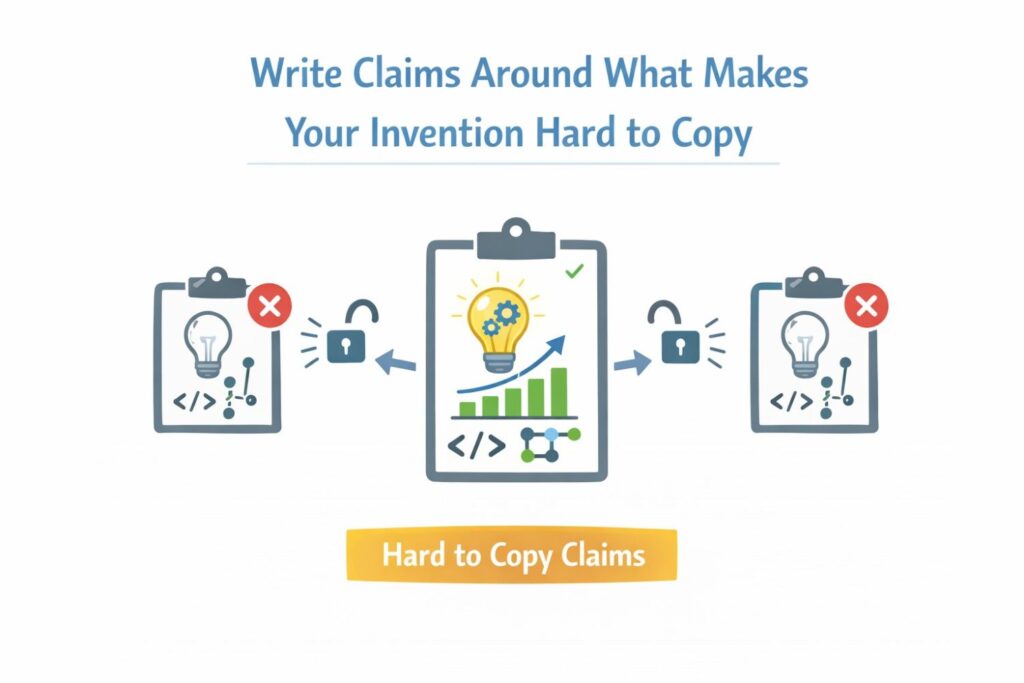
Your goal is to make clear what another company would have to rebuild if they wanted to match what you do. That often leads to stronger and cleaner claim language because it forces you to focus on necessity instead of surface detail.
Think like a copycat before you write like an inventor
One of the smartest ways to improve claim strength is to reverse your point of view. Do not start by asking how your invention works. Start by asking how a rival would try to copy it.
A competitor does not care about your product story. They care about getting the same business result with the least effort and the lowest risk. That mindset reveals where your real protection should sit.
If a rival could change the interface and still keep the core performance, then the interface is not the best claim center.
If they could swap labels, reorder screens, or tweak user settings without losing the real advantage, then those details belong lower in the claim set, not at the center of it.
The core claim should aim at the technical move they would still need in order to compete.
The most valuable claim often sits under the visible feature
What customers see is often not what competitors need to copy.
That is why strong patent strategy looks beneath the visible product feature. The visible feature may be a dashboard, an alert, a prediction, a control mode, a routing output, or a generated result.
But under that feature is usually a technical method that makes the feature possible in a commercially meaningful way. That hidden method is often the stronger claim target.
This matters for businesses because market value usually comes from repeatable advantage, not presentation alone. If your claim protects only the visible layer, a competitor may rebuild the engine and present it differently.
If your claim protects the hidden engine, you create more pressure. That does not guarantee perfect coverage, but it raises the cost of imitation.
Protect the part they cannot remove without getting worse
A practical test for claim drafting is this: if a competitor removed this element, would their system become meaningfully worse?
That question helps separate valuable claim material from filler. Many inventions include helpful pieces, but only a few are truly load-bearing. Those load-bearing parts often drive the business result.
They may reduce failure, improve precision, cut compute cost, shrink latency, increase trust, or make deployment possible in real conditions. Those are the parts to study closely.
If the answer is yes, and removing that element would hurt the rival’s offering in a real way, then that element may deserve a central role in your claims. If the answer is no, then it may still belong in the patent, but probably not as the main claim anchor.
Claims should target dependence, not decoration
Competitors can decorate around your patent if your claims are aimed at optional details.
They can change naming, appearance, ordering, placement, and extra workflow steps very quickly. They can move one action before another. They can split one component into two.
They can wrap a different user experience around the same technical core. If your claims focus on those decorative differences, they may be too easy to design around.
A better claim captures dependence. It covers the technical relation that matters.
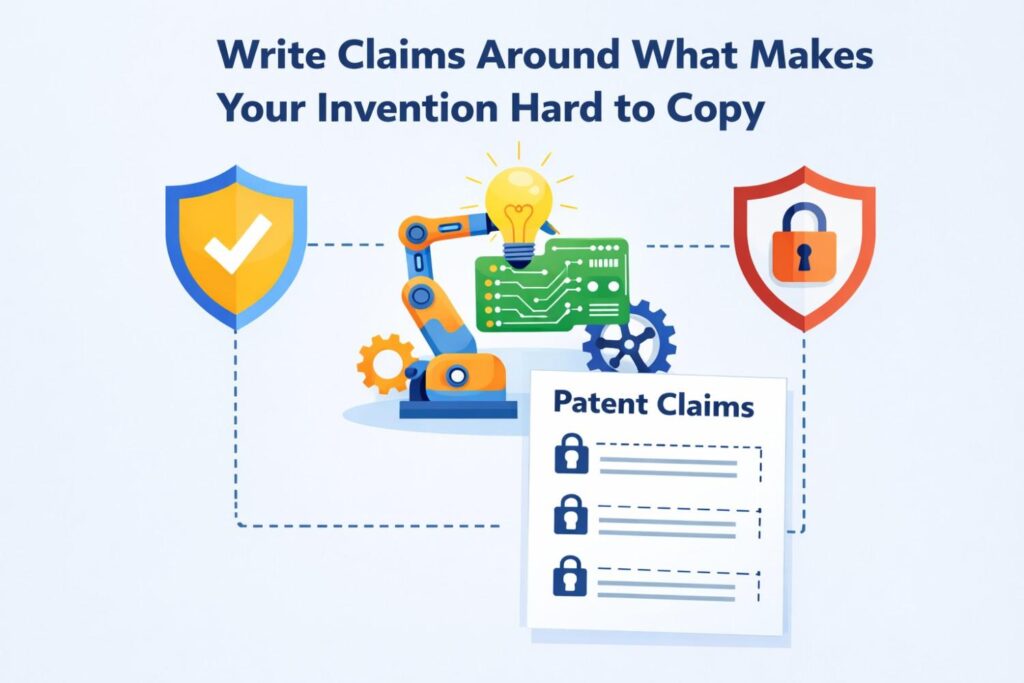
It focuses on the rule, sequence, transformation, coordination step, or machine behavior that the copying product depends on to deliver the same value.
That is why thoughtful claim drafting feels less like describing a product and more like identifying a pressure point.
A copy-resistant claim usually maps to a business bottleneck
The strongest claims often line up with a bottleneck in the product.
That bottleneck might be where performance breaks without your method. It might be where scale becomes too costly without your architecture. It might be where accuracy drops without your processing step.
It might be where customer trust fails unless the system handles risk in a very specific way. When you find that bottleneck, you often find the area where copying becomes painful.
For businesses, this is one of the most useful ways to connect patents to strategy. A claim that covers a bottleneck is often more valuable than a claim that covers a broad but shallow idea.
That is because bottlenecks shape commercial reality. If your patent reaches into one of those choke points, it can matter in negotiations, diligence, fundraising, and market defense.
Draft around what rivals would keep, not what they would cut
If a competitor copied your product tomorrow, they would not copy every part. They would cut whatever they could. They would simplify wherever possible.
They would keep only the pieces required to deliver the result customers care about.
That is exactly why this is such a useful drafting lens. Ask what they would keep no matter what. Ask what they would preserve because losing it would damage the value proposition. Those are often the claim-worthy elements.
This approach also keeps your patent work grounded in market reality. It avoids the trap of drafting around internal team pride. Not every clever engineering step belongs in a lead claim.
The better question is whether that step would survive in a stripped-down copy built for competition. If it would, it deserves attention.
Build your claim around the hidden must-have
In many strong patents, the core invention is a hidden must-have.
It is not always the feature customers talk about first. It is the thing inside the system that makes the promise real.
may be a routing rule, a threshold logic, a recovery step, a memory structure, a model handoff, a timing sequence, a resource allocation method, or a system state decision.
Whatever form it takes, the common pattern is the same: the business outcome depends on it even if users never see it.

That makes it a strong candidate for claims because competitors often end up needing hidden must-haves too.
They may present them differently, but if they want the same performance, those underlying choices become hard to escape.
Avoid Broad Claim Language That Breaks Under Prior Art
Broad claim language can feel powerful when you first read it. It sounds expansive. It sounds like it covers more ground. It sounds like the kind of claim that would scare off competitors.
But in practice, broad language often creates the exact opposite result. It gives prior art more room to hit you. It makes your invention easier to compare to old systems. It weakens the part of the claim that should be doing the real work.
If you want claims that survive, you cannot chase width at the cost of strength.
You need language that is broad in the right places and specific in the places that carry the invention. That difference is where strong claim drafting begins.
Broad language feels safe, but it often removes your protection
At first, many founders believe broad claims give them the best chance to protect more of the market.
That instinct is understandable. If the claim reads at a high level, it may seem like it covers more possible versions of the product. The problem is that prior art also lives at a high level.
Older patents, papers, and public systems often describe general ideas in very wide terms.
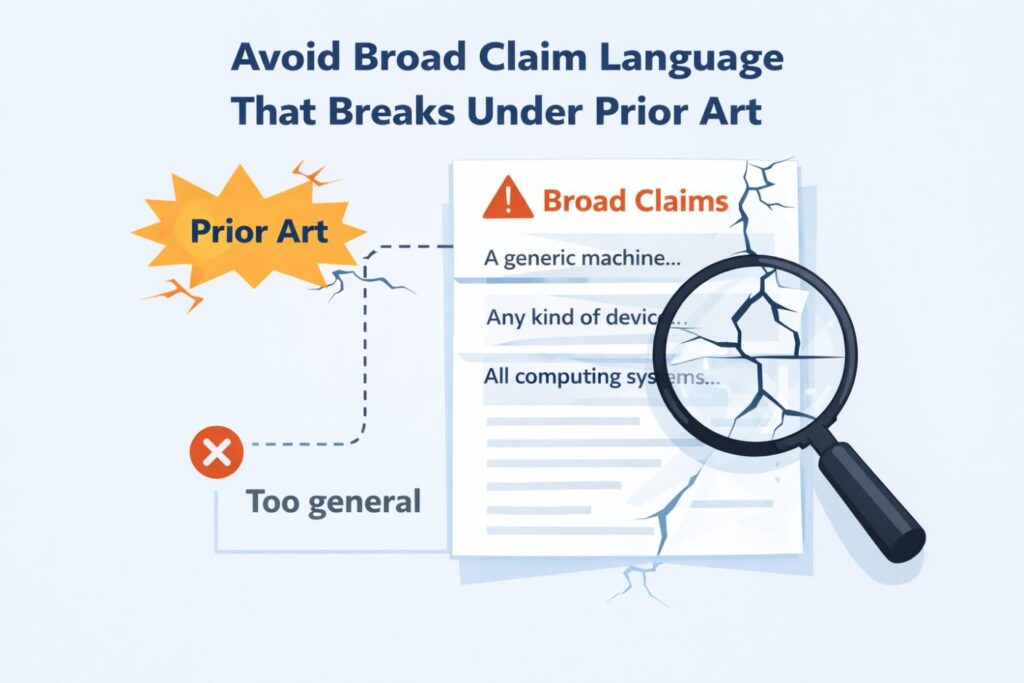
When your claim uses the same kind of language, it becomes much easier for an examiner to line them up and say the invention is already there.
This is why smart drafting does not ask only how much surface area a claim covers. It asks whether the language captures the real technical difference in a way that old references cannot swallow whole.
Broad is not the same as strategic
A claim can be broad and still be badly drafted. A claim can also be more focused and still protect something highly valuable. The real question is not whether the wording is wide.
The real question is whether the wording is anchored to the part of the invention that matters.
A lot of weak claims use broad language because the drafter wants to avoid limiting the invention too early.
That sounds sensible, but it often turns into claims that describe goals instead of methods, outcomes instead of mechanisms, and categories instead of distinctions.
Those claims look impressive until prior art arrives. Then they start to crack because they never tied themselves to the real technical move in the first place.
The wider your wording, the more careful your anchor must be
You do not need to avoid breadth entirely. Good claims often need room to cover product variation, future versions, and likely copycats. But if you want that room, the claim still needs an anchor.
It needs one or more elements that connect the language to a real point of technical separation.
Without that anchor, a broad claim becomes easy to reject. It starts reading like a general description of a field rather than a legal boundary around an invention.
The examiner does not need to find a perfect match. They only need enough overlap to argue that the claim is already known or obvious. Broad wording makes that job easier unless the claim also points clearly to what is actually new.
General verbs are often danger signs
Many weak claims lean too hard on generic verbs. They say things like receiving, processing, analyzing, determining, generating, transmitting, selecting, storing, or displaying.
Those verbs are not wrong. In fact, they may be part of the invention. The problem is that they are often too general to carry patent weight on their own.
When you build a claim around generic verbs, you flatten the invention. You make it sound like a standard computing workflow instead of a distinct technical method.
Prior art almost always includes systems that receive data, process data, generate outputs, and store results. So the moment your claim depends mostly on those words, it becomes easier for an examiner to map old references onto it.
Generic verbs need technical context
A stronger claim gives those verbs a job. It shows how the system performs the step in a distinct way, in a distinct sequence, under a distinct condition, or with a distinct structural relation.
That added context is often where the invention lives.
For businesses, this matters because the claim is not supposed to describe the category of work your system performs. It is supposed to protect the way your system does it differently.

If your wording never gets to that difference, you may end up with a claim that looks broad but gives very little real value.
Broad functional language can hide the weak center of the claim
One common trap is functional language that sounds useful but says too little about how the invention works.
A claim may say a component is configured to optimize, improve, coordinate, authenticate, predict, prioritize, or adapt. Those words can help express intent, but they can also hide vagueness.
If the claim says only that the system achieves a function, prior art can often point to older systems that aimed at the same function. The battle then becomes harder because your claim never made the difference visible.
You are left trying to argue that your invention is special based on material that should have been reflected in the claim from the start.
Functional words should point to a technical path
Strong claims often use functional wording, but not by itself. The function should be tied to a real path.
That path may involve a rule, a threshold, a transformation, a sequence, a machine interaction, a system relation, or a condition that triggers behavior.
Once the function is grounded in that kind of structure, the claim becomes much harder to dismiss as just another broad goal statement.
This is one reason startups do better when they treat patent drafting as part of product strategy, not just legal cleanup.
When the claim language is built around the actual technical path, it becomes easier to protect the invention that drives the company forward.
PowerPatent helps founders do that faster, with smart software and real attorney oversight, so the filing stays grounded in what matters. You can see how it works here: https://powerpatent.com/how-it-works
Claims break when they describe the result but not the move
Prior art attacks become much stronger when your claim is written around the final result instead of the move that creates it.
Old systems may have reached similar results in rough form, even if they got there in a weaker or very different way. If your claim focuses only on the result, that difference can disappear.
This is where many teams lose strength without realizing it. They describe what the user gets, what the system outputs, or what benefit is achieved. But claims survive better when they focus on what the system specifically does to make that happen. That is where the distinction becomes visible.
A result is easy to compare, but a method is harder to absorb
Examiners can often line up results across references with very little effort. A system that improves speed or accuracy may sound close enough to another system that also improves speed or accuracy.
But when the claim captures the specific technical move that causes the improvement, the comparison gets harder. The prior art must now show more than a shared goal. It must show the meaningful mechanism too.
That is why tactical claim writing often feels more concrete than founders expect. The point is not to write the most abstract promise. The point is to express the technical choice that makes the promise real and defensible.
Broad categories can erase your novelty
Another common mistake is using category words that are too broad to show where the invention sits.
Terms like module, engine, platform, processor, interface, model, network, or controller may be accurate, but by themselves they often say very little. They describe a bucket, not a distinction.
This becomes a problem when the claim depends on those category words without unpacking what the claimed part actually does in a patent-relevant way.
Prior art usually includes modules, processors, networks, and controllers. So those labels do not help much unless the claim also explains the specific role, relation, or behavior that sets the invention apart.
Labels do not protect what behavior protects
Internal product labels can be helpful for your team, but they are not enough to create a resilient claim.
A claim is stronger when it protects behavior, interaction, or structure instead of relying on names for internal components. Once the behavior is visible, the patent starts guarding the part a competitor would actually need to reproduce.
This is especially useful for businesses because names change. Product architecture evolves. Teams rebrand internal systems all the time. Claims need to survive those changes and still track the underlying invention.
Broad claims often invite obviousness attacks
Sometimes a claim is not rejected because one old reference shows every element. Instead, it gets rejected because the examiner says it would have been obvious to combine known pieces.
Broad claim language can make this easier. When a claim is drafted at a high level, it often reads like a bundle of familiar ideas with little visible technical tension between them.
The examiner then has a simple story. One reference shows one part. Another shows the second part.
A third shows the environment. Put them together, and the claim seems obvious. The broader and more abstract the wording, the easier that story can become.
Concrete relationships make combination arguments harder
A better claim often forces the examiner to do more work. When the claim includes a meaningful technical relationship, a specific sequence, or a system choice tied to a real problem, it becomes harder to say the pieces would naturally fit together.
That does not stop every obviousness attack, but it often strengthens your position because the claim now reflects more than a generic mix of known parts.
This matters in business terms because office actions cost time and money. If your claims start from a more defensible structure, you may reduce prosecution friction and end up with cleaner protection.
Watch for words that could apply to almost any product in the field
A simple way to pressure-test broad claim language is to ask whether the words could describe almost any product in the category. If the answer is yes, then the language is probably too general to do enough work.
For example, if a claim could fit most AI tools, most workflow systems, most cloud platforms, or most control systems in the space, it may not be pointing clearly enough to your actual invention.
Broad coverage sounds nice in theory, but in practice it often means the claim is resting on field-level language rather than invention-level language.
Your claim should narrow the field without boxing in the product
This is the balance strong teams aim for. The claim should narrow the field enough to expose what is different, but not so much that it traps the company inside one exact implementation.
That is why claim writing is strategic. It is not just about adding detail. It is about adding the right detail.
Businesses benefit when this balance is handled well because the patent becomes both stronger and more useful. It becomes more likely to survive examination and more likely to map onto what competitors would actually build.
Overbroad language can make your own invention sound ordinary
This is one of the most frustrating mistakes in patent drafting. A company may have created a real technical breakthrough, but the claim language makes it sound like a standard workflow.

The novelty is there in the product, but it disappears in the wording.
Wrapping It Up
Strong patent claims do not survive prior art attacks by sounding big. They survive because they are built with care around what is actually new, what actually matters, and what a real competitor would struggle to avoid. That is the core idea behind everything in this article.