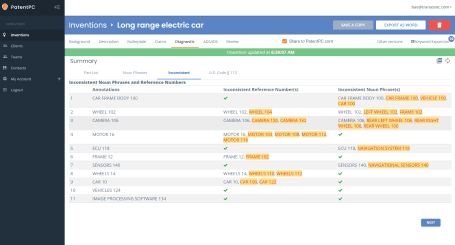
Every fast-growing company hits this wall at some point: global patent costs start to feel messy, slow, and out of control. You are paying agents in different countries. You are answering the same questions again and again. You are wiring money across borders. And somehow, the bills keep growing while clarity keeps shrinking. It does not have to be this way. If you want to protect your inventions across the world without bleeding cash or losing speed, you need a smarter way to manage global agent spend. In this guide, we will break down how to consolidate vendors, trim fees, and take back control—without slowing down your startup.
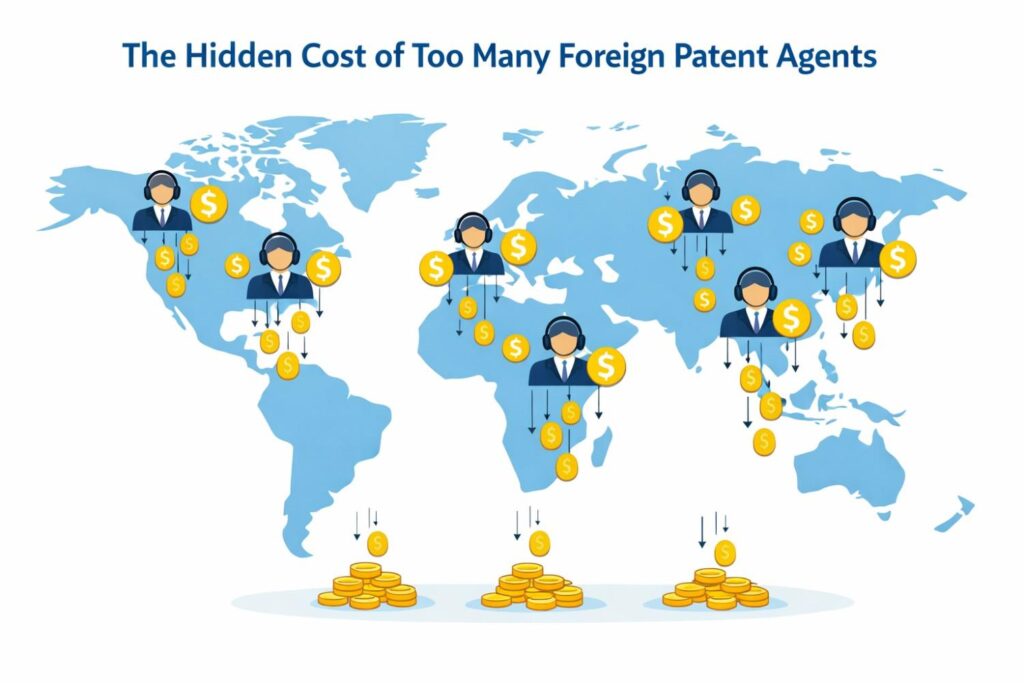
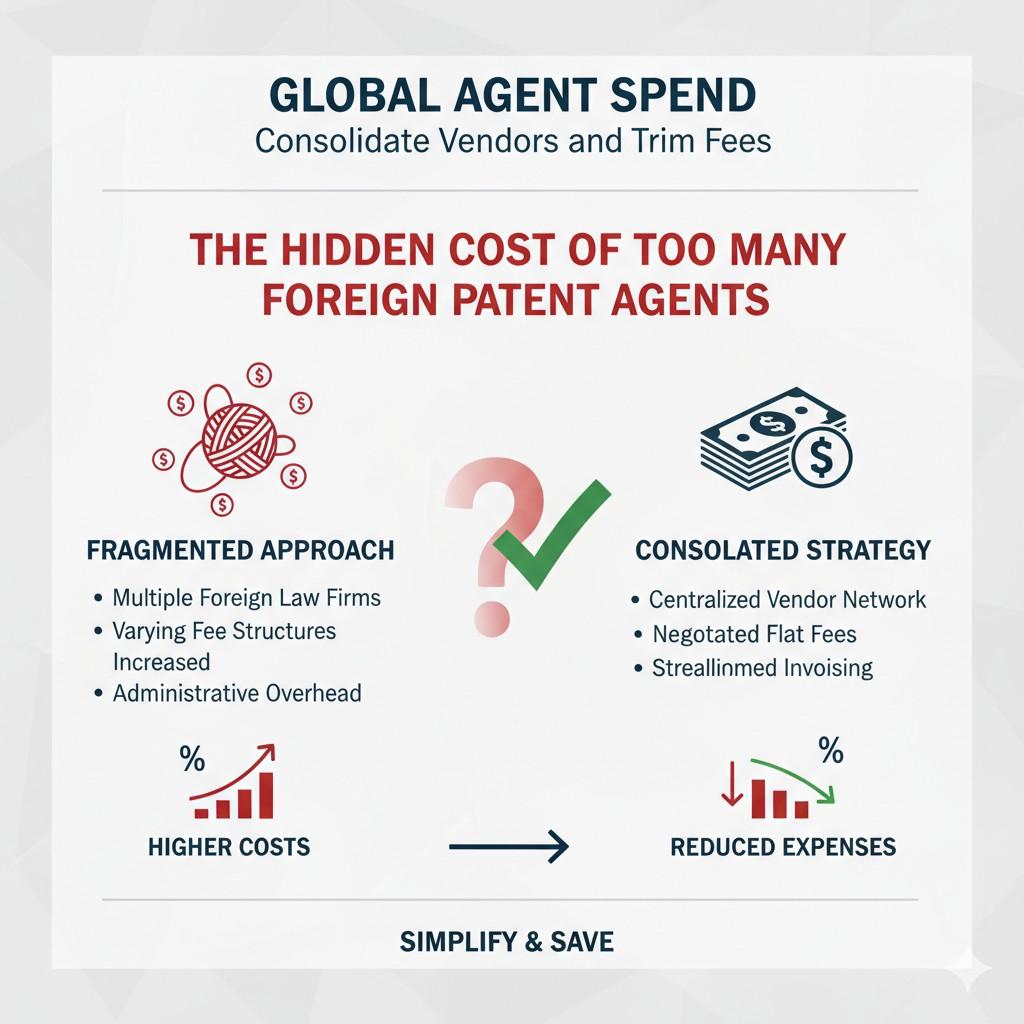
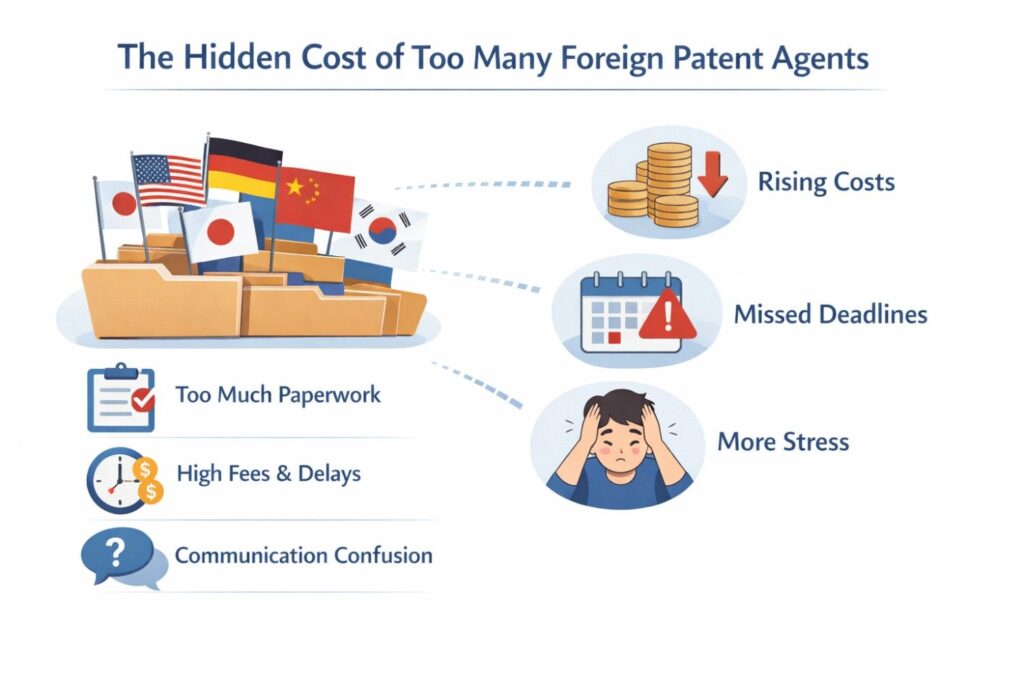
The Hidden Cost of Too Many Foreign Patent Agents
When your company starts filing patents in multiple countries, it can feel like a sign of progress. New markets. New protection. Bigger vision. But behind that growth, something quiet starts to happen.
Each new country often means a new local patent agent. And each new agent adds another layer of cost, delay, and confusion.
What looks like smart global coverage can slowly turn into a tangled web of vendors that drain your time and money.
If you are serious about building a strong global IP position, you cannot afford to ignore this hidden drag. The real cost is not just in the invoices. It is in the lost speed, the lack of clarity, and the risk of mistakes that stack up over time.
Fragmented Communication Slows Everything Down
At first, working with local agents in each country feels necessary. They know their local rules. They handle filings. They send updates. But when you have five, ten, or fifteen different agents, communication starts to break down.
Each agent has their own style. Some respond quickly. Some take days. Some ask detailed technical questions.
Others send short notes that leave you guessing. Your internal team has to adjust to each one. That takes time and energy that should be spent building your product.
The real issue is not language or time zones. It is fragmentation. When updates are coming from all directions, it becomes harder to see the full picture of your global patent portfolio.
Deadlines can overlap. Requests can conflict. You may end up answering the same question in slightly different ways across countries, which can create inconsistency in your filings.
To fix this, you need a single point of coordination. One place where all foreign filings are tracked.
One team that sees the whole map. If you are still emailing different agents directly in each country, that is your first red flag. Start by centralizing communication.
Route all foreign questions through one core team. Even better, work with a system that already integrates global filings into one dashboard so nothing slips through.
If you want to see how a centralized approach works in practice, you can explore how modern platforms handle this at https://powerpatent.com/how-it-works.
Duplicate Work Creates Invisible Fees
When you hire many foreign agents, you often pay for the same work multiple times. Each agent reviews your application. Each one may suggest edits. Each one may reformat claims. That review time shows up as billable hours.
You might think, “That is just part of filing abroad.” But much of this work is repetitive. If your original patent is strong and structured properly from the start, it should not need heavy reworking in every country.
The hidden cost is in these small, repeated adjustments. A few hours here. A few changes there. Multiply that by ten countries, and you are looking at thousands of dollars in avoidable fees.
The smart move is to invest more in getting the original application right before it goes global.
A well-drafted application reduces the need for local rewriting. It makes foreign filing more of a translation and compliance step, not a redesign project.
This is where strategy matters. Before you file internationally, ask yourself whether your core patent was written with global expansion in mind.
If it was only designed for one country, you are almost guaranteed to pay extra later. A strong foundation saves more than it costs.
Inconsistent Strategy Across Countries
When you manage separate agents in each country, strategy can drift. One agent may push for narrow claims to move faster. Another may suggest broader language.
A third might recommend dropping certain claims to reduce fees.
Each recommendation might make sense locally. But taken together, they can weaken your overall position. You may end up with a patchwork of rights that do not align with your business goals.
For startups, this is dangerous. Your patents should protect your core technology in a consistent way across key markets. If your claims look very different country to country, enforcement becomes harder.
Licensing becomes messy. And investors may question the strength of your global protection.
To avoid this, your company needs a central strategy owner. Someone who understands your product roadmap and ensures that foreign filings align with your long-term plan. This is not just a legal task. It is a business decision.
Before approving any foreign amendment, step back and ask how it fits into the bigger picture. Does it support your core moat? Does it protect the features that drive revenue?
Or is it just reacting to a local examiner without considering global impact?
Bringing everything under one coordinated system makes this much easier. When your global portfolio is managed through a single platform with attorney oversight, you can see how each change affects the whole.
If you are curious how that level of coordination can work without slowing your team down, you can look at the process here: https://powerpatent.com/how-it-works.
Payment Chaos and Currency Leakage
Paying multiple foreign agents often means paying in different currencies, at different times, under different billing rules. Some agents require retainers. Some bill per action. Some send invoices that are hard to decode.
This creates more than accounting work. It creates risk. Missed payments can lead to lost rights. Exchange rate swings can increase your actual spend without you noticing. Small bank transfer fees add up.
The chaos makes it hard to forecast your true global patent budget. And if you cannot predict your costs, you cannot manage them.
One practical step is to demand clearer billing from every foreign vendor. Ask for standard fee estimates in advance. Ask for confirmation before any extra work begins. If an agent cannot provide cost clarity, that is a signal.
An even stronger move is consolidation. When you reduce the number of vendors you work with, you reduce the number of billing streams. Fewer vendors mean fewer surprises.
Over time, you should aim for a model where your global patent costs flow through one structured system.
This gives your finance team clean data. It also gives you leverage to negotiate better rates because you are bringing more volume to fewer partners.
Lost Negotiation Power
When you spread your filings across many small foreign agents, you often lose leverage. Each agent handles a small slice of your work.
That means your business may not be large enough to negotiate better rates in any one country.
But if you consolidate filings through a central partner that manages higher volume across jurisdictions, that partner can negotiate better terms on your behalf. Volume matters.
The hidden cost of vendor sprawl is that you look small everywhere. Consolidation makes you look bigger in the eyes of the agents doing the work.
As a founder, you should think about your global IP spend the same way you think about cloud infrastructure or manufacturing.
Would you randomly pick different providers in each region without negotiating rates? Probably not. You would look for scale and efficiency.
Patent protection should be treated with the same discipline.
Internal Team Burnout
There is one more hidden cost that rarely shows up in spreadsheets. Managing many foreign agents burns out your internal team.
Your head of legal, your CTO, or even you as the founder may end up chasing emails, reviewing scattered documents, and tracking deadlines manually.
This mental load slows product work. It shifts focus away from growth. And it increases the chance of human error.
The best companies build systems that reduce friction. If your global patent process feels like constant firefighting, that is a sign the system is broken.
Start by mapping out how much internal time is spent managing foreign filings each quarter. You may be surprised. Once you see the true time cost, the case for consolidation becomes obvious.
A modern approach blends smart software with real attorney guidance so that coordination, tracking, and quality control happen in one place. That frees your team to focus on what actually builds value.
If your goal is to protect your technology while staying fast and lean, it is worth exploring how a streamlined model works in detail at https://powerpatent.com/how-it-works.
Too many foreign patent agents do more than increase invoices. They create friction, risk, and lost opportunity.
When you bring structure and consolidation into your global IP strategy, you do not just cut fees. You gain clarity, control, and confidence in how your innovation is protected worldwide.
Why Vendor Sprawl Kills Speed, Control, and Cash
When your patent footprint expands across borders, it feels like progress. More countries. More coverage. More protection. But if that growth happens without structure, it creates drag.
Vendor sprawl is not just a cost issue. It is a speed issue. It is a control issue. And over time, it becomes a cash issue that quietly slows your company down.
Most startups do not notice the damage at first. The problems build slowly. A few extra emails. A few extra invoices. A few delays that seem minor on their own. But when you step back, you see a system that is working against you instead of for you.
If you want to protect your technology and move fast, you need to understand how vendor sprawl quietly erodes your advantage.
Speed Suffers When Ownership Is Blurry
When multiple foreign agents handle different parts of your portfolio, ownership becomes unclear.
Who is tracking deadlines? Who ensures that claim language stays aligned? Who verifies that instructions sent to one country match the strategy in another?
When ownership is not clear, tasks slow down. Emails get forwarded. Questions get bounced around. Each agent waits for confirmation. Your internal team becomes the middle layer trying to connect everyone.
This delay may only be a few days each time. But in patent prosecution, timing matters.
Office actions have strict deadlines. Strategic responses require thoughtful coordination. A delay in one country can affect your filing timeline in another.
Speed is a competitive advantage. If your patent system is slow, your ability to secure protection before competitors shrinks.
Investors notice timing gaps. Acquirers review how clean and organized your filings are. A messy, slow process signals risk.
To fix this, speed must come from central control. One coordinated team should oversee foreign instructions. One platform should track timelines across all countries.
You should be able to log in and see where everything stands without chasing anyone.
If your current setup requires spreadsheets and manual follow-ups, that is a warning sign. The more automation and visibility you build into your process, the faster you move.
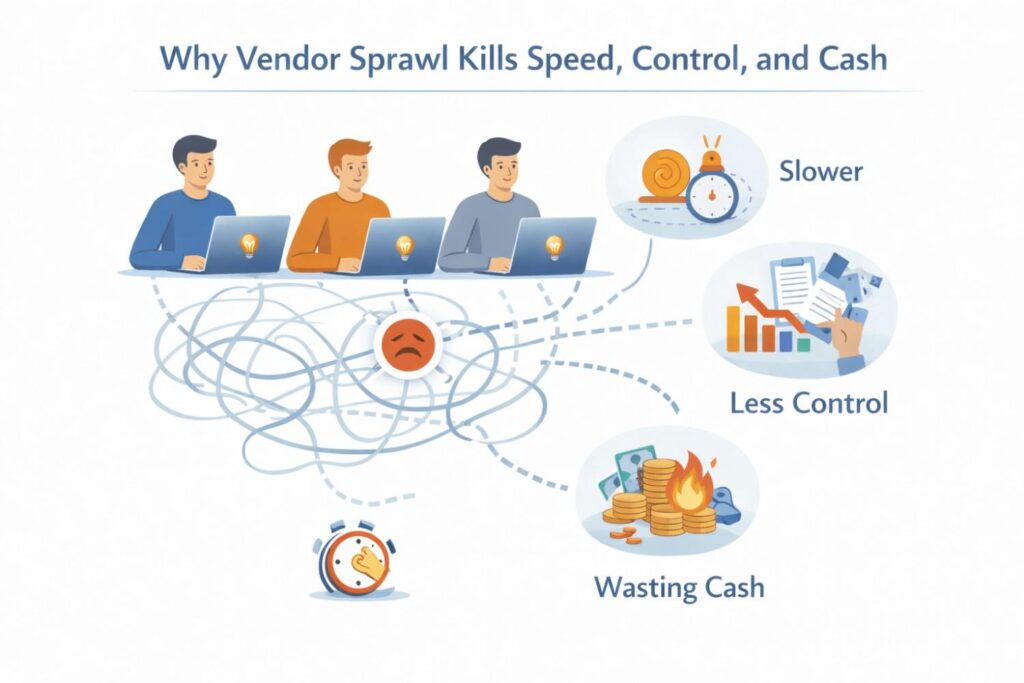
You can see how a unified approach improves turnaround and visibility here: https://powerpatent.com/how-it-works.
Control Slips When Information Is Scattered
Control is not about micromanaging agents. It is about having clarity. When information lives in separate inboxes, local portals, and scattered PDF attachments, control weakens.
Imagine preparing for a funding round. An investor asks for a clear summary of your global patent position. You scramble to gather updates from different countries.
Some reports are outdated. Some are pending. You are not fully confident in the status.
That lack of visibility hurts leverage.
A strong IP position should be easy to understand and explain. It should show deliberate planning. It should demonstrate that your company treats intellectual property like a core asset, not an afterthought.
Vendor sprawl breaks that narrative. Each agent reports in a different format. Some provide detailed summaries. Others send minimal updates. There is no uniform data set.
To regain control, you need standardized reporting. Every country update should follow the same structure. Every deadline should be logged in one master system.
You should be able to generate a clear snapshot of your portfolio at any moment.
If your current system cannot produce that clarity within minutes, it needs improvement. Control is not about more paperwork. It is about better organization.
Cash Flow Becomes Unpredictable
Cash flow is oxygen for startups. When patent costs become unpredictable, planning becomes harder. Vendor sprawl often creates uneven billing cycles. One month might be quiet. The next might bring multiple foreign invoices at once.
Because each agent operates independently, there is rarely a coordinated cost forecast. You are reacting instead of planning.
This reactive pattern causes stress. It may force you to delay filings. It may push you to cut corners.
In some cases, companies abandon certain countries not because they are unimportant, but because the cost timing feels overwhelming.
A smarter model builds visibility into future spend. Before entering national phase in multiple countries, you should know the estimated cost over the next twelve to eighteen months. Not just filing fees, but prosecution costs as well.
This level of forecasting requires central data. It requires one system that tracks not only deadlines but expected actions and related expenses.
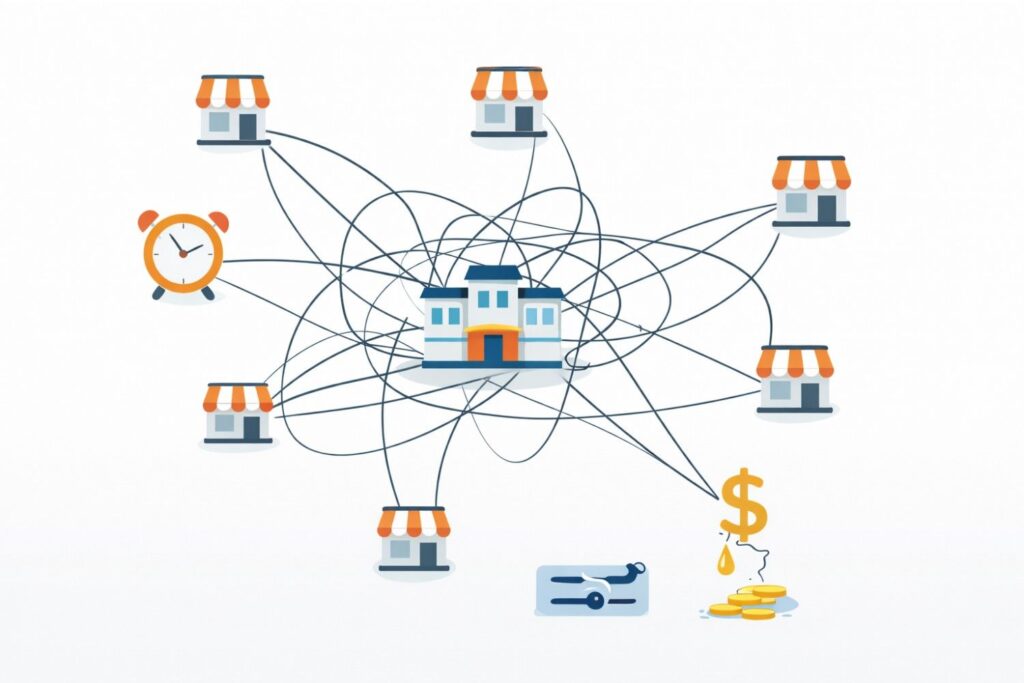
When you consolidate vendors or route work through a coordinated structure, forecasting becomes realistic. You can align patent spend with funding milestones. You can decide strategically which markets deserve priority.
Cash flow control is not about spending less at any cost. It is about spending wisely and predictably.
Strategic Drift Becomes Normalized
Vendor sprawl often leads to subtle strategic drift. Each local agent focuses on passing examination in their country. That is their job. But no single agent sees your entire competitive landscape.
Without a central strategic review, amendments may accumulate that slowly narrow your protection. Over time, your global patent family may lose cohesion.
Strategic drift is dangerous because it is gradual. You rarely see one dramatic mistake. Instead, you see a series of small adjustments that move you away from your original vision.
To prevent this, every major amendment should be reviewed through a global lens. Before accepting claim changes in one country, ask how they impact enforcement in others. Ask whether they protect your most valuable features.
This requires oversight by someone who understands both the legal and business context of your technology.
A coordinated system with attorney supervision at the core can catch inconsistencies early. It can flag when a change in one country may weaken your position elsewhere.
If you are curious how combining smart software with real attorney review reduces drift, you can explore that model here: https://powerpatent.com/how-it-works.
Vendor Sprawl Reduces Accountability
When responsibility is divided among many small vendors, accountability becomes diluted. If something slips through the cracks, it is harder to identify where the failure occurred.
Was it a missed instruction? A delayed response? A misunderstanding between agents? When no single party has full visibility, problems become shared and therefore less owned.
Consolidation increases accountability. When you work with a streamlined structure, expectations are clearer. Timelines are tracked centrally. Performance is measurable.
As a founder, you should demand transparency. Ask how deadlines are monitored. Ask what backup systems exist to prevent missed filings. Ask who is responsible for quality control.
If the answers feel vague, that is a risk.
Vendor sprawl feels flexible on the surface. But in practice, it weakens discipline. And discipline is what protects long-term value.
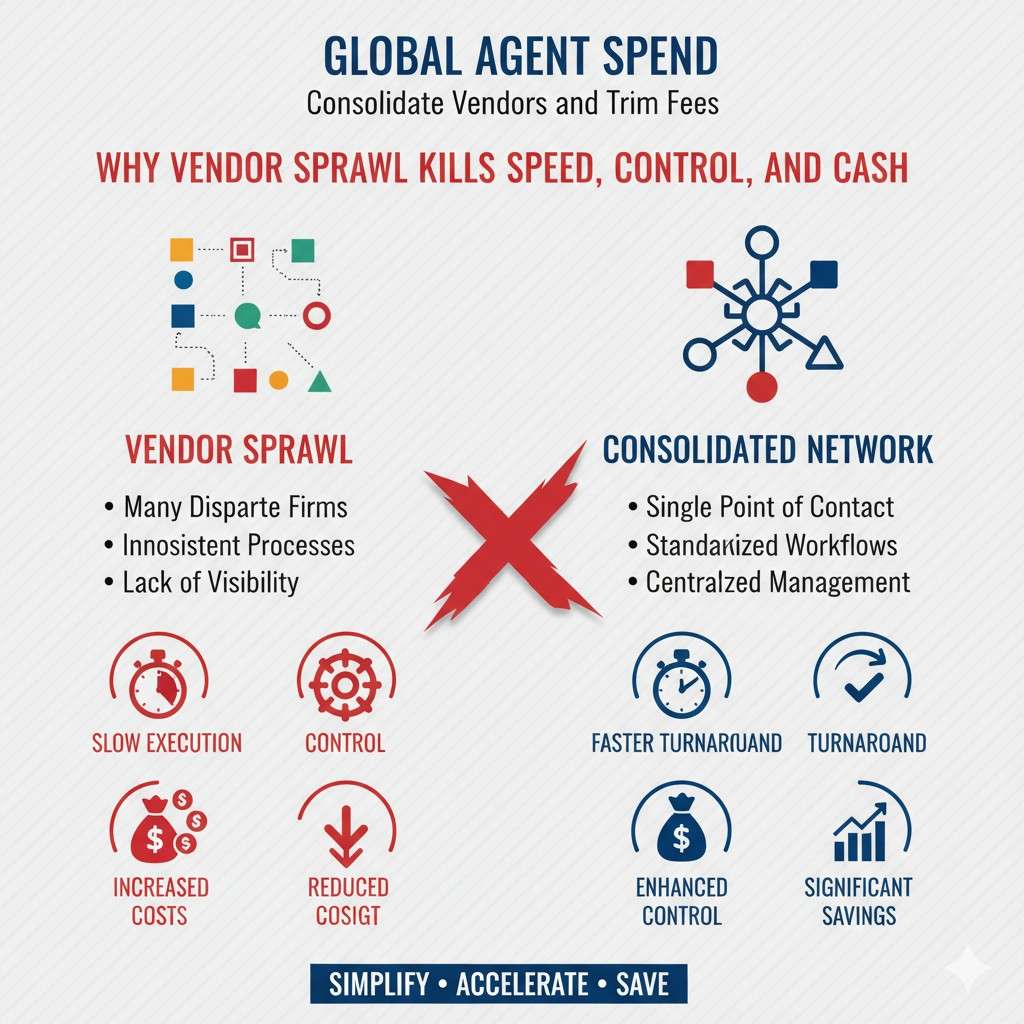
When you trim vendors and build a unified global approach, you do more than reduce fees. You increase speed. You gain control. You stabilize cash flow. And you protect the strategic integrity of your inventions.
How to Consolidate Global Patent Vendors Without Losing Protection
When founders hear the word consolidate, they sometimes worry it means cutting corners. It does not.
Consolidation is not about reducing protection. It is about removing noise so your protection becomes stronger, clearer, and easier to manage.
If your global patent setup feels scattered, the goal is not to suddenly fire every foreign agent. The goal is to design a smarter structure. One that keeps local expertise where needed but removes duplication, confusion, and waste.
Consolidation is a strategic reset. And when done correctly, it makes your IP portfolio more durable, not less.
Start With a Full Portfolio Audit
Before changing anything, you need a clear picture of what you have. Many companies skip this step.
They assume they understand their global filings. But when they look closely, they discover inconsistencies in claim scope, unexpected deadlines, or uneven coverage across markets.
A real audit goes deeper than a simple list of countries. It reviews who manages each jurisdiction, how instructions flow, how amendments are approved, and how invoices are processed.
During this review, patterns appear. You may notice that certain agents consistently charge more for similar tasks. You may see that response timelines vary widely.
You may find that some countries require heavy internal involvement while others run smoothly.
This clarity is powerful. It shows where friction exists. It also gives you leverage when renegotiating relationships.
If you do not have a centralized dashboard to view this information easily, that itself is a sign consolidation is overdue.
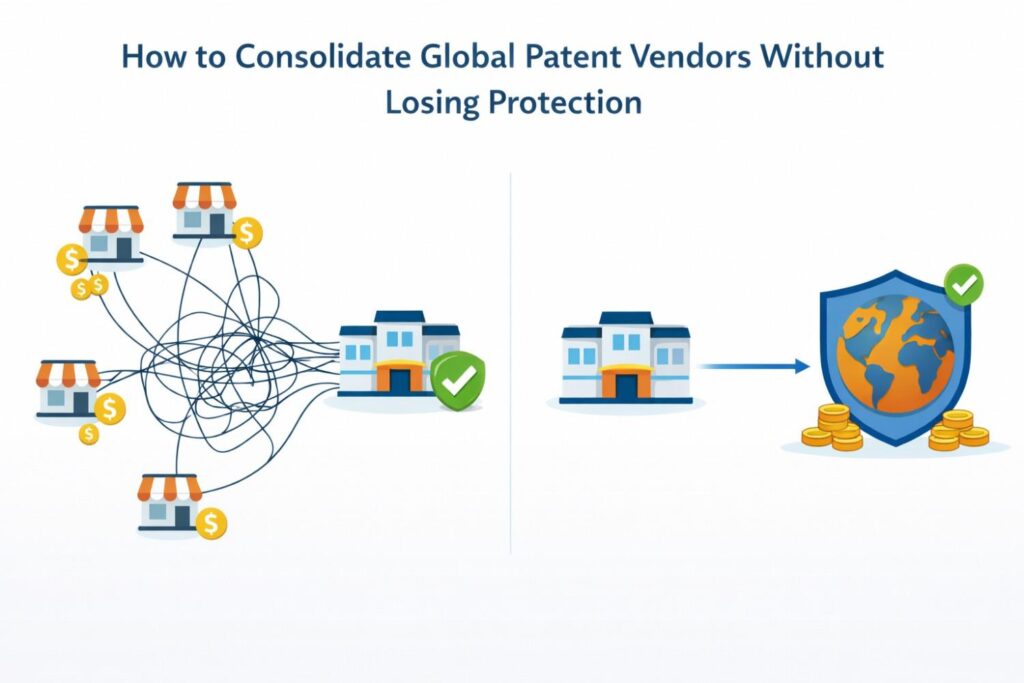
Modern platforms allow you to see your entire global position in one place, reducing the need for manual tracking. You can see how that works here: https://powerpatent.com/how-it-works.
Identify Core Markets Versus Peripheral Filings
Not every country deserves the same level of attention. Some markets are critical to revenue, manufacturing, or competition. Others are defensive or exploratory.
Vendor sprawl often happens because companies treat every jurisdiction the same. Each one gets its own agent, its own workflow, its own set of communications. Over time, this becomes unmanageable.
Consolidation begins by ranking your markets by strategic importance. Where are your customers? Where are your competitors? Where do you expect enforcement risk?
Once you define core markets, you can design a tighter oversight model for them. Peripheral countries can follow a more standardized path with less customization.
This shift reduces complexity without sacrificing protection. It aligns your legal spend with business reality.
Move Toward a Central Coordinating Partner
One of the most effective consolidation moves is appointing a central coordinating partner to manage foreign filings. This partner does not replace local agents entirely. Instead, they act as the hub.
All foreign instructions flow through this hub. All updates return through it. Strategy is reviewed centrally before being sent outward.
This model reduces direct communication between your internal team and multiple foreign agents. It creates a buffer that filters noise and enforces consistency.
The key is choosing a partner that blends technology with real attorney review. Software alone cannot manage nuance. Pure manual oversight lacks speed. A hybrid system delivers both efficiency and judgment.
With this structure, your team interacts with one organized interface instead of a web of emails across time zones.
Standardize Templates and Instructions
In many companies, foreign agents receive slightly different versions of the same instructions. Some include more context. Some are rushed. Some lack key technical background.
This inconsistency leads to variable results. One agent may interpret your goals differently than another.
As part of consolidation, create standardized instruction templates. Define how claim amendments should be reviewed. Define what level of approval is required before filing responses.
Standardization does not remove flexibility. It simply ensures that every country starts from the same strategic baseline.
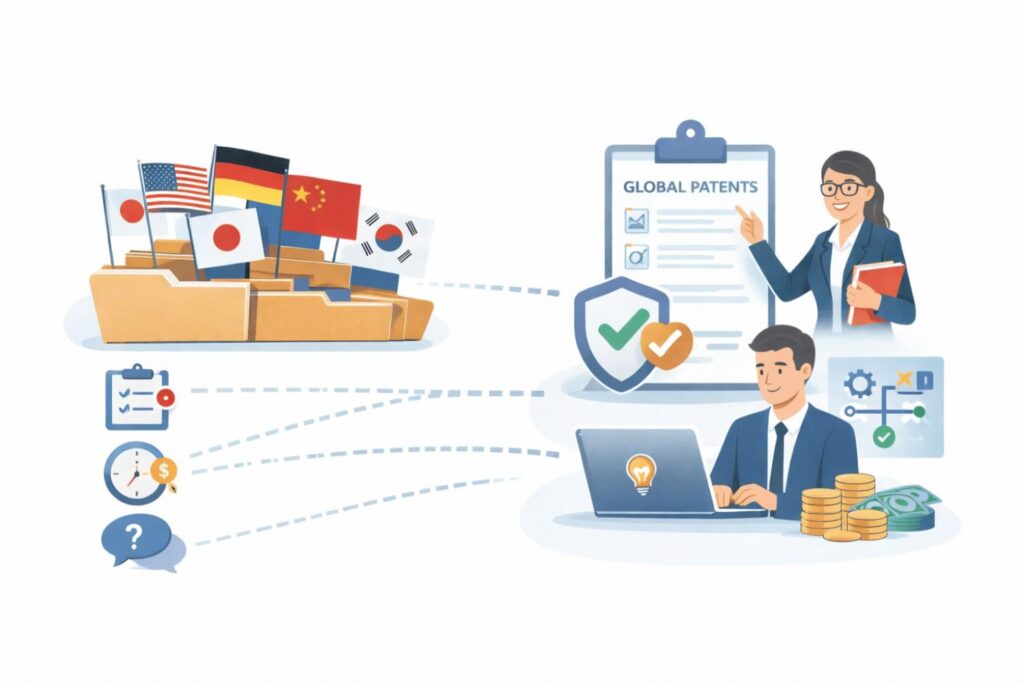
Over time, this consistency reduces back-and-forth communication. It also lowers the risk of misalignment.
When combined with a centralized dashboard that tracks every instruction and response, you create a clean audit trail. That trail becomes valuable during due diligence or acquisition discussions.
Renegotiate Fee Structures With Data
Once you centralize your data, you gain something powerful: evidence. You can see how much you spend per jurisdiction. You can compare cost patterns. You can identify outliers.
This data allows you to renegotiate from a position of strength. Instead of asking for discounts blindly, you can point to patterns. You can consolidate volume with fewer agents in exchange for better rates.
Some agents may resist. That is normal. But if you bring consistent volume and streamlined communication, many will be willing to adjust.
You may also decide to replace underperforming agents with more efficient alternatives. Consolidation is not about loyalty. It is about performance and alignment.
When you reduce the number of vendors, you simplify negotiations. You also reduce administrative overhead tied to managing multiple billing systems.
Integrate Technology to Reduce Manual Work
True consolidation is not only about fewer vendors. It is about smarter infrastructure.
If your patent management still depends on manual spreadsheets, scattered email threads, and static PDF storage, you are building risk into your system.
A modern global patent strategy relies on technology that tracks deadlines automatically, stores documents in a searchable format, and provides real-time portfolio visibility.
When software handles tracking and reminders, your team focuses on decisions, not clerical tasks.
The most effective models combine this software backbone with oversight from experienced patent attorneys. That combination ensures filings remain high quality while workflows stay efficient.
If you want to understand how technology and attorney review work together in one streamlined system, you can explore the process here: https://powerpatent.com/how-it-works.
Communicate the Shift Internally
Consolidation also requires internal alignment. Your leadership team should understand why changes are happening. Finance should understand the new cost forecast model.
Engineering should know how invention disclosures will move through the updated system.
Without clear communication, consolidation can feel disruptive. With clarity, it feels empowering.
Explain that the goal is stronger protection with less friction. Emphasize that centralization reduces risk and improves predictability. Show how the new system saves time for everyone involved.
When internal stakeholders see the benefit, adoption becomes smoother.
Protect Quality While Reducing Complexity
The most common fear around consolidation is that reducing vendors may reduce quality. In reality, the opposite is often true.
When strategy is centralized, quality improves because decisions are reviewed through a global lens. When data is unified, inconsistencies are easier to spot. When oversight is structured, errors decline.
Complexity does not equal strength. A clear, coordinated system produces stronger results than a scattered network of loosely connected agents.
Your goal is not to minimize global reach. It is to maximize clarity, efficiency, and strategic alignment.
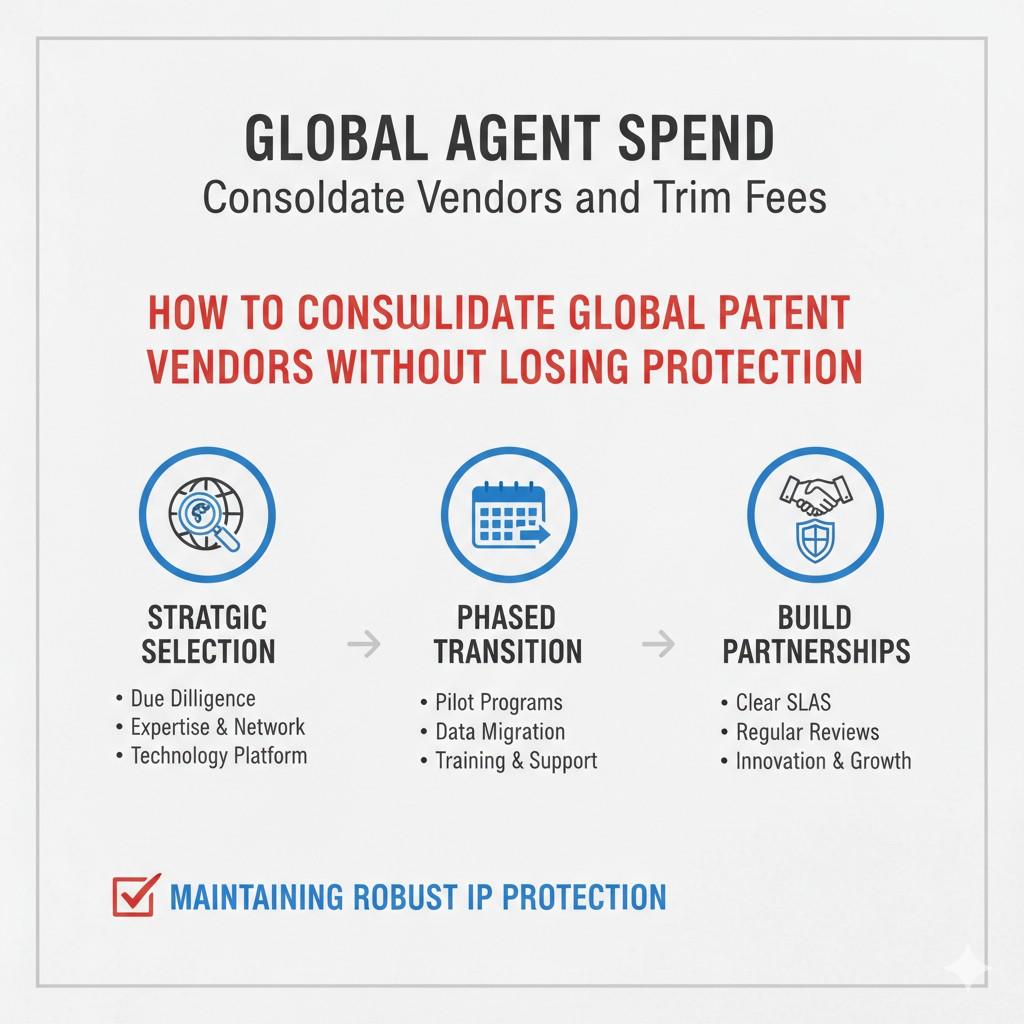
Consolidation gives you leverage. It gives you visibility. It gives you control.
And most importantly, it allows you to protect your technology worldwide without letting administrative chaos slow your growth.
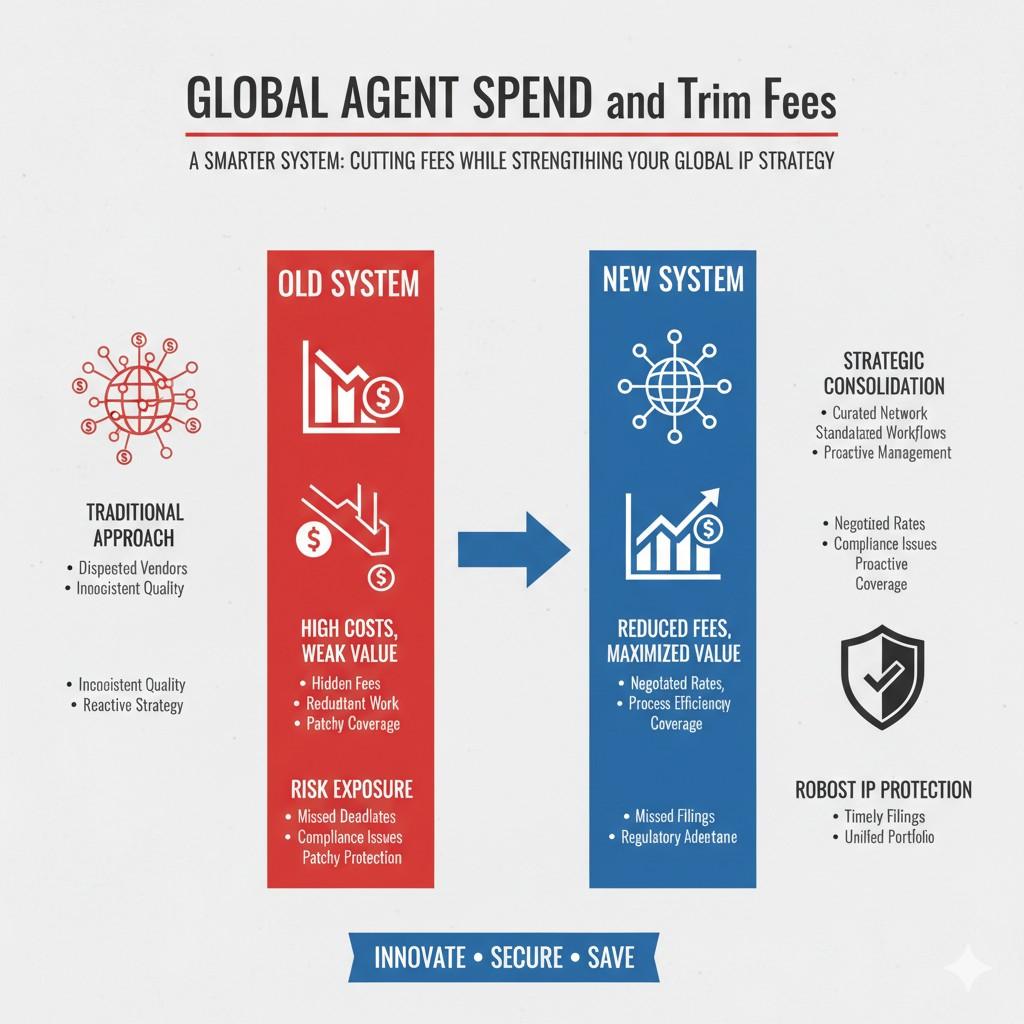
A Smarter System: Cutting Fees While Strengthening Your Global IP Strategy
By now, one thing should be clear. The problem is not global filing itself. The problem is the structure behind it. If the structure is scattered, your costs rise and your strategy weakens.
If the structure is smart, you can reduce fees while making your protection stronger.
A smarter system does not mean doing less. It means doing things in the right order, with the right oversight, and with full visibility from day one.
The companies that manage global patent spend well are not lucky. They are intentional. They treat patents as business assets, not as random legal tasks. And they build systems that support scale.
Build Your Global Plan Before You File Everywhere
Many startups rush into international filings because they feel pressure. A competitor raises funding. An advisor says “file in as many countries as possible.” Fear drives expansion.
A smarter approach begins earlier. Before entering multiple countries, pause and build a clear global plan.
Ask yourself what markets truly matter over the next five years. Think about where your product will be sold. Think about where competitors could copy you. Think about where enforcement would realistically happen.
When you align filings with real business goals, you avoid waste. You also gain confidence. Every dollar spent has purpose.
This planning stage should not live in a spreadsheet alone. It should be connected to your product roadmap and funding timeline. When patents align with growth stages, spend becomes predictable instead of reactive.
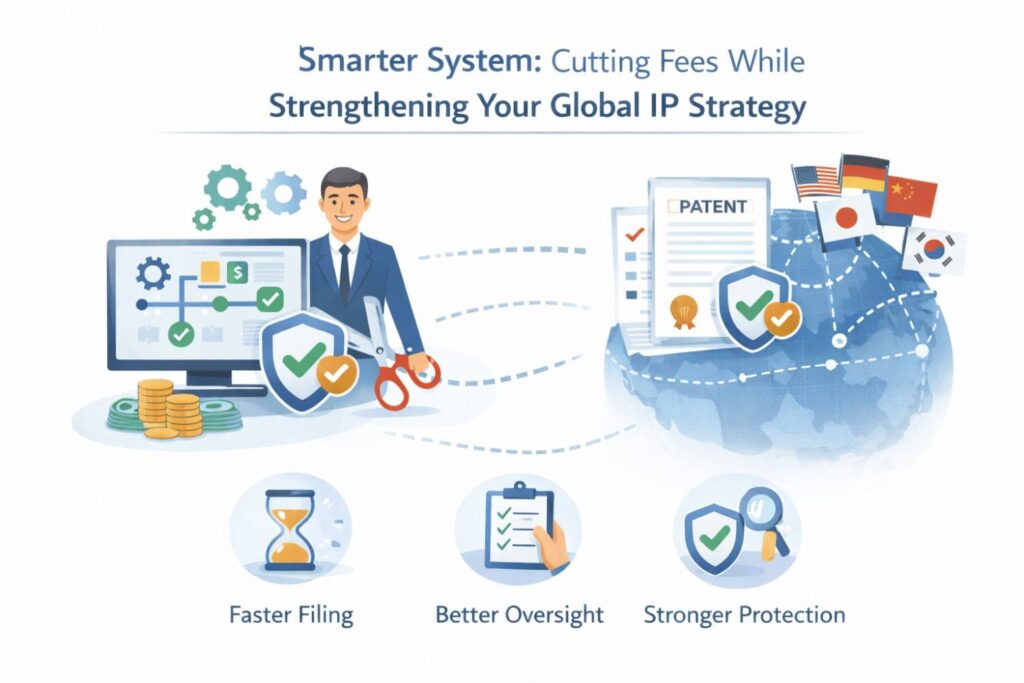
A structured platform that ties filings, deadlines, and strategy together can make this alignment far easier. You can see how a modern workflow supports that planning here: https://powerpatent.com/how-it-works.
Design Once, Deploy Many Times
One of the biggest fee drains in global patent work is redesigning strategy country by country. A smarter system focuses on designing your core patent family correctly from the start.
If your initial application is drafted with global expansion in mind, it reduces future friction. Claims are structured for flexibility. Technical descriptions are detailed enough to support amendments later. Variations are anticipated early.
When the foundation is strong, foreign filings become cleaner. Local agents spend less time revising and more time executing.
This does not mean overcomplicating the first draft. It means thinking ahead. It means involving experienced oversight early, not only after problems appear.
Strong initial drafting is one of the most powerful cost controls you can implement. It trims fees before they ever show up.
Centralize Data to Reveal Waste
You cannot trim what you cannot see. A smarter system makes every action visible. Every invoice. Every office action. Every deadline.
When data is centralized, patterns appear. You may notice that certain jurisdictions require repeated amendments. You may see that some patent families are consuming more budget without clear business value.
This visibility allows you to make hard but smart decisions. You may choose to abandon weaker filings earlier. You may decide to narrow focus in certain markets.
These decisions are strategic, not reactive. They are based on data, not guesswork.
Centralization also strengthens your position during fundraising or acquisition. When investors see a clean, well-organized portfolio with clear cost history, it signals discipline.
Discipline builds trust. Trust increases valuation.
Combine Technology With Real Attorney Oversight
Some founders think software alone can solve patent cost issues. Others believe only traditional law firms can manage complexity. Both extremes miss the point.
Technology brings speed, tracking, and organization. Attorneys bring judgment, experience, and strategic thinking. The smartest system combines both.
When smart software handles deadlines, document storage, and workflow automation, administrative waste drops. When experienced attorneys review strategy and quality, risk drops.
This combination allows you to move fast without cutting corners. It also reduces the back-and-forth that often inflates foreign agent fees.
Instead of reacting to problems country by country, you proactively guide your global portfolio from a central point.
This hybrid model is designed specifically for startups that want strong protection without traditional delays. If you want to see how that balance works in practice, you can review it here: https://powerpatent.com/how-it-works.
Shift From Reactive Spending to Strategic Investment
When vendor sprawl controls your process, patent costs feel like random bills. When you build a smarter system, those same costs become planned investments.
You know why you are filing in a certain country. You know how much the next stage will likely cost. You know who is responsible for each step.
This clarity changes how you think about IP. It stops feeling like a legal burden. It becomes a growth tool.
You protect key technology before competitors catch up. You strengthen your position during partnerships. You gain leverage in licensing discussions.
And because your system is efficient, you achieve all this without unnecessary overhead.
Make IP a Strength, Not a Distraction
Your main job as a founder is to build and grow. Patent strategy should support that mission, not distract from it.
A smarter global system reduces noise. It removes repetitive communication. It standardizes processes. It gives you clear insight into costs and timelines.
When that foundation is in place, patents stop feeling heavy. They start feeling like protection you can rely on.
Consolidating vendors and trimming fees is not about shrinking your ambition. It is about building a clean, controlled path for global growth.
If your current setup feels scattered, expensive, or hard to manage, that is a signal. You can redesign it. You can centralize it. You can make it stronger and leaner at the same time.
The companies that win globally are not the ones that spend the most on patents. They are the ones that spend wisely, with structure and intention.
If you are ready to see how a streamlined, attorney-backed platform can simplify global filings while protecting what you are building, take a closer look at how it works here: https://powerpatent.com/how-it-works.
Wrapping It Up
Global patent protection should feel like a strategic move. It should support growth. It should strengthen your position in the market. It should give investors confidence and discourage competitors. If it feels chaotic, expensive, and hard to manage, the problem is not global filing itself. The problem is the system behind it.