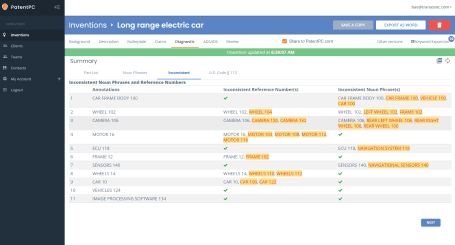
Family mapping sounds like a quiet background task you can ignore until later. But it’s actually one of the most important steps when you’re dealing with patent protection. If you don’t map your patent family the right way, you can accidentally pay twice for the same coverage. It happens more than you’d think. A founder files a new application, not knowing they already locked in rights earlier. Or they expand to new countries without realizing certain parts of the invention were already covered. These mistakes slow you down, cost money you don’t need to spend, and leave you thinking patents are too messy to deal with while you’re building
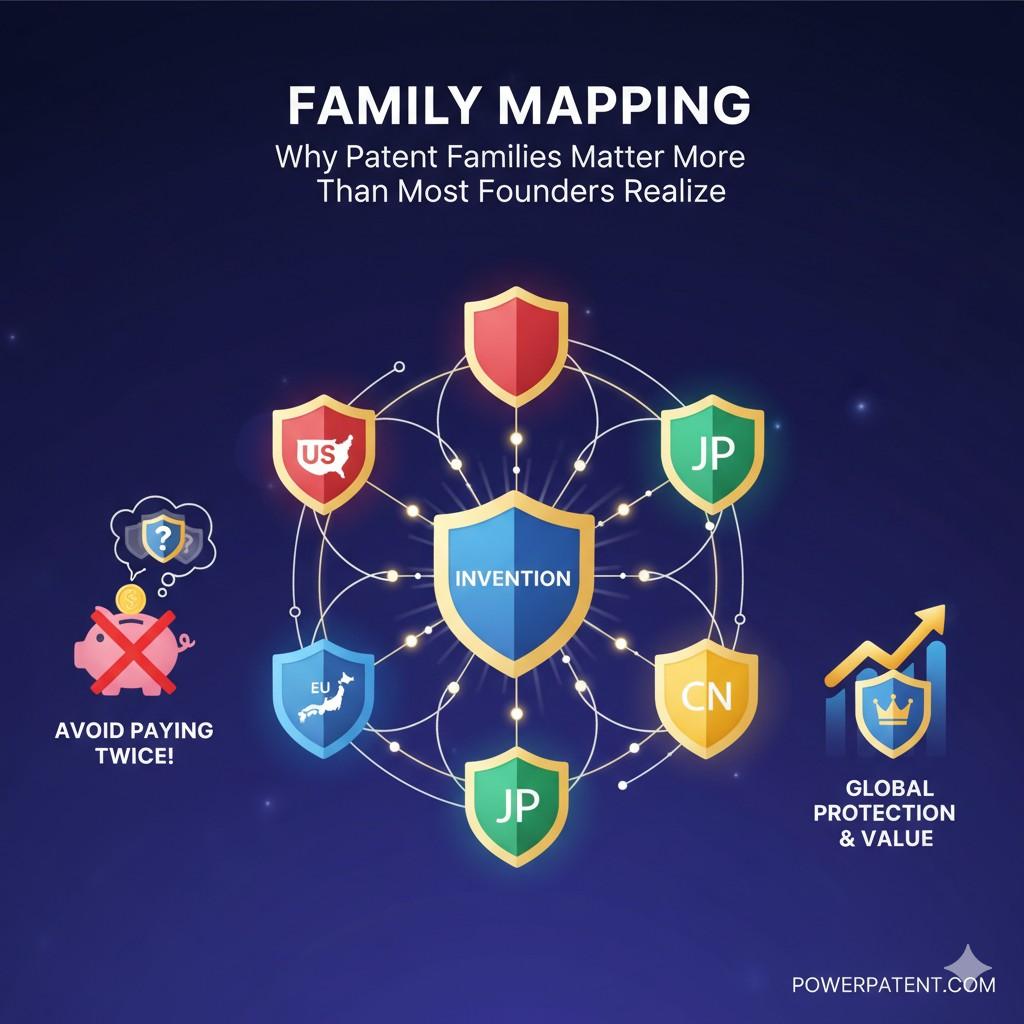
Why Patent Families Matter More Than Most Founders Realize
When people hear the phrase patent family, they often imagine something abstract or overly technical, almost like a filing cabinet label that lawyers care about but founders never need to think about.
In reality, a patent family is one of the strongest tools you have for protecting the life story of your invention. Every feature you build, every improvement you ship, every new use case you discover can link back to a single core idea.
When these pieces are tied together the right way, you get stronger, broader protection without unnecessary cost.
When they are scattered or disconnected, you end up paying for the same ground twice or missing openings you didn’t know were there.
The real reason families matter for fast-moving teams
Most startups build in layers. You release a first version, then you tweak it, then you discover something new in the process. You are always moving. Patent offices, on the other hand, move slowly and follow rigid rules.
Family mapping becomes the bridge that connects your speed with their structure. It gives you one clean view of everything that traces back to the same root idea, so you never lose track of what is already protected or what still needs attention.
Without a mapped family, it is easy to forget you described a feature six months ago in a provisional draft or that you already filed something similar during an early fundraising push.

Later, when you go to file again, you unknowingly cover the same feature twice and pay for work that adds no new value.
How clarity removes the risk of overspending on protection
Many founders assume overspending happens because they are reckless with filings. In most cases, the opposite is true. Overspending happens because founders are careful and want to protect everything they build, but they cannot see the full path of past filings.
When your work is spread across emails, attachments, old drafts, and multiple versions of your code, it becomes almost impossible to track which version contained what.
Family mapping solves this by tying all related filings back to a shared parent. Once you can see the entire chain, it becomes clear where you already have coverage and where you need to extend it.
This simple visibility is powerful. You begin to understand how one early filing can support later improvements. You notice when two filings are trying to protect the exact same thing.
You catch gaps before examiners do. Most important, you stop guessing and start making decisions with confidence instead of fear of missing something.
Why proper mapping strengthens global strategy
Global expansion tends to make patent costs jump quickly, especially for deep tech businesses. Each new country has its own deadlines, fees, forms, and examiners.
Without a well-mapped family, you walk into each new filing blind. You may think you need to file a fresh application in every new region, even when the original filing already covers the core idea.
Or you may file too soon or too late because you don’t have a single place that tracks timing across the whole family.
When you invest the time to map your family properly, these choices become clearer.
You can trace your rights from the parent filing to every child filing across every region. You know exactly how much of your invention is already protected in each place.
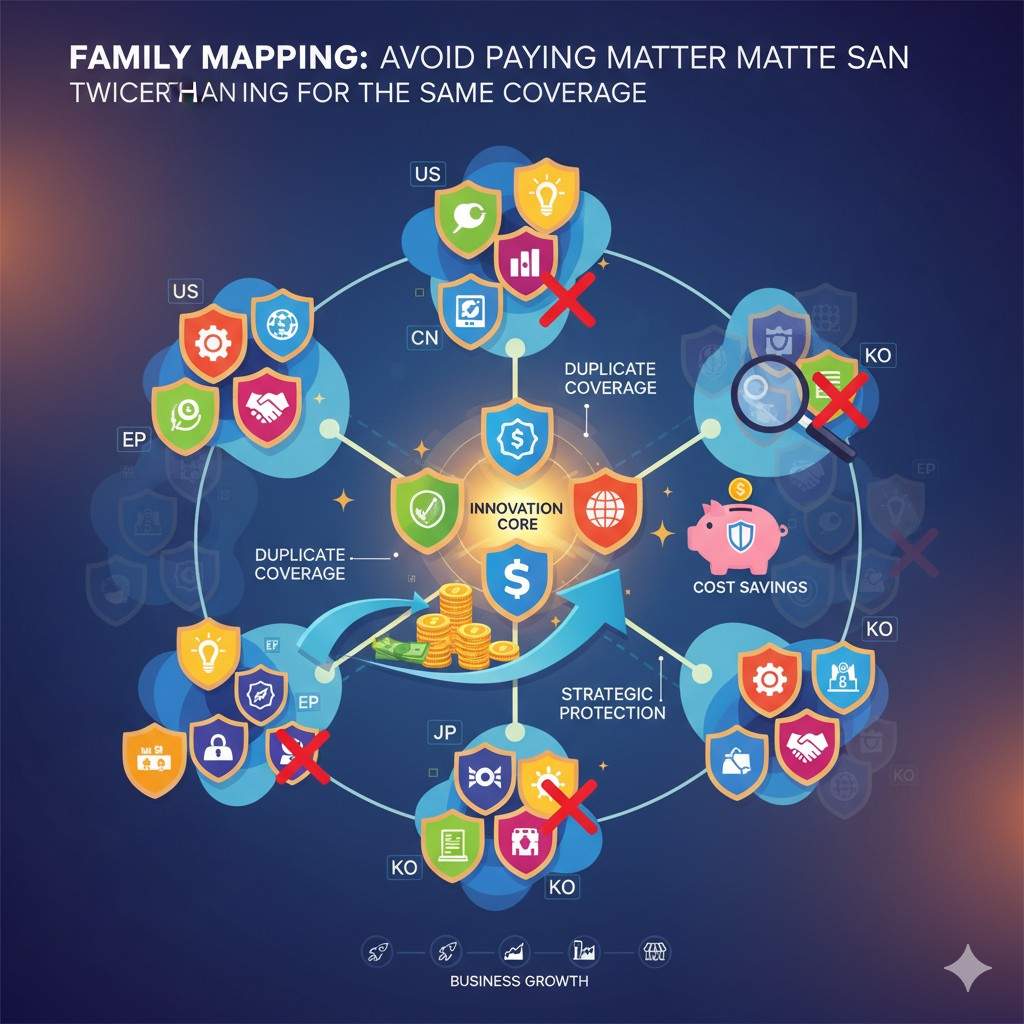
You can expand coverage or hold off based on facts instead of impulse. This keeps your global strategy tight, intentional, and financially sound.
How family mapping protects you when your invention evolves
One of the hardest parts of building a startup is that your invention never stays the same. A feature you once thought was minor becomes the heart of the product.
A side experiment becomes your strongest differentiator. A part of your model that seemed obvious suddenly becomes valuable when competitors start copying it. If your filings do not grow with your product, you lose leverage.
Family mapping gives you a structure to keep every new insight tied back to the core filing. When you discover a new feature or improvement, you can see instantly whether it fits within the existing family or whether you need a new branch.
This prevents overlap while giving you freedom to evolve without losing legal ground. It also keeps your attorney aligned with your roadmap, because they can see your invention’s growth in one place instead of digging through old files.
Simple steps founders can take even before talking to an attorney
You don’t need legal training to build the habit of thinking in patent families. You only need to treat your invention like a growing tree with one root. Every time you create something new, ask yourself where it sits in the story of the invention.
Think of what gave rise to it. Think of how it links to what you filed earlier. Think of whether the improvement changes the scope of protection or simply strengthens what you already claimed.
By making this a normal part of your process, you avoid the biggest risk: forgetting details that already exist somewhere in your notes or earlier drafts. You walk into every attorney meeting prepared, with a clear picture of how your idea has evolved.
This saves you time, reduces fees, and makes attorneys far more effective because they are working with a clean map instead of scattered clues.
How PowerPatent makes this process nearly foolproof
Most founders want this clarity but don’t have the time to create it manually. That is where the PowerPatent platform changes everything. It connects your documents, drafts, filings, updates, and technical work into a single, organized family tree.
You can trace coverage across countries in seconds. You can see exactly which features are protected where. You can avoid duplicate filings because the platform highlights overlaps before they turn into expensive mistakes.
And because real patent attorneys review your structure, you never rely on guesses or assumptions.
This combination of software and attorney oversight gives you a system that grows with your invention. It keeps your map clean even as your product changes.
And it gives you confidence to protect your work without slowing down your build cycle.
If you want to see how this works step by step, you can check out how the platform operates here: https://powerpatent.com/how-it-works
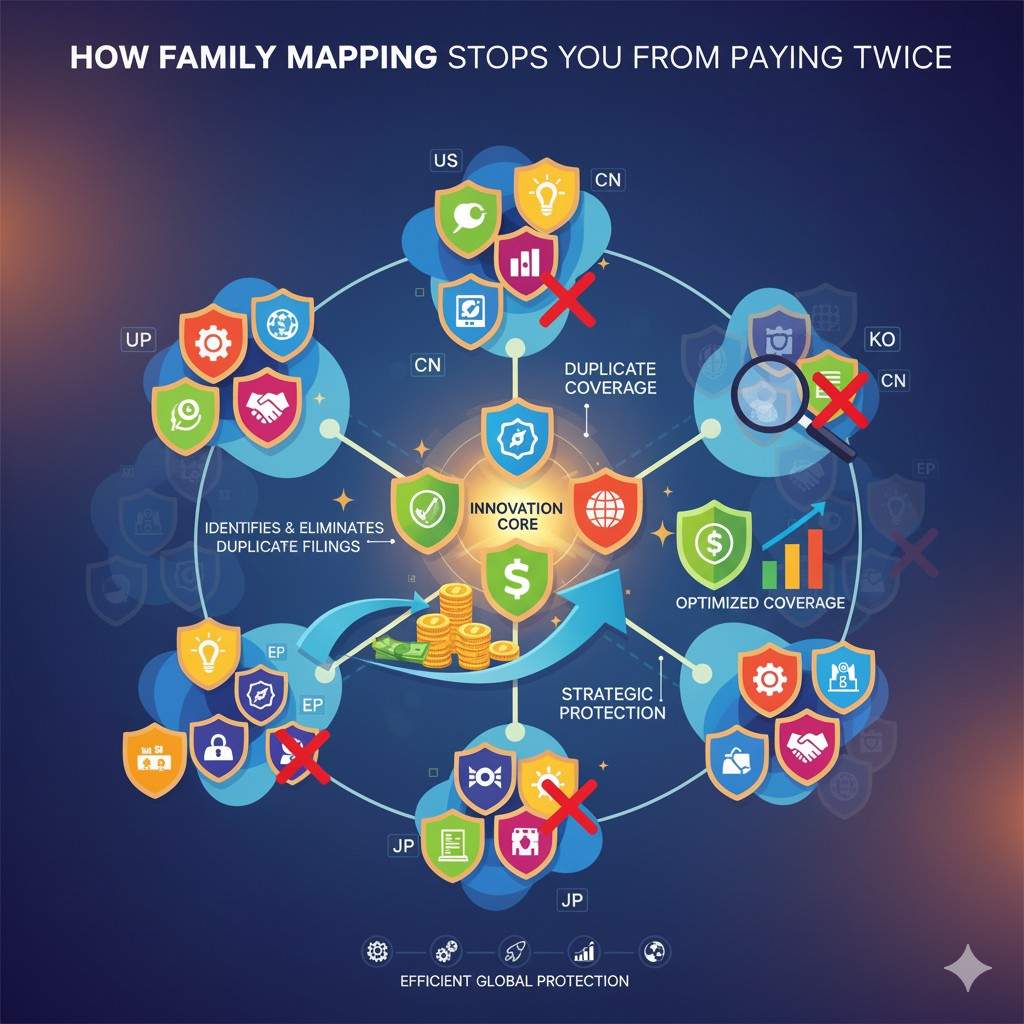
How Family Mapping Stops You From Paying Twice
Family mapping is one of those ideas that feels almost too simple when you first hear it, yet it quietly prevents some of the most expensive mistakes founders make in the patent world. The problem is never that founders are careless.
The real problem is that startups move quickly, build quickly, ship quickly, and update constantly.
When you are releasing new versions, rewriting code, adding new layers of intelligence, and discovering new use cases every few months, it becomes nearly impossible to remember what you filed, when you filed it, and how much ground your earlier filings already cover.
Without a clean family map, you’re walking into each new filing half-blind.
This is how double-paying happens. You might write up a new feature thinking it’s fresh territory, only to discover months later that the same feature was already written into your original provisional.
Or you may pay an attorney to draft a new application for an improvement, not realizing that the improvement fits comfortably inside an already pending non-provisional.
These small overlaps can cost thousands of dollars per year and multiply quickly as you expand internationally. Family mapping stops these leaks by giving you one connected picture of everything that grows from your original filing.
Seeing the parent application as the anchor of all protection
Every patent family starts with a parent. The parent is the first place you described your invention in detail. Most founders underestimate how powerful this parent can be.
If it is drafted well, it becomes a foundation that supports expansions for years. When you know what the parent covers, you understand what you do not need to file again.
You also see where you can safely add new branches without recreating the same coverage.
The parent acts as a timestamp too. It locks in your priority date, which is the legal moment your idea was first captured. When you map your family, you see how later filings carry that early timestamp forward.
That timestamp is gold because it lets you protect improvements without losing your early advantage.
When founders skip family mapping, this connection between parent and child filings is easy to lose track of. And when the connection is lost, you can end up refiling ideas that are already protected under the parent.
Understanding how small improvements can sit inside existing coverage
One of the biggest misconceptions around patents is that every improvement requires a new application. In many cases, improvements are simply natural progressions of the same root idea.
When you map your family properly, you can see how your improvements sit relative to the claims and disclosures you already made. This saves you from spinning up a brand-new filing for something already covered.
Founders often write improvement filings during fast product cycles. You may add automation to a workflow, add a sensor to a hardware system, improve accuracy in a model, or refine a control mechanism.
At the time, the improvement feels like a brand-new idea. But once you map the family, you sometimes realize the improvement fits perfectly inside the original description.
In that case, a new filing adds nothing and costs money for no real gain. Mapping shows you exactly when a new filing is necessary and when it is not.
Keeping timing aligned so you never pay unnecessary fees
Patent deadlines are strange because they don’t follow business logic. They follow legal rules. And those rules vary from one country to another. When you expand your protection internationally, you must hit each country’s deadline based on the date of your parent filing.
Without mapping, you lose sight of these dates. When you lose sight of dates, you often pay rush fees, late fees, or file brand-new applications to cover missed opportunities. These are avoidable costs, but only if you can visualize the family’s entire timeline.
Family mapping gives you a clean timeline that shows every branch, every country, and every priority date.
You always know which deadlines are coming up long before they do. You also know when a new filing is needed and when extending an existing one is enough.
This prevents you from creating duplicate applications just to stay safe. Instead, you act based on insight and calm planning.
Keeping your engineers and attorneys aligned so nothing gets duplicated
Duplicate filings often happen because founders, engineers, and attorneys are not always sharing the same picture. Your engineers know the product’s evolution. You know the business strategy. Your attorneys know the legal strategy.
When these pieces are not aligned, small overlaps slip through. An engineer might describe an improvement to the attorney without realizing it already sits in an earlier draft.
Or an attorney might suggest a new filing without knowing the full history of internal documents. When this happens, you pay twice for coverage you already had.
Family mapping solves this misalignment by giving everyone a shared frame of reference. With a mapped family, engineers can easily point to where their new work belongs in the structure. Attorneys can quickly scan what is already protected.
Founders can guide the strategy without guessing. Everyone is working with the same picture. And this unified picture eliminates the risk of duplicate filings caused by communication gaps.
Connecting your product roadmap directly to your patent roadmap
The fastest way to waste money in patents is to let your product roadmap and your patent roadmap drift apart.
When these paths separate, you start filing for things that no longer matter and missing things that suddenly do. Family mapping connects these paths again.
It shows how each new feature, improvement, or pivot fits into the story of your invention. You can see where the roadmap overlaps with existing filings and where it opens new protection opportunities.
This alignment is more than a legal benefit. It is a business advantage. When you map your family against your roadmap, you stop guessing which parts need protection.
You can time filings around releases. You can allocate budget based on what will move the business. And you can avoid filings that no longer match your direction, which is a common source of wasted spend.
How PowerPatent turns this into a simple, ongoing habit
Most founders do not have time to manually map patent families. The information lives in too many places: code repositories, pitch decks, provisional drafts, internal notes, email attachments, and earlier applications. Trying to connect these manually is slow and error-prone.
PowerPatent removes the friction. It automatically connects your filings, drafts, disclosures, and updates into a single family view. You can see what exists, what overlaps, and what gaps need attention.
The platform points out possible duplicate coverage before it becomes an expense. It shows you what part of your invention sits in which filing.
And with real attorneys reviewing everything behind the scenes, you get a system that combines intelligent software with human oversight.

This means you no longer worry about paying twice. You simply follow the map. And because the map stays updated as your invention grows, you always have a clean, trusted picture that protects you from costly mistakes.
You can see how this works in practice at https://powerpatent.com/how-it-works
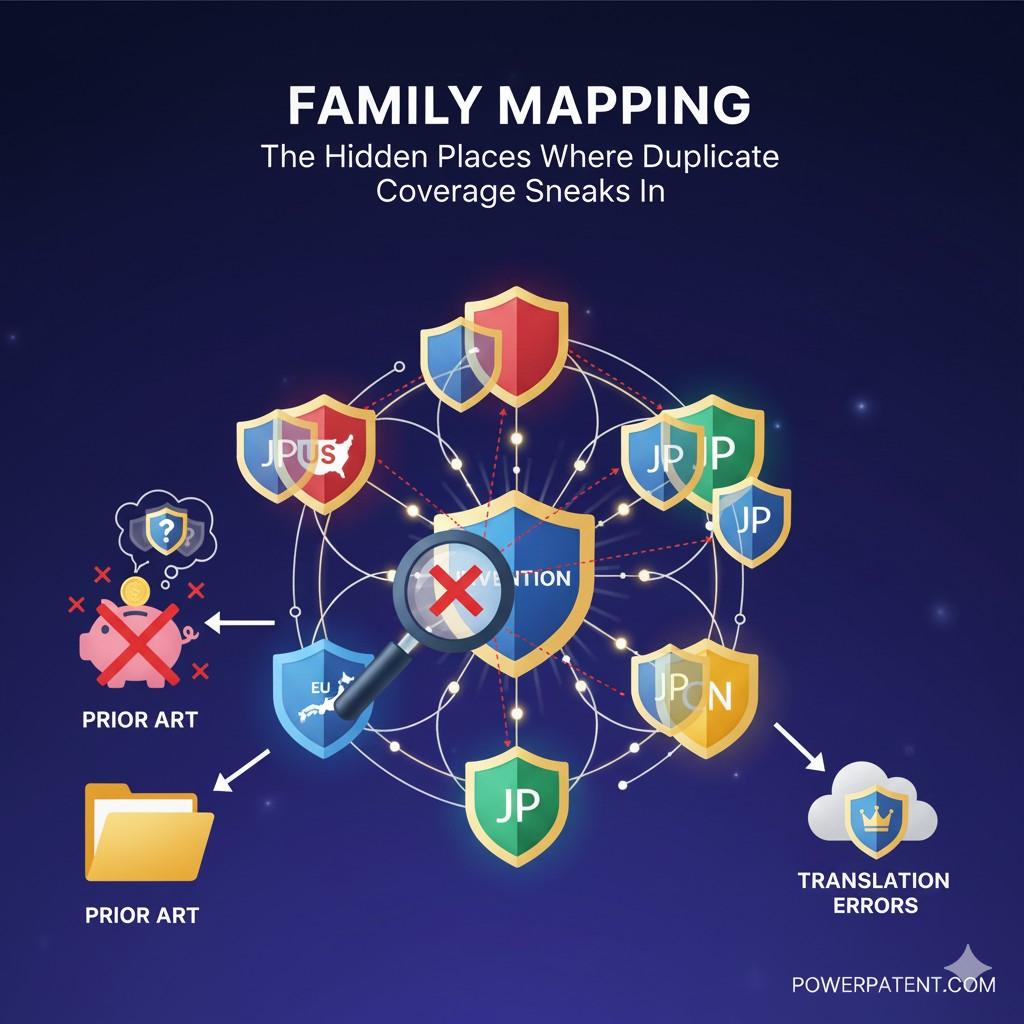
The Hidden Places Where Duplicate Coverage Sneaks In
Duplicate coverage rarely looks obvious when you are in the middle of building. It hides in the quiet corners of your workflow, tucked between rapid feature updates, product pivots, and the normal chaos of startup life.
Most founders do not realize they paid twice until long after the money is gone and the filings are locked in. By then, the damage has already happened.
What makes this even trickier is that duplicate coverage does not always come from carelessness. It usually comes from speed.
When your team moves quickly, information spreads unevenly, and that uneven spread creates blind spots. Family mapping exists to close those blind spots before they turn costly.
When early drafts contain more than you remember
Many founders assume duplicate filings happen because they wrote too little in their first draft. In reality, the more common issue is that early drafts contain more detail than you remember.
During the early days, you might have described a broad vision of your system, including features you had not even built yet.
Those early ideas often get buried inside provisional filings, design documents, or technical notes. Months later, when those ideas finally become real, they feel new.
You file again. You pay again. You believe you are protecting fresh ground. But when someone finally compares the two documents, they match almost word-for-word.

A mapped family prevents this because it lets you look backward before you move forward. You can quickly check whether the early version captured what today feels new.
When engineers ship something that was already protected
Engineers are always improving the product, sometimes without telling anyone until it is ready. You might not hear about a new algorithm, a new containerized process, or a way your system handles data differently until after it is pushed into production.
By then, the change becomes part of the core product narrative, and it sounds like something that needs fresh protection.
But many engineer-driven improvements are natural outgrowths of your earlier work, and that earlier work may already have coverage sitting quietly inside an existing application.
When your team uses a mapped family, engineers can attach their updates to the right branch with almost no effort.
This creates a shared understanding and prevents misunderstandings that would otherwise lead to duplicate filings.
When marketing or fundraising creates a slightly different version of your story
During fundraising or product launches, you often polish your messaging. You highlight certain features more prominently or frame your technology differently depending on your audience.
These polished versions sometimes drift from the technical language used in earlier filings. When you later turn these polished versions into new patent drafts, they can look different enough that you feel they need their own application.
But beneath the surface, they may be describing the same underlying system already protected elsewhere. Family mapping helps you compare language, structure, and underlying logic.
You quickly see whether a new story is truly new or just a new way of talking about old ideas.
When you explore new countries without realizing how much coverage you already have
International filings amplify the risk of paying twice. Each country has its own laws, deadlines, and forms, and the process feels new every time you enter a new region.
Because of this, founders assume they need fresh filings for each part of the world.
But in many cases, a single parent filing can support dozens of countries without the need for new applications. When founders skip family mapping, they often pay for full rewrites or new conversions that are not necessary.

With a proper family map, you can trace your parent filing into each region and see exactly what additional work is required. Most times, it is far less than expected.
When your roadmap shifts and your filings don’t shift with it
Startups pivot. Features change direction. Priorities move. When that happens, it is easy to forget what parts of your original filings still matter and which parts no longer serve your strategy.
If you don’t track changes against a family map, you may file for features that no longer exist or pay to expand protection for ideas you quietly dropped six months earlier.
The risk here is not just duplicate coverage but wasted protection. A mapped family lets you hold your filings up against your live roadmap.
When something falls out of your product’s future, you stop sinking money into protecting it. When something becomes more important, you know where to strengthen your coverage without redoing work.
When your attorney cannot see the full picture
Even great attorneys rely on the information they receive. If they don’t see your earlier drafts, old emails, updated architecture diagrams, or early prototypes, they cannot know when a new filing is covering old ground.
They work with what you give them. When information trickles in inconsistently, attorneys naturally err on the side of caution and create new filings to avoid missing anything.
That caution is well-intentioned, but it leads to redundant applications. A family map solves this because it gives your attorney a panoramic view of everything tied to your invention.
They can see the parent. They can see the children. They can see what has changed and what has stayed the same. This allows them to target new filings precisely where they add value instead of duplicating coverage.
How PowerPatent removes these hidden traps
This is where PowerPatent makes a real difference for founders who move quickly and do not have time to track every small piece of their invention’s evolution.
The platform gathers all drafts, updates, improvements, disclosures, provisional filings, non-provisionals, and international filings in one place. It organizes them into a family structure that is easy to understand even if you have never looked at a patent document before.
As you build, PowerPatent keeps the map in sync with your work. Every new update, every new idea, and every new release can be placed in the right location. The system shows where you already have coverage and where you still need it.
It highlights overlap before you spend money on it. And with real attorneys reviewing your map, you get accuracy without effort.
This kind of visibility removes surprises. It keeps your patent strategy clean, intentional, and aligned with your business.
And it helps you invest in protection that actually moves your company forward instead of protection that repeats what you already bought.
You can see how PowerPatent handles this process right here: https://powerpatent.com/how-it-works
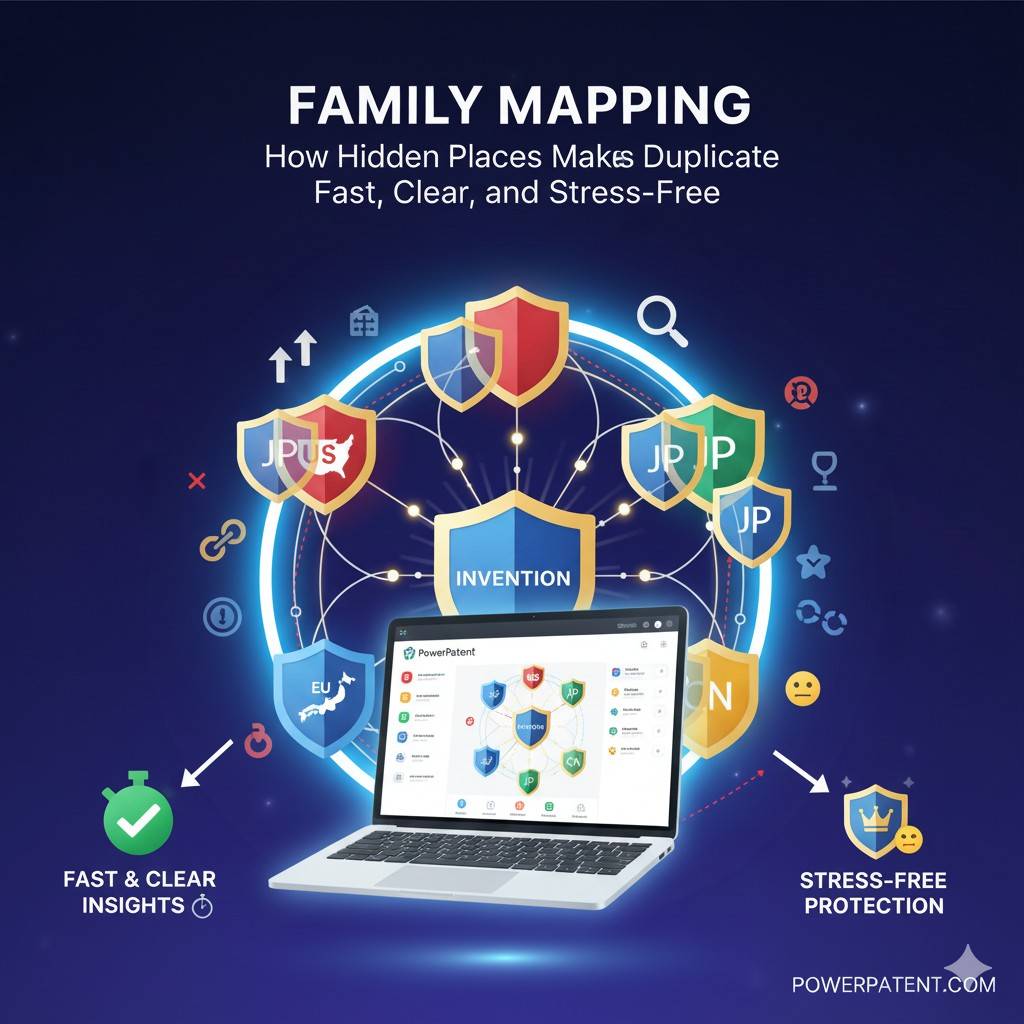
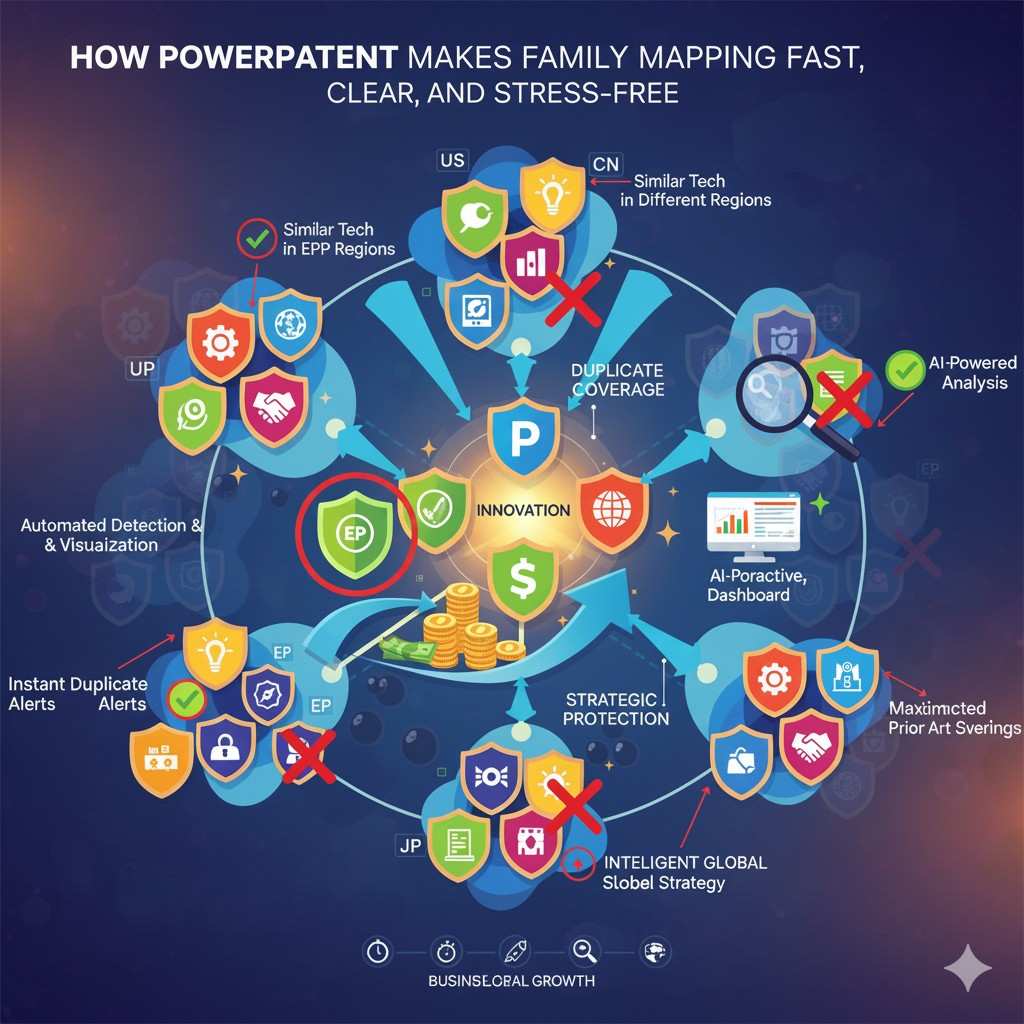
How PowerPatent Makes Family Mapping Fast, Clear, and Stress-Free
Family mapping becomes powerful only when it is easy to maintain. Most founders never create a map on their own because the work feels heavy, scattered, and uncertain.
The documents live in too many different places. The timelines shift as the product changes. The language inside early filings is often dense, making it hard to know what sits where.
Even when you try to track everything manually, you end up with a spreadsheet that becomes outdated the moment your team ships a new feature.
PowerPatent solves this by giving you a living system that does the heavy lifting automatically and keeps your protection aligned with your real product, not the version that existed months ago.
Bringing all your patent work under one roof
A startup’s invention story usually sits across many places. Some of it lives inside code repositories. Some of it sits in provisional drafts or internal notes. Some of it stays locked inside your head as you make strategic decisions on the fly.
PowerPatent pulls all of these pieces into a single, organized workspace. Instead of juggling documents, you see the entire picture in one place.
You can trace an idea from the first time you wrote it down to the international filings that protect it today.

This unified view is what makes family mapping finally feel manageable. It becomes less like detective work and more like simply looking at your reflection.
Showing you exactly what is covered and what is still open
One of the hardest parts of patent strategy is knowing where the gaps are. Most founders overprotect some areas and underprotect others. PowerPatent solves this by giving you a clear visual map.
You can see which features fall under your parent application, which ones are protected by child filings, and which ones need attention. This clarity removes the guesswork that normally leads to duplicate filings.
When you see overlap, you avoid spending money on it. When you see a gap, you address it before a competitor does.
And when you are preparing for fundraising or due diligence, you have a map that proves your protection is intentional, not accidental.
Keeping your deadlines tracked so nothing slips
Every country sets its own rules for when filings must be made and when decisions must happen. Missing even one deadline can force you into paying for work you didn’t need or filing a brand-new application just to keep the door open.
This is where PowerPatent’s automated timeline becomes invaluable. The system tracks every deadline across every branch of your family. It shows you what is coming up, what needs attention, and what can wait.
This prevents panic filings and last-minute rush work. Instead of acting out of fear, you act out of clarity. You know exactly how much time you have to make decisions, which means you can invest your energy in your product rather than paperwork.
Helping your attorney focus on strategy instead of cleanup
Attorneys do their best work when they have a clean, organized view of the invention. When they can see the full family, they focus on strategy instead of reconstruction.
PowerPatent gives them this clarity from day one. They can spot overlap instantly. They can see where an improvement belongs. They can guide you on when to branch out and when to rely on the parent.
This makes your legal spend far more efficient. Instead of paying for redundant drafting or repeated research, you pay for actual strategic thinking.
And because your attorney is working with up-to-date information, they make decisions that fit your current product, not the outdated version they saw months earlier.
Adapting automatically as your product evolves
Your invention changes fast, but traditional patent workflows do not. Most systems assume your product stays still, which is never true for a startup. PowerPatent was built for movement.
As your team ships updates, explores new uses, adds intelligence, or rewrites core components, the platform adapts the family map automatically. You can attach new ideas to the right branch with almost no effort.
You always know where your latest work fits in the bigger picture. This keeps your protection aligned with reality and prevents the silent drift that leads to duplicate coverage.
Turning family mapping into a simple habit instead of a painful chore
When mapping becomes easy, it becomes natural. You stop thinking of it as a legal exercise and start using it as a planning tool. You check your map the same way you check analytics or product dashboards. It becomes part of your workflow, not an interruption to it.
The map gives you a calm sense of control. You know what is protected, what needs to be protected next, and what you can safely ignore. This shapes your decisions with confidence and keeps your strategy focused on what actually moves your business forward.
Giving founders the power to make smart, fast decisions
Speed matters. Clarity matters. Confidence matters. PowerPatent gives founders all three. With a living, accurate map of your entire patent family, you stop paying twice for the same coverage.
You stop filing out of fear of missing something. You stop wasting time searching for old drafts or trying to remember what you filed last year. Instead, you make smart decisions at the exact moment you need to.
You protect what matters, skip what doesn’t, and grow your patent family in a logical, cost-effective way.
You can see exactly how PowerPatent does this if you want a closer look at the workflow and the tools that power it: https://powerpatent.com/how-it-works
Wrapping It Up
Family mapping is not just a legal exercise. It is a way of keeping your invention’s entire story clean, connected, and easy to understand as you grow. When you can see how every feature, improvement, and new idea ties back to your earliest filing, you make smarter decisions. You avoid surprises. You avoid wasted spend. And you avoid the quiet, hidden problem that drains so many startup budgets without anyone noticing: paying twice for protection you already have.