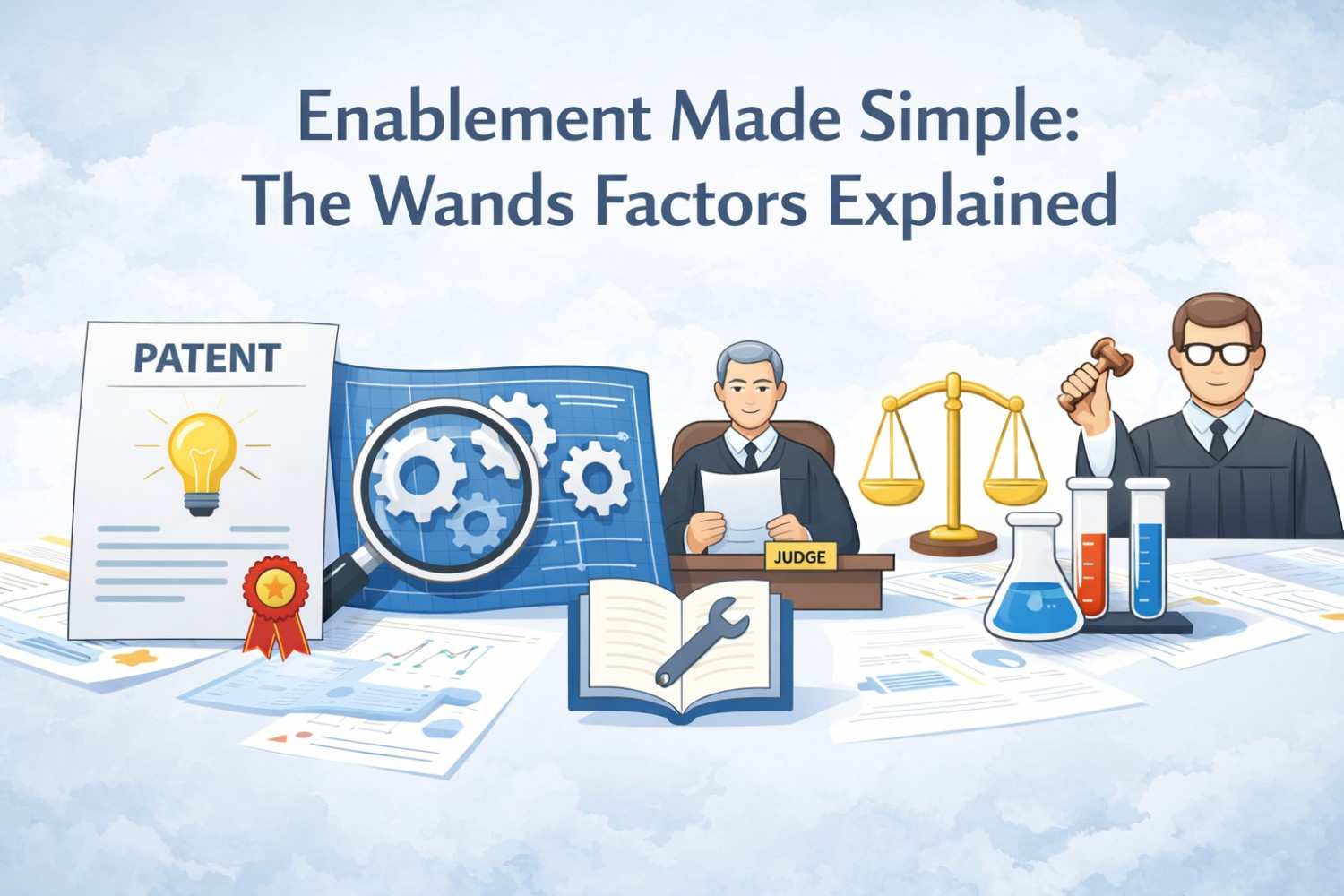
Most patents fail for one quiet reason. Not because the idea was bad. Not because someone else invented it first. They fail because the patent did not teach enough. That single idea is called enablement. Enablement is the rule that says your patent must explain your invention so clearly that a normal engineer could rebuild it without guessing. If you miss this, your patent can look strong on the outside and still fall apart the moment it matters. Courts use something called the Wands Factors to decide whether a patent meets this rule. The name sounds complex. The idea is not.
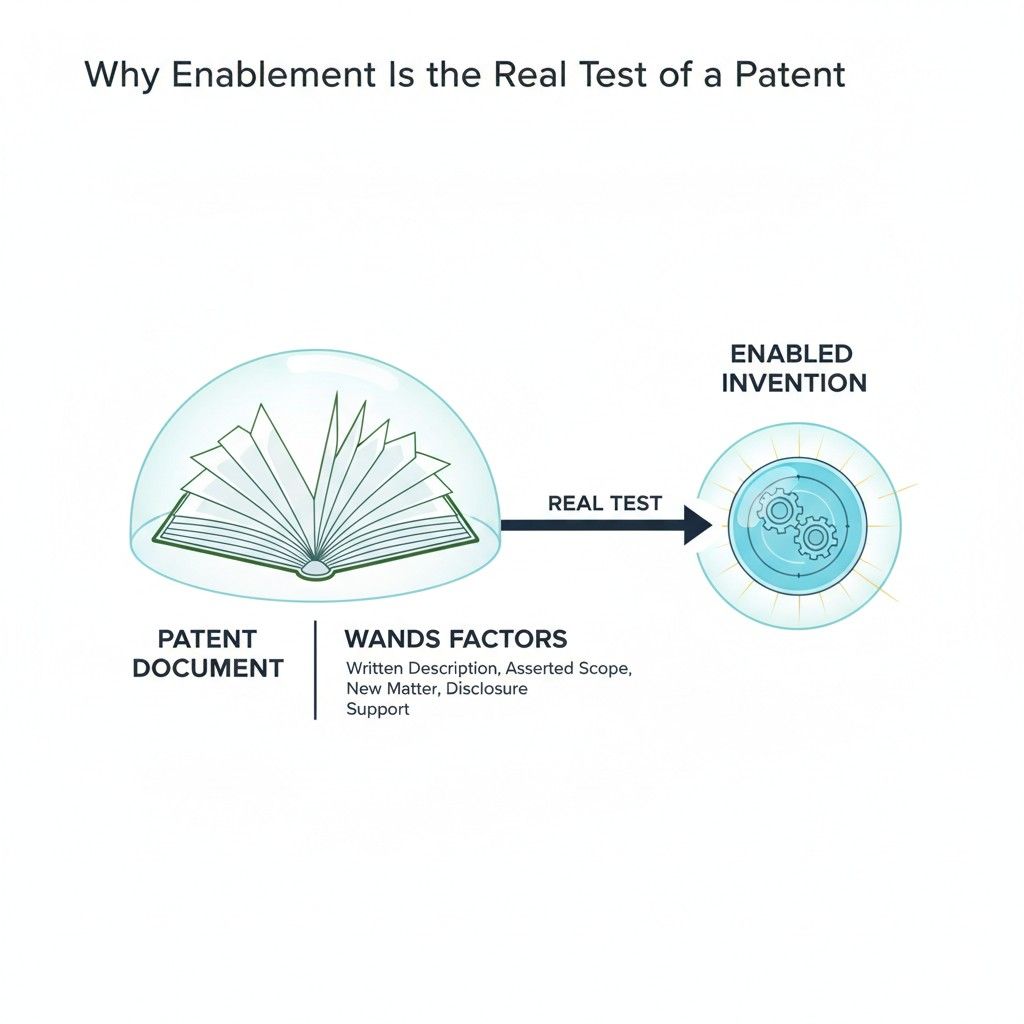
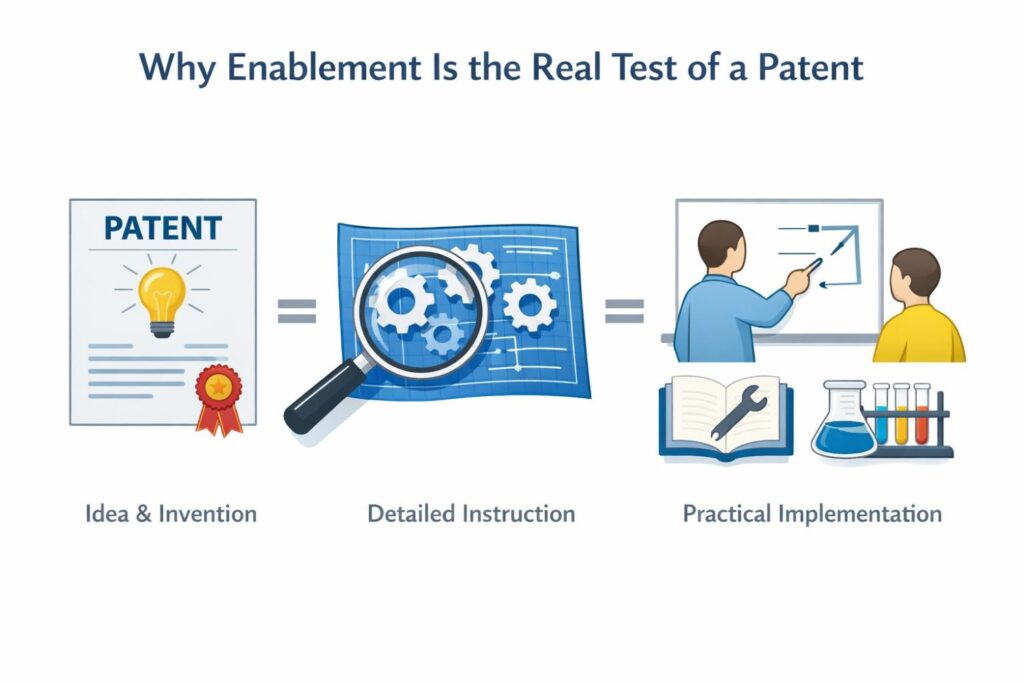
Why Enablement Is the Real Test of a Patent
Enablement is not a side rule. It is the core test that decides whether a patent actually protects anything at all. Many founders think patents are about claiming an idea first.
Courts think patents are about teaching others how to build that idea in the real world. This gap is where most patents quietly fail.
Enablement exists to keep the patent system fair. You get a time-limited monopoly, but only if you give the public real knowledge in return. That trade is not emotional or theoretical. It is practical.
If your patent does not explain the how, not just the what, it can be ruled invalid even years later when it finally matters.
For businesses, this makes enablement a strategic issue, not a legal detail. A patent that is not enabled is a false sense of safety. It looks strong in a pitch deck but collapses under pressure.
The difference between an idea and an enabled invention
Most startups are built on ideas that feel obvious once you hear them. That does not mean they are easy to build. Enablement lives in that gap.
An idea is saying a system can predict user behavior. Enablement is explaining how the data is collected, how it is cleaned, how the model is trained, and how outputs are used.
Courts do not protect inspiration. They protect execution that is clearly explained.
If your patent stops at the idea level, it invites others to fill in the blanks. If your patent teaches the execution, it blocks them.
Why courts care more than investors do
Investors often care that a patent exists. Courts care whether it works.
This is why many patents pass early reviews and still fail in litigation. Enablement is rarely tested until enforcement. By then, the cost of fixing it is massive or impossible.
Businesses that treat enablement as a first step, not an afterthought, avoid this trap. They write patents assuming someone hostile will try to rebuild the invention using only the patent. That mindset changes everything.
Enablement as a business risk, not a legal one
A weak patent is not neutral. It is risky.
If a competitor challenges your patent and wins on enablement, the patent is gone. Not narrowed. Not weakened. Gone. That can affect valuation, partnerships, and acquisition talks overnight.
Enablement failure also weakens your position before a dispute even starts. Strong patents discourage copying. Weak ones invite it.
This is why enablement should be owned by the business, not outsourced blindly. Founders understand the real system better than anyone. That knowledge must show up in the patent.
How enablement protects against fast followers
In fast-moving markets, speed is everything. Teams copy what works. Enablement is how you slow them down.
When a patent clearly explains the working parts, it becomes harder for competitors to claim they independently invented the same thing.
The more detailed and grounded your disclosure is, the narrower their escape routes become.
This does not mean giving away secrets recklessly. It means choosing the right level of detail so that the invention is reproducible, but still protected.
The hidden cost of vague patents
Vague patents feel safe at first. They seem broad. They sound impressive. They are also fragile.
Courts see vague language as a sign that the inventor did not fully understand or fully explain the invention at the time of filing. That is deadly for enablement.
Every unclear step creates room for attack. Every skipped explanation raises the question of undue effort. Over time, these gaps add up.
Strong patents are not the ones that say the most. They are the ones that explain the most important parts clearly.
Enablement starts long before writing begins
Enablement is not something you add at the end. It starts when you decide what to protect.
Founders should ask simple questions early. Could another engineer rebuild this from scratch using only words and diagrams? Are the hard parts explained, or just implied? Are we relying on common sense, or actual steps?
Answering these questions while the product is still fresh in your mind leads to stronger filings and fewer regrets later.
Why software and AI patents fail enablement more often
Software moves fast. AI moves faster. Many patents fail because they describe goals, not methods.
Saying a model improves accuracy is not enough. Courts want to know how. What data. What training flow. What system structure. What decisions are made and when.
This does not require math-heavy detail. It requires clarity. Plain language explanations often work better than complex ones.
Teams that document their systems as they build them often have the easiest time meeting enablement later.
Enablement as leverage in negotiations
Strong enablement changes how others treat your company.
Partners take you more seriously. Acquirers trust your IP. Competitors hesitate before pushing boundaries. This leverage comes from credibility.
When a patent reads like it was written by someone who actually built the system, it carries weight. When it reads like a concept paper, it does not.
How PowerPatent builds enablement into the process
Enablement should not depend on guessing what a lawyer wants. It should flow naturally from how founders already think.
PowerPatent is built to capture how things really work, using smart software guided by real patent attorneys who know where courts draw the line. This makes it easier to explain the invention fully without drowning in legal noise.
The goal is simple. Turn real product knowledge into real protection, fast. You can see how that process works here: https://powerpatent.com/how-it-works
The mindset shift that changes everything
The biggest change is mental.
Do not think of your patent as a shield made of words. Think of it as a manual that proves you were first and knew what you were doing. Enablement is that proof.

When founders adopt this mindset, their patents stop being fragile promises and start becoming real business assets.
What the Wands Factors Actually Measure
The Wands Factors are often described as a test, but that framing misses the point. They are really a lens.
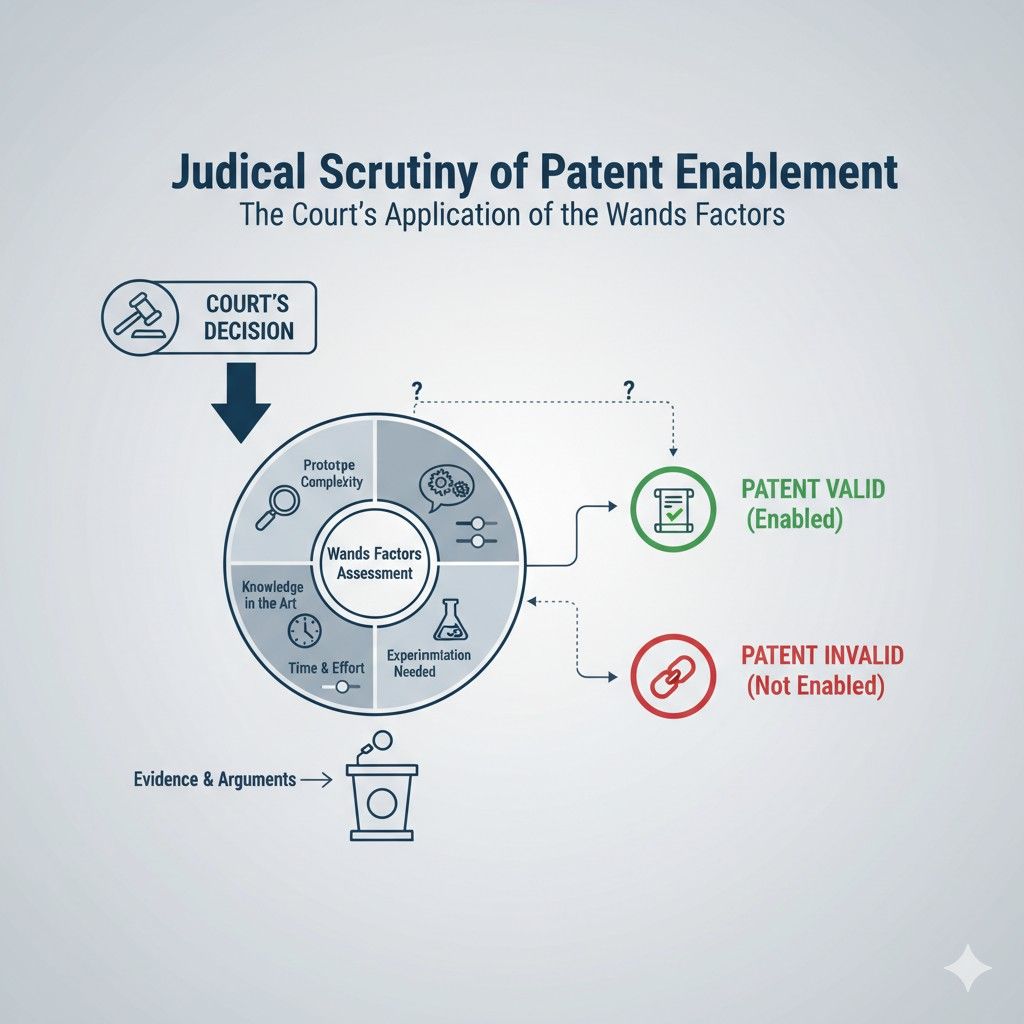
Courts use them to look at your patent and decide whether it truly teaches someone how to make and use the invention without unfair struggle.
The name comes from an old court case, but the thinking behind it is very current. The factors are not boxes to check. They are signals. Together, they show whether your patent gives real guidance or just high-level ambition.
For businesses, understanding what these factors measure helps you make smarter choices when you document and protect what you are building. You do not need to memorize them. You need to understand the behavior they reward.
The real question behind every Wands analysis
Every enablement fight comes down to one core question. Would a skilled person need to experiment too much to make this work?
Courts are not allergic to experimentation. Some testing is normal. What they look for is undue effort. That is effort caused by missing explanations, unclear steps, or hand-waving around the hard parts.
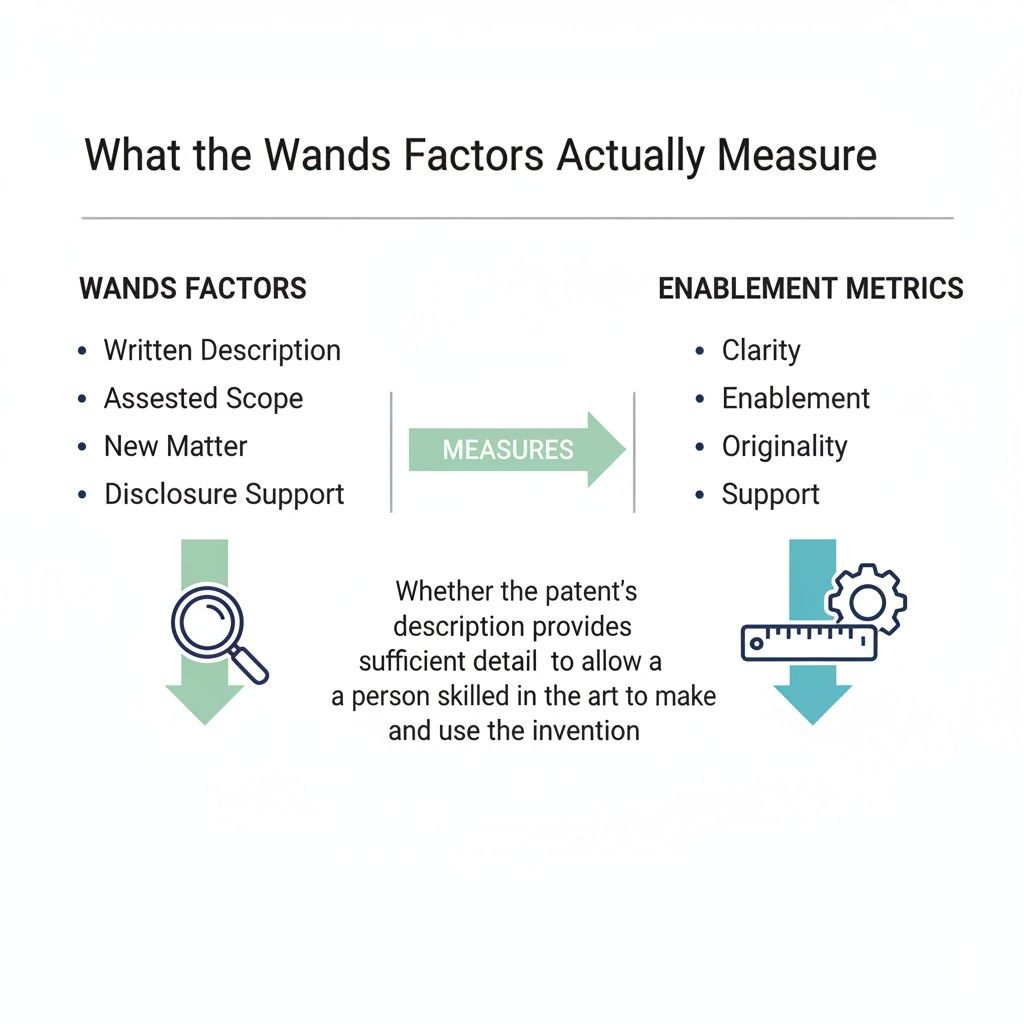
The Wands Factors exist to decide whether the patent caused that extra burden.
How much guidance your patent actually gives
One major signal courts look for is how much practical direction the patent provides.
This is not about length. A long patent can still be empty. A shorter one can be very enabled. What matters is whether the reader is walked through the invention in a grounded way.
Businesses should focus on explaining decisions. Why certain components are used. Why steps happen in a certain order. These explanations reduce guesswork and strengthen enablement.
The role of prior knowledge in your field
Courts do not assume the reader knows nothing. They assume a skilled person in the field is reading.
But this cuts both ways. If something is truly standard, you do not need to overexplain it. If something is new or uncommon, you cannot gloss over it.
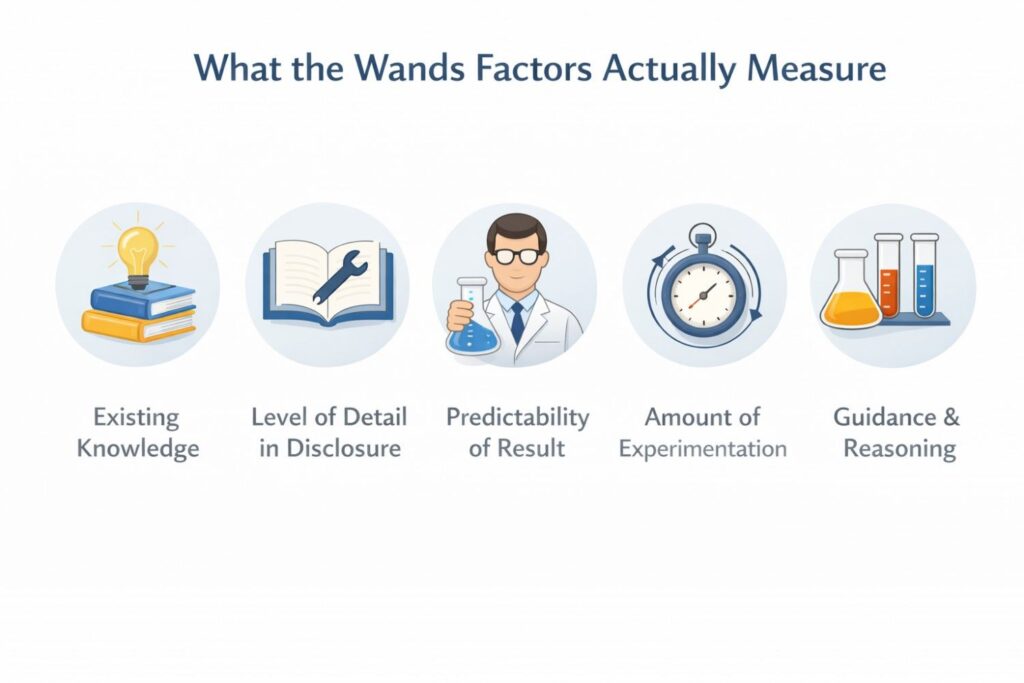
The Wands Factors measure whether your patent correctly balances this. Overreliance on assumed knowledge is one of the fastest ways to fail enablement, especially in fast-changing fields like software and AI.
Why the complexity of your invention matters
Simple inventions need less explanation. Complex systems need more.
Courts adjust their expectations based on how hard the invention is. A distributed system with multiple modules, data flows, and decision logic requires deeper teaching than a simple mechanical improvement.
For founders, this means you should not fear complexity. You should acknowledge it. Explaining complexity clearly is a strength, not a weakness.
How predictable your technology really is
Some fields behave in predictable ways. Others do not.
If small changes can cause big differences in results, courts expect more detail. This is especially true for areas like machine learning, chemical processes, and advanced hardware.
The Wands Factors measure whether your patent respects this reality. If outcomes are sensitive, you need to explain how to manage that sensitivity.
The number of working examples you provide
Examples are powerful because they show reality, not theory.
Courts look at whether your patent includes concrete implementations or just abstract descriptions. One well-chosen example can do more than pages of general talk.
For businesses, this is an opportunity. Real product examples, simplified and generalized, often map perfectly into strong patent disclosures.
The scope of what you are claiming
Broad claims demand stronger enablement.
If you claim a wide range of uses or configurations, your patent must teach how those variations work. If it only explains one narrow case, the mismatch becomes a problem.
This is where many startups get burned. They claim big but teach small. Courts notice.
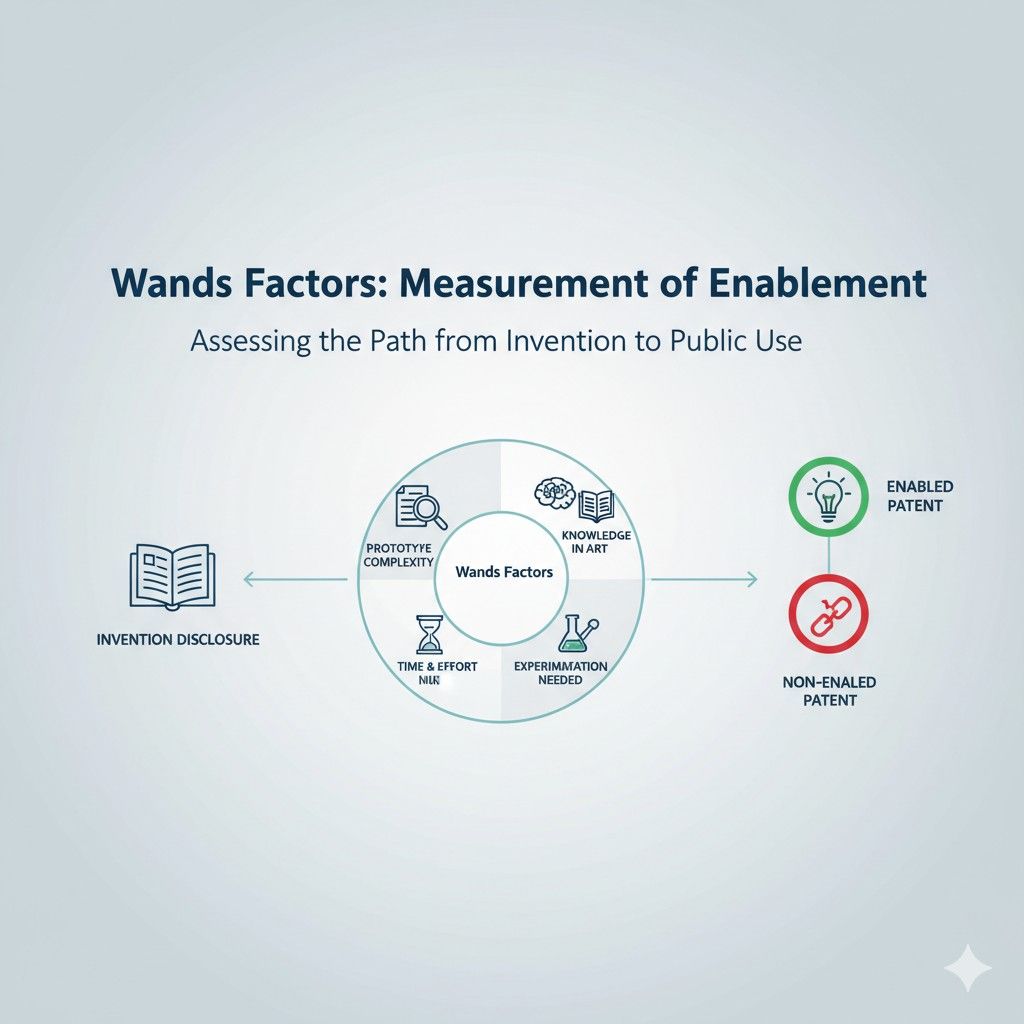
Strategically, it is often smarter to align claim scope with what you can confidently explain.
How much experimentation is still required
Some experimentation is expected. Endless trial and error is not.
Courts look at whether the patent leaves the reader with a clear path or a maze. If critical parameters are missing, or success depends on luck, enablement is weak.
Founders should aim to eliminate mystery. If something took you months to figure out, that learning likely belongs in the patent.
Timing matters more than people think
Enablement is judged at the time of filing, not years later.
You cannot rely on future advances to fill gaps. The patent must stand on its own based on what was known when you filed.
This is why capturing details early is so important. Waiting until things feel polished often means losing critical context.
What the Wands Factors reward in practice
Taken together, the Wands Factors reward honesty and clarity.
They favor patents written by people who actually built the invention. They punish patents written to sound impressive without teaching substance.
For businesses, this means the best patent strategy often mirrors the best product documentation strategy. Clear thinking leads to clear protection.
Turning measurement into action
You do not need to cite the Wands Factors in your patent. You need to internalize what they measure.
Explain the hard parts. Respect the reader’s intelligence, but do not assume magic. Align what you claim with what you teach. Capture real examples from real builds.
This is exactly the kind of thinking PowerPatent is designed to support, blending structured guidance with attorney insight so enablement is built in, not bolted on.

You can explore how that works here: https://powerpatent.com/how-it-works
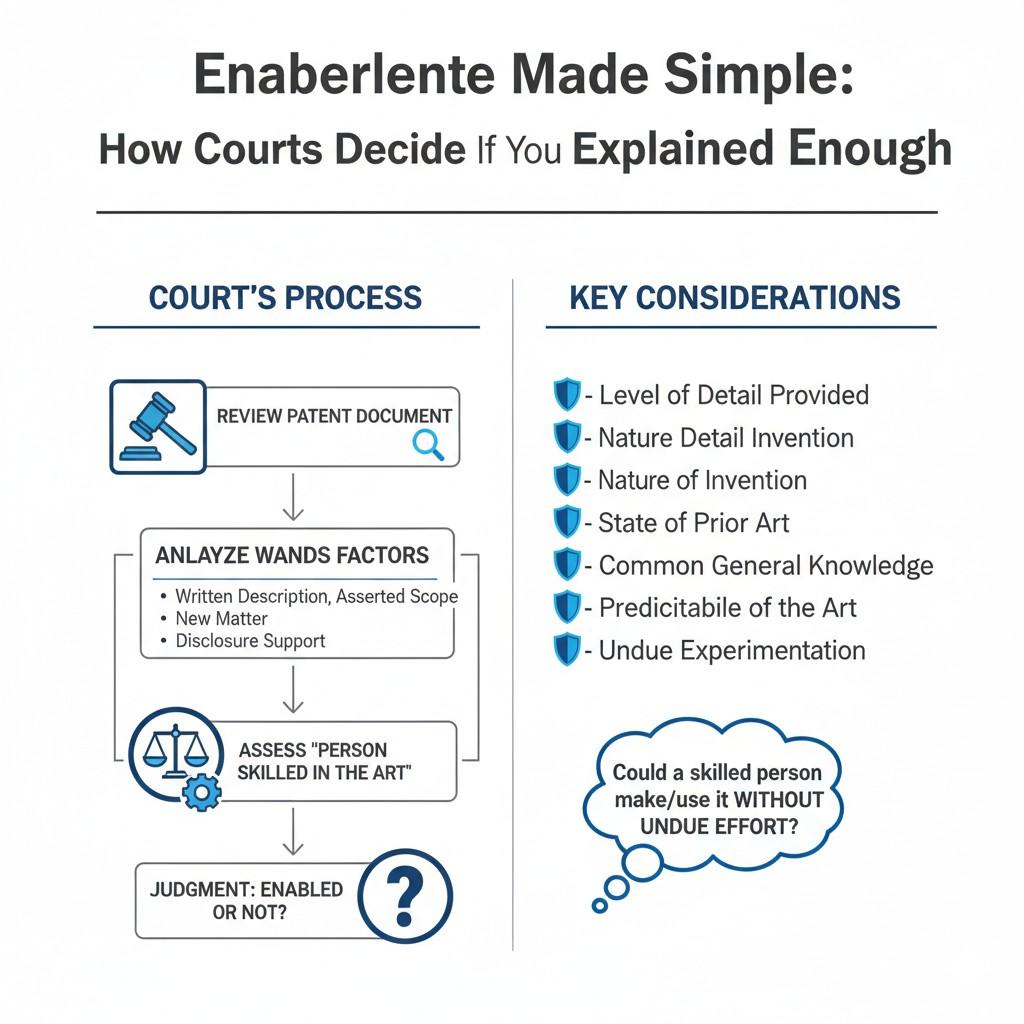
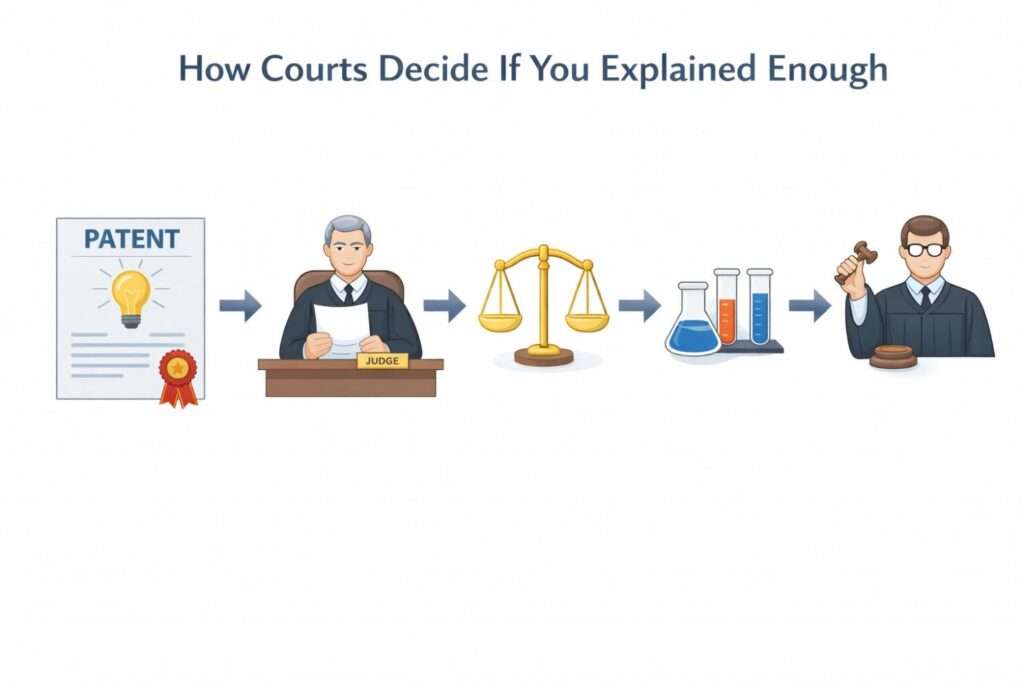
How Courts Decide If You Explained Enough
Courts do not read patents the way founders or investors do. They are not impressed by vision. They are not persuaded by big promises. They read patents like instruction manuals written under oath.
Their job is to decide whether the inventor truly gave the public usable knowledge in exchange for exclusive rights.
This section matters because this is where theory turns into consequence. Many patents look fine until a judge applies real pressure. Understanding how courts think helps businesses avoid invisible failure points long before a dispute ever happens.
Courts assume a skeptical reader
When a court reviews enablement, it assumes the reader is skeptical but skilled. This reader is not trying to make the invention fail, but they are also not filling in gaps out of kindness.
The court asks whether the patent stands on its own. If a step is missing, the court does not guess. If a choice is unclear, the court does not assume the best interpretation.
This is why clarity beats cleverness every time. Simple explanations survive scrutiny better than fancy language.
Enablement is tested when stakes are high
Enablement is rarely challenged early. It usually comes up when money, market share, or survival is on the line.
This timing matters. By the time enablement is tested, your patent is no longer just a document. It is evidence. Every vague sentence becomes a weakness that opposing experts can attack.
Businesses that write patents assuming no one will ever read them closely are gambling with future leverage.
Courts reconstruct the invention from the patent alone
One of the most important ideas to understand is that courts isolate the patent.
They do not look at your product. They do not review your GitHub. They do not consider what your team knows internally. They ask whether the patent itself teaches enough.
If critical logic lives only in code or in someone’s head, it does not count. The patent must carry that knowledge forward on its own.
This is why internal documentation and patent drafting should not be separate worlds. What matters internally often matters legally.
The role of expert witnesses
Enablement cases often involve experts from both sides. Each expert explains how a skilled person would read the patent.
Courts listen closely to whether experts describe a smooth path to building the invention or a painful one full of trial and error.
Patents that explain reasoning, not just steps, give friendly experts more ground to stand on. Patents that skip reasoning give opposing experts room to claim undue effort.
Why courts dislike result-based language
One common enablement failure is describing results instead of mechanisms.
Saying a system improves performance, increases accuracy, or reduces latency does not explain how it does so. Courts are wary of this language because it hides complexity behind outcomes.
They want to see cause and effect. What inputs change. What processing happens. What outputs result.
For businesses, this means translating success metrics into system behavior inside the patent.
How courts treat broad claims under pressure
Broad claims attract attention. When challenged, courts test whether the full scope of those claims is enabled.
If a patent claims many variations but only explains one, courts often rule that the unexplained portions are not enabled.
This does not mean broad claims are bad. It means broad claims require broad teaching. Businesses should align ambition with explanation.
The danger of assuming common sense
Many founders assume certain steps are obvious. Courts are cautious with that assumption.
What feels obvious today may not have been obvious at filing. What feels obvious to one team may not be obvious to the field as a whole.
Courts look for evidence in the patent itself that something was truly standard practice. If that evidence is missing, the assumption can fail.
How timing shapes the court’s view
Enablement is locked in at filing. Courts do not allow later improvements to fill gaps.
If your patent relies on techniques that were not well understood at the time, courts expect you to explain them more deeply.
This is especially important in emerging fields. Early movers must teach more, not less.
Why diagrams and flow explanations matter
Courts do not just read text. They look at structure.
Clear flow explanations, system diagrams, and step-by-step narratives help courts understand how the invention operates as a whole.
These elements reduce ambiguity. They also make it harder for opponents to argue that the invention cannot be reproduced.
The quiet power of consistency
Courts pay attention to internal consistency.
If one section describes a process one way and another section describes it differently, credibility suffers. If terms are used loosely, confusion grows.
Consistency signals that the inventor had a firm grasp of the invention. Inconsistency signals guesswork.
What courts reward without saying so
Courts rarely praise patents explicitly. But patterns are clear.
They uphold patents that read like they were written by builders. They invalidate patents that read like they were written to sound impressive.
They reward honesty about constraints. They reward explanations of tradeoffs. They reward teaching over claiming.
Turning court logic into drafting strategy
Businesses that understand court logic draft differently.
They capture decisions while building. They explain why systems are structured a certain way. They avoid magical thinking in writing.
This is not about writing more. It is about writing what matters.

PowerPatent is designed around this reality. The platform helps founders surface the right details at the right time, with attorney oversight to ensure courts will see what they need to see. You can explore how that works here: https://powerpatent.com/how-it-works
Wrapping It Up
Enablement is not a technical hurdle you clear once and forget. It is the standard that decides whether your patent will stand when it is finally tested. The Wands Factors are simply the tool courts use to measure whether you lived up to that standard. For businesses, the takeaway is clear. A patent is only as strong as its ability to teach. If it cannot guide a skilled person to rebuild what you made without heavy guessing, it is not real protection. It is paperwork. The strongest patents come from founders who treat enablement as part of building, not part of filing. They document decisions as they make them. They explain the hard parts while they are still fresh. They respect the reader and do not hide behind big words or vague outcomes.