Every founder faces the same moment. You’re building fast, your product is shaping up, and then you spot a competitor inching into your space. Maybe they just launched a feature that looks a little too close to yours. Maybe they filed a patent. Maybe they raised a round and started talking loudly in the press. Whatever it is, something inside you tightens. You pause. You wonder if you should shift course, fight harder, or quietly walk away from a part of your vision.
Seeing the Truth Behind Competitor Moves
Many founders react to competitors the same way they react to sudden weather. A headline blows in, a feature drops, a press release hits, and it feels like a storm you didn’t plan for.
But most competitor activity is not as dramatic as it looks on the surface. The real signal sits underneath.
When you learn how to read that deeper layer, you stop being tossed around and start using their movement to sharpen your own path.
Looking Past the Noise to Find the Real Intent
A competitor’s move often says more about their pressure points than their strengths. When another company suddenly adds a feature that overlaps with yours, it may look like they are sprinting ahead, but sometimes it’s a patch, not a plan.
Sometimes it shows they feel a gap in their product and are plugging holes to impress investors or calm customers.
If you can pause long enough to understand the pressure they are under, you gain an advantage they can’t see.
The easiest way to do this is by tracking how fast they move and how their messaging shifts.
Slow, heavy changes usually point to internal confusion or an attempt to look innovative without actually moving the core product. Quick, repeated updates can point to early traction or new funding they are trying to justify.

Neither scenario is automatically good or bad. What matters is how you interpret it.
When you understand the why behind their actions, you can decide whether the move threatens your direction or simply fills space in their roadmap.
Reading Between the Lines When Competitors File Patents
A patent filing tells a story, and if you read it carefully, you can learn what your competitor values most. Some patents signal genuine innovation. Others signal fear. Many are filed to slow others down, not to create defensible breakthroughs.
When you see a competitor file something close to what you are building, the instinct might be panic. But a more strategic view is to study what the filing actually protects.
Often the claims are narrow, covering only a small slice of the idea. Sometimes the language shows their technical route is different from yours, which means both of you can operate without stepping on each other.
This is the moment where having your own solid patent strategy becomes a superpower. When you have clear protection around your core tech, you can watch competitor filings with calm clarity instead of reactive fear.
You can decide whether to reinforce your own filings, accelerate parts of your roadmap, or ignore the move altogether.
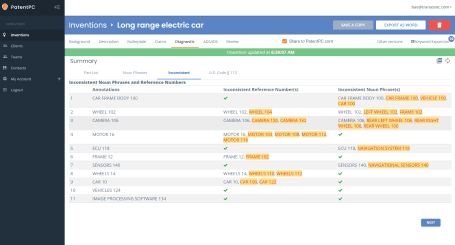
PowerPatent makes this part simple by turning complex claims into clear summaries and helping you see exactly where you stand.

If you want to understand how the process works in practice, the walk-through at https://powerpatent.com/how-it-works shows it in plain, simple steps.
Using Competitor Patterns to Predict Their Next Moves
Competitors rarely make random choices. Their actions follow patterns tied to funding cycles, customer churn, leadership changes, or market pressure. When you can identify these patterns, you gain the ability to predict what they will do next.
For example, if a competitor with weak revenue suddenly announces a major pivot, it likely means they are fighting for survival, not racing ahead.
If a well-funded rival quietly adds a small but technical feature without promoting it, they may be testing the market before going big.
Mapping these patterns helps you avoid overreacting and lets you plan with control. It also helps you identify openings.
When competitors stretch themselves thin, you can occupy the space they leave behind. When they slow down, you can accelerate.
When they charge into a noisy feature war, you can shift focus to deeper value that takes longer to copy. These insights only come if you train yourself to study patterns instead of moments.
Making Competitive Watch a Daily Pulse Instead of a Panic Trigger
Competitive monitoring works best when it’s woven lightly into your routine, not done in frantic bursts.
A simple daily or weekly pulse keeps you informed without pulling you out of your product work. When you check in regularly, you catch real signals early. You also avoid the emotional spikes that come from sudden surprises.
Over time, this rhythm gives you a calm foundation to make smarter decisions about whether to drop a direction, narrow your focus, or double-down with confidence.
Clear competitive insight becomes even more valuable when you are planning your intellectual property. It helps you see which parts of your tech give you real differentiation and which parts are safe to let go.

If you want a simple way to turn this clarity into strong patent protection, the flow at https://powerpatent.com/how-it-works shows the exact steps founders use to protect their edge while staying fast.
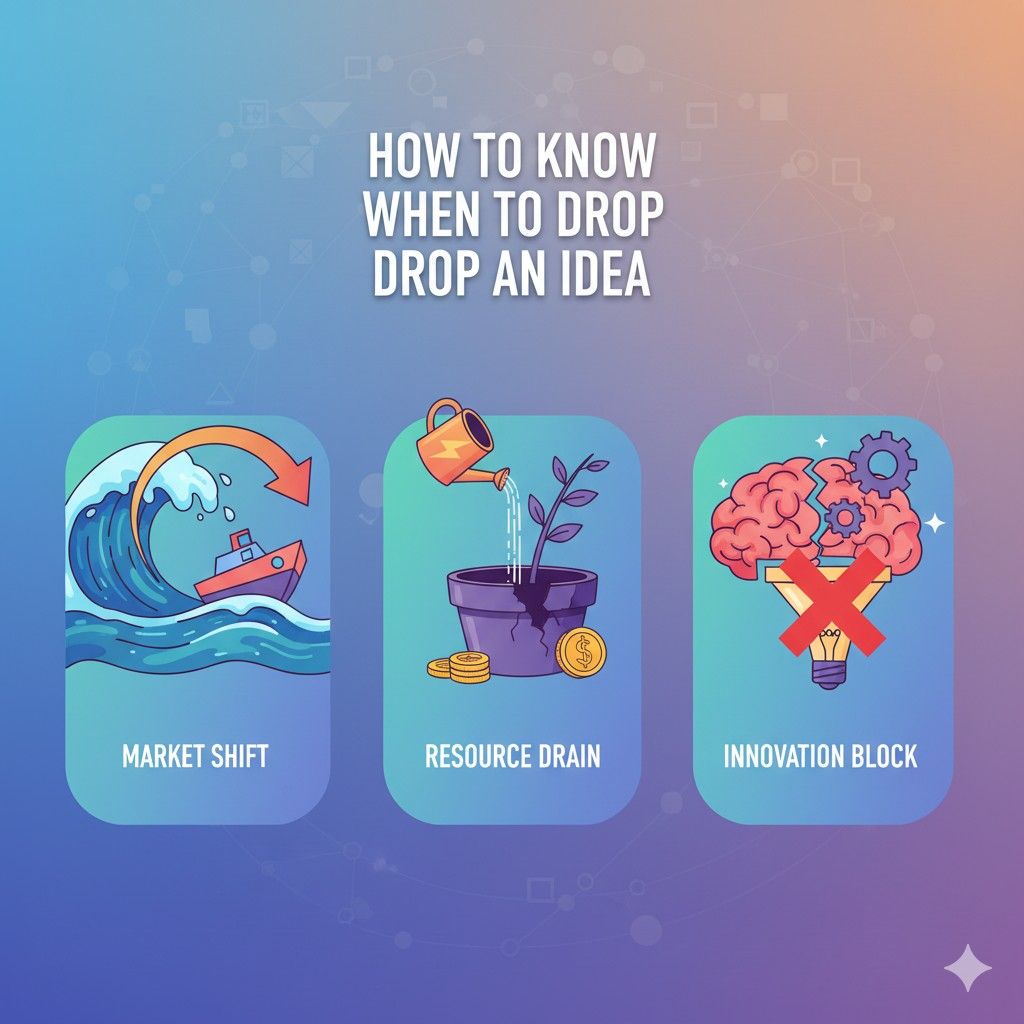
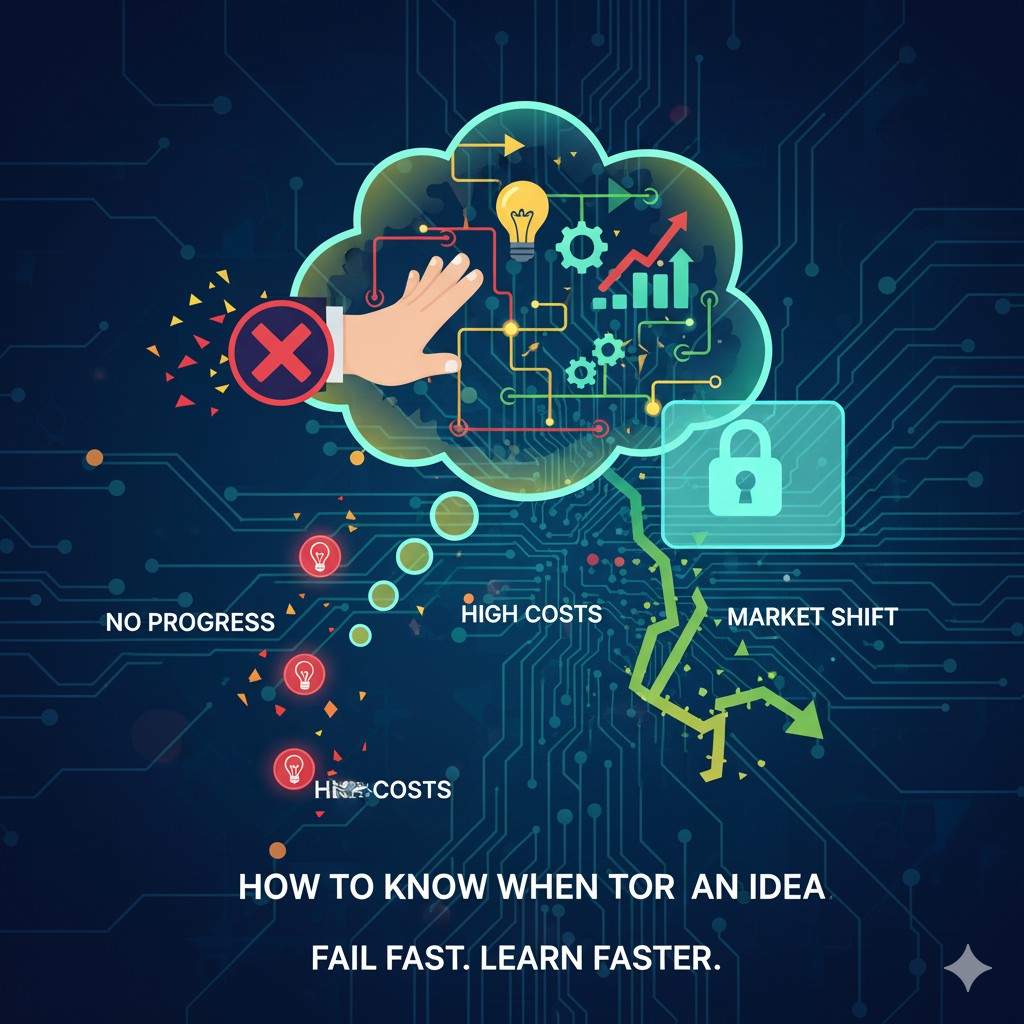
How to Know When to Drop an Idea
Every founder has at least one idea they try to keep alive long after it starts dragging them down. It’s normal.
When you care about what you’re building, it’s easy to convince yourself that the idea just needs more time, or more users, or one small push before it finally clicks.
But the truth is that some ideas drain more energy than they return. The challenge is learning to see the moment when an idea stops serving your mission and starts slowing your entire company.
Seeing the Early Signs That an Idea Is No Longer Worth Protecting
A hard truth many founders avoid is that the idea you fall in love with is not always the idea that moves your product forward. Sometimes the early warning signs are small.
Maybe your team keeps delaying work on that feature. Maybe customers give polite interest but never deep excitement. Maybe competitors enter the space and you feel pressure instead of opportunity.
These early signs matter because they tell you something simple: the idea is no longer pulling you forward. It is pulling you sideways.
When that happens, the natural instinct is to double effort because it feels safer than admitting the idea might not have the future you imagined.

But the moment you look honestly at these signals, you gain the freedom to protect your time, energy, and resources for work that actually builds your advantage.
Understanding When the Market Is Speaking and When It Is Just Quiet
Not every slow response from the market means you should drop an idea. Some ideas need time to mature. Some need deeper messaging. Some need patience.
The real signal to watch is whether the idea creates movement. If every touchpoint with customers feels like you are pushing a heavy object uphill, that resistance is telling you something important.
But if you see small sparks of interest, even slow ones, that may show the idea has value if shaped the right way.
The key is to avoid reading silence as rejection. True rejection is active. It’s when customers consistently avoid the idea, or worse, forget it exists. Silence can be solved with better positioning or clearer explanation.
Rejection means the idea does not solve an urgent problem, no matter how well you explain it. When you learn to separate the two, dropping an idea becomes a smart decision, not an emotional one.
Knowing When a Competitor’s Move Makes an Idea Too Expensive to Pursue
One of the clearest moments to drop an idea is when the competitive landscape shifts in a way that makes your execution too expensive, too slow, or too risky.
If a well-funded competitor claims a space with a deep tech moat or heavy patent coverage, your cost to compete may outweigh the potential gain. This does not mean you surrender.
It means you redirect your energy to areas where you can move faster, innovate deeper, and protect your work more effectively.
This is the reason competitive watch matters.
When you see competitors building strong protection around a path you were considering, you can step away early instead of investing years into a direction that may never pay off.
With support from tools like PowerPatent, you can understand these signals with simple clarity.
Real attorney oversight helps you see whether their patents block your approach or whether the space is still open for your unique method. You can see for yourself how that process works at https://powerpatent.com/how-it-works.
Accepting That Dropping an Idea Creates Space for Stronger Ones
One of the most underrated benefits of dropping an idea is the space it creates for everything else. When founders cling to an idea out of habit or hope, they often miss the openings appearing right in front of them. Markets shift. Customers evolve.
New problems surface. But if your focus is glued to an idea that isn’t gaining traction, you lose the chance to notice the ideas that could transform your product.
Dropping an idea is not a sign of failure. It is a sign of maturity. It shows you are building for impact, not ego. It also shows your team that you value clarity over attachment.
Teams move faster when the vision is uncluttered. They step into new opportunities when leadership signals that it is safe to release what no longer fits.
Using Patents as a Filter to Decide What Stays and What Goes
A powerful way to decide whether to drop an idea is to ask a simple question: is this something worth protecting?
If the idea does not create unique value that customers feel, and it does not give you a competitive edge that can be protected, it might not belong in your long-term strategy.
Patents become a lens for clarity. When you think about what is worth patenting, you focus naturally on the most defensible, technical, differentiating parts of your product.
PowerPatent helps founders make this decision without legal confusion.
The platform breaks complex technical concepts into simple language and shows you exactly which parts of your invention have the strength to stand as real intellectual property.
By seeing this clearly, you can spot ideas that do not carry long-term value and let them go without hesitation. You can explore this in more detail at https://powerpatent.com/how-it-works.
Turning the Act of Dropping Into a Competitive Advantage
The companies that win are not the ones that chase every idea. They are the ones that decide quickly, commit strongly, and move with intention. Dropping an idea gives you back speed.
It gives you back focus. It gives you back the space to double-down on the projects that set you apart. In fast-moving markets, that kind of disciplined clarity becomes a competitive weapon.
When you drop an idea with confidence, you make room for deeper inventions, stronger protection, and clearer execution. You stop reacting to competitors and start choosing the ground where you can win.
And when you have a simple, strong patent strategy backing your decisions, you can make these calls with peace instead of doubt.
That’s the heart of real competitive strategy. It’s not about doing everything. It’s about doing the right things with full conviction.
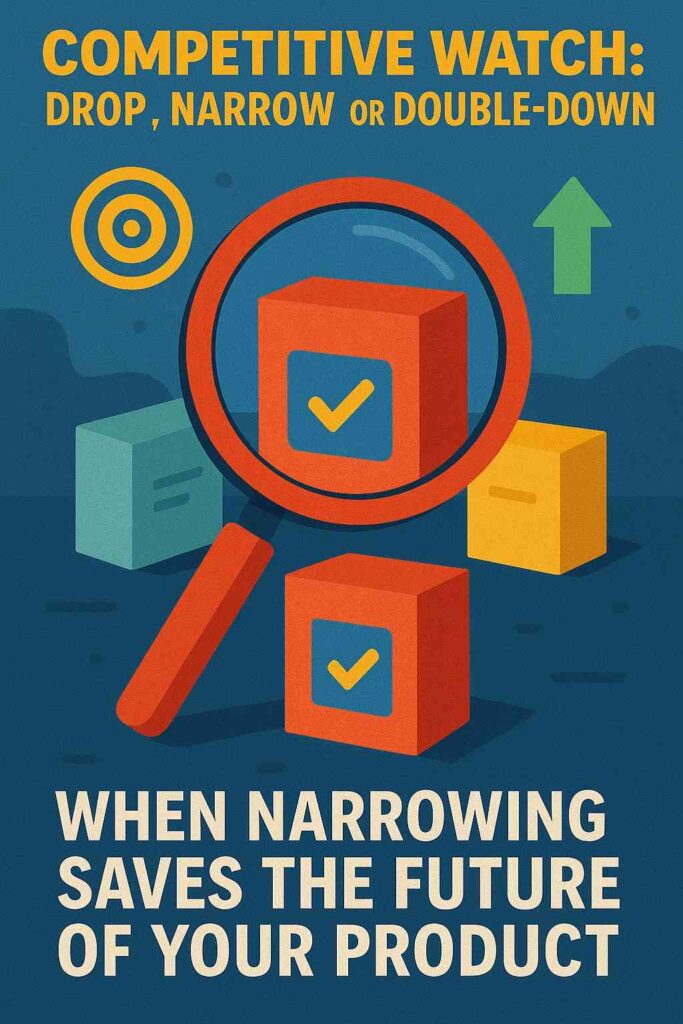
When Narrowing Saves the Future of Your Product
There is a moment in every startup where the product becomes too wide. It happens slowly, almost without anyone noticing.
A feature is added to please one customer, then another to satisfy a demo, then another because a competitor mentioned something similar.
Before long, the product feels bloated, like a multi-tool with too many blades and none of them sharp. This is the moment when narrowing becomes the smartest move you can make.
Narrowing is not pulling back. It is sharpening. It is choosing the exact place where your product creates the strongest advantage, the deepest value, and the most defensible position.
Many founders resist narrowing because it feels like saying no to potential growth. But in reality, narrowing is often what unlocks growth. It is the act that turns scattered effort into concentrated power.
Understanding Why Focus Creates Momentum
A product that tries to do everything ends up feeling dull. It is hard to explain. Hard to position. Hard for customers to remember. Hard for teams to rally around. But when you narrow, things become clear. Your team knows exactly what they’re building.
Your message becomes crisp. Your roadmap becomes cleaner. Customers start to understand you faster, trust you sooner, and see your product as something built for them, not everyone.
Momentum does not come from adding more. It comes from removing the parts that drag.
When you narrow, you cut the friction. You reduce the internal debates. You stop dividing your energy across too many directions. Suddenly the product moves forward with a speed that was not possible before.
Seeing What Deserves Your Deepest Focus
Choosing where to narrow starts with a simple truth: not all parts of your product create equal value. Some features are nice to have. Some are necessary to keep up with the market.
But a few small parts create the real magic. These are the pieces customers talk about, return for, and rely on.
They are usually the pieces that competitors struggle to copy because they require deeper expertise, stronger technology, or a unique insight you discovered through experience.
Your job is to identify those pieces with absolute clarity. Look at the features that spark genuine excitement. Look at the parts your team fights to improve. Look at the parts that create measurable outcomes for your users.
When you isolate these, you discover where the product wants to grow naturally, not where you are forcing it to grow.
This is also where patent thinking becomes a powerful filter. If a part of your product has potential for real protection, that is a sign it has deep technical value.
Patents expose the paths worth doubling-down on. They highlight your true edge.
And PowerPatent makes this process simple by translating complex invention details into clean insights your team can understand without legal training.
The walkthrough at https://powerpatent.com/how-it-works shows exactly how founders use this clarity to guide their product focus.
Narrowing When Competitors Try to Pull You Off Course
Competitors can make you feel like you have to match them feature for feature. But this is one of the fastest ways to lose your advantage.
When you react to competitors instead of following your own direction, you widen your product without intention. You start playing on their map instead of building your own.
The way to win is by narrowing into the zone competitors cannot follow. This could be a technical angle they do not understand. It could be a workflow they cannot replicate.
It could be a customer segment they overlook. When you narrow into the space where your product shines, you create a pocket of strength that becomes hard for others to invade.
This is also the point where competitive watch becomes a strategic tool instead of an emotional trigger. When you study competitor behavior calmly, you see their weaknesses more clearly.
You spot where they are spreading too thin. You see where they are trying to appear strong but actually lack depth. These openings help you decide where narrowing will deliver the biggest impact.
Knowing When Narrowing Is More Powerful Than Pivoting
A pivot is a big move. It changes the direction of the entire company. But narrowing is a precise adjustment. It keeps the core of your product intact while sharpening its aim.
Many founders jump to pivoting because it feels bold. But often the real breakthrough comes from narrowing, not starting over.
Narrowing lets you keep your foundation. It keeps your branding, your learnings, your product architecture, and your customer trust.
You simply choose the one piece that has the most potential and shape everything around it.
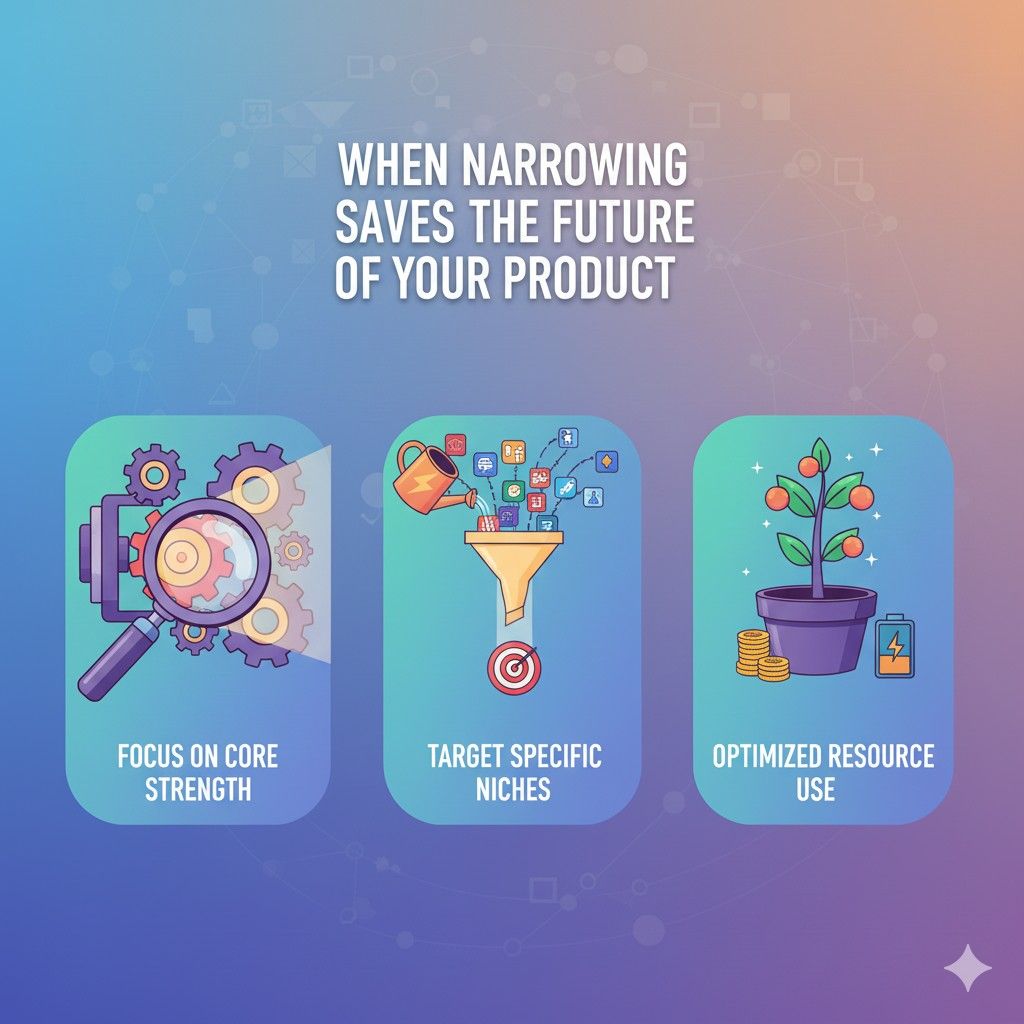
The outcome is a product that feels stronger, not different. Your team stays aligned because the mission stays consistent. Your customers stay engaged because the value becomes sharper instead of unfamiliar.
Using Narrowing as a Practical Tool to Build Moats
Deep technical moats do not come from doing more. They come from doing one thing so well that others cannot keep up. When you narrow, you create space for depth.
You give your engineers time to refine the smallest details. You allow yourself to make the product smarter, faster, and more stable than anything in the same category.
Strong patents come from this kind of depth. They come from the unique method, the hidden layer, the precise mechanism that you perfected because you had the focus to refine it.
And once that depth is protected, your company gains a shield that competitors cannot easily break through.
PowerPatent was built around this reality. It helps founders identify the exact parts of their tech that are worth protecting, not the ones that are easy to describe.
With clear guidance and real attorney support, you can use your narrowing decisions to shape filings that give you long-term advantage. If you want to see how the process works step-by-step, the overview at https://powerpatent.com/how-it-works lays it out in simple language.
How Narrowing Helps Your Team Move Faster and With More Confidence
A team that is trying to build too many things at once becomes tired. You can feel the drag in meetings. Ideas get lost. Priorities blur. But when you narrow, everything snaps into place.
Teams suddenly know what great looks like. They know which projects matter most. They know how to measure progress. The work feels lighter because every effort has a clear purpose.
Teams often describe narrowing as a form of relief. They finally get permission to stop chasing noise and pour their energy into one path that feels meaningful.
With that clarity, decisions happen faster. Experiments become sharper. Execution becomes cleaner. You spend less time debating and more time building.
This kind of clarity helps you make better calls about patents as well. When your product is focused, you can easily see which innovations rise to the top. You can describe them more clearly.
You can document them more accurately. And you can move through the patent process without the chaos of shifting priorities.
Turning Narrowing Into a Long-Term Advantage
The companies that thrive over time share a common trait: they are willing to narrow when others widen.
They choose depth when others chase breadth. They commit to excellence where others chase coverage. Narrowing gives you the leverage to build a product that stands out instead of blending in.
When you narrow, you create the conditions for meaningful invention. You open the door to true differentiation.
You make room for patents that matter. You position your company to double-down with confidence when the moment is right.

This is the heart of sustainable competitive strategy. Narrowing saves products. It sharpens visions. It stabilizes teams. It builds moats. It clears the noise so you can create something powerful enough to protect.
How to Double-Down With Speed, Clarity, and Protection
There comes a point where hesitation costs more than action. After you study your competitors, after you drop the ideas that hold you back, and after you narrow your focus to what matters most, you reach a moment where you must commit.
This moment defines whether your product becomes a leader or stays in the shadow of companies that move with more conviction. Double-down does not mean reckless expansion. It means putting your full weight behind the one thing that gives you real leverage.
Many founders struggle here because they fear choosing wrong. But double-down is not guessing. It is a decision built from evidence. You know what customers lean toward.
You know what competitors are missing. You know what your team can execute faster and better than others.
And you know which part of your invention is strong enough to protect. When all of these align, doubling-down becomes the smartest, safest, and most strategic move you can make.
Understanding When the Timing Is Right
You cannot double-down too early or too late. Too early, and you risk committing to something customers have not proven they need. Too late, and a competitor might plant a flag in the exact space you hesitated to claim.
The right time is when traction starts showing small but consistent signals. The signals may come through high-value users leaning hard into one feature, or early adopters using your product in ways you didn’t expect, or repeated feedback that points toward the same pain point.
These are hints, not blasts. But they are enough to tell you where the energy naturally flows. When you see this steady pull, you do not wait for a dramatic moment.

You commit while the edge still belongs to you. This is how breakout products are built: not from loud leaps, but from quiet conviction backed by careful observation.
Doubling-Down With a Clean, Confident Roadmap
A real double-down move starts with a roadmap that cuts everything that does not serve the core. This is where the discipline from narrowing pays off. When you have already stripped away the noise, doubling-down becomes a matter of deepening the work that remains.
You invest more of your design time, engineering time, and attention into the features that form your central engine.
You do not chase new directions at this stage. You refine. You optimize. You strengthen. You polish.
You make the product feel inevitable, not optional. This level of focus builds a type of excellence competitors cannot easily copy, because most of them are still split across too many priorities.
Great roadmaps are not long lists. They are short, sharp, and demanding. Double-down gives you permission to build that way.
Why Speed Matters More When You Double-Down
Speed becomes your edge once you commit fully. Customers feel the difference when a product starts improving at a faster rhythm. Competitors feel the pressure when every release you push sharpens your advantage.
But speed is not chaos. It is not rushing. It is the result of engineers knowing exactly what to build and why.
When your team moves under a double-down strategy, decisions happen faster because choices are aligned with one direction. Meetings shrink. Debates shorten. Experiments have clearer goals.
Progress compounds because every action pushes the same mission. This is the kind of speed that changes markets.
Speed also becomes critical for patent strategy. When you know your direction, you can capture your innovations early.
Filing at the right moment protects the exact technical breakthroughs you are building. With PowerPatent, this becomes far easier.
The platform turns your evolving breakthroughs into clean documentation, and real attorneys guide the process so you can file quickly without slowing down engineering.

If you want to see how it fits into a fast-moving product cycle, the overview at https://powerpatent.com/how-it-works breaks it down.
Using Patents to Strengthen Your Commitment
A double-down strategy becomes far more powerful when it is paired with strong IP protection. Committing to a direction without protecting it leaves room for competitors to follow close behind.
But committing with protection creates a moat that grows deeper the further you go.
Patents turn your technical focus into a defensive wall. They give you the legal and strategic firepower to own the space you are building into. And when you file early, competitors cannot simply mirror your features.
They cannot replicate your internal methods. They cannot mimic your hidden architecture. They can appear similar on the surface, but their foundation will never match yours.
This advantage becomes even more important when investors evaluate your long-term potential.
A clear double-down move combined with protected IP sends a strong signal that your company is building a durable, defensible business, not just another product in a crowded market.
Doubling-Down Without Overextending
One of the biggest fears founders have with doubling-down is the feeling of risk. They worry that committing too fully could trap them. But doubling-down does not mean closing doors.
It means walking through the one door that shows real opportunity. You can still test small ideas. You can still explore new angles. You simply do not dilute the core.
The key is staying aware of capacity. Double-down should make your work simpler, not heavier. It should lighten your roadmap, not overload it.
If you find your team burning out during a double-down effort, it usually means you are adding new ambitions instead of investing deeper in the core.
The correction is simple: return to the one thing. Strengthen that piece until it becomes undeniable. Everything else can wait.
This is where patent alignment helps again. If a direction cannot generate protectable invention, it may not deserve your full commitment.
When your double-down aligns with your defensible value, you avoid overextension. You build with purpose, not panic.
Turning Doubt Into Direction
Every founder feels doubt during a double-down phase. It is natural. You are choosing a path with intention, which means you are also choosing to set aside other paths.
The doubt does not mean you are wrong. It means you are stepping forward with awareness.
The way to convert that doubt into direction is by grounding your decisions in feedback, data, and signal. If customers repeatedly engage with one feature more than anything else, trust that.
If your team naturally gravitates toward one part of the product, trust that. If your patentable insights live mostly in one area, trust that too. These signals are not accidents. They point to the place where your advantage grows.
Founders who learn to trust these signals become unstoppable. They commit earlier. They build faster. They protect smarter. They win because they are not scattered. They have a center, and they build around it with intention.
Doubling-Down as a Long-Term Competitive Strategy
A strong double-down move does more than help your product in the short term.
It shapes the entire future of your company. When you pick one direction and reinforce it with depth, speed, and protection, you create a long-term advantage that compounds over time.
Competitors may try to mimic your surface features, but they will not match the precision of your execution. They will not match the speed of your iteration.
They will not match the layers of insight beneath your design. And if you file strong patents through a smooth, guided workflow like PowerPatent’s, they will never match your defensibility.

This is how category leaders emerge. They identify the thing they can be the best at. They double-down. They defend it. They refine it. They build a company on top of it.
Wrapping It Up
Every founder faces turning points that shape the future of their product. Some moments demand that you step back and let an idea go. Others call for sharpening your focus until the noise falls away. And sometimes, when the signals line up and the path becomes clear, you must double-down with full commitment. These choices feel heavy when you are in the middle of building, but they become far easier when you understand the true meaning behind your competitors’ moves and the deeper value inside your own technology.