You do not win a patent by writing more words. You win by drawing the right line. That line is your claim scope. Too wide, and it gets rejected. Too narrow, and competitors walk right around you. The real skill is knowing where to narrow and where to hold strong. In this article, I will show you how to think about claim scope like a heatmap. You will see where the pressure is high, where you can flex, and where you must stand firm. If you are building real tech and want real protection, this will change how you look at patents forever.
What Claim Scope Really Means (And Why Most Founders Get It Wrong)
Claim scope is not just legal text. It is the fence around your business. It defines what you own and what others cannot touch.
If you are building real technology, your claim scope decides whether your patent becomes a strong shield or just a framed document on the wall.
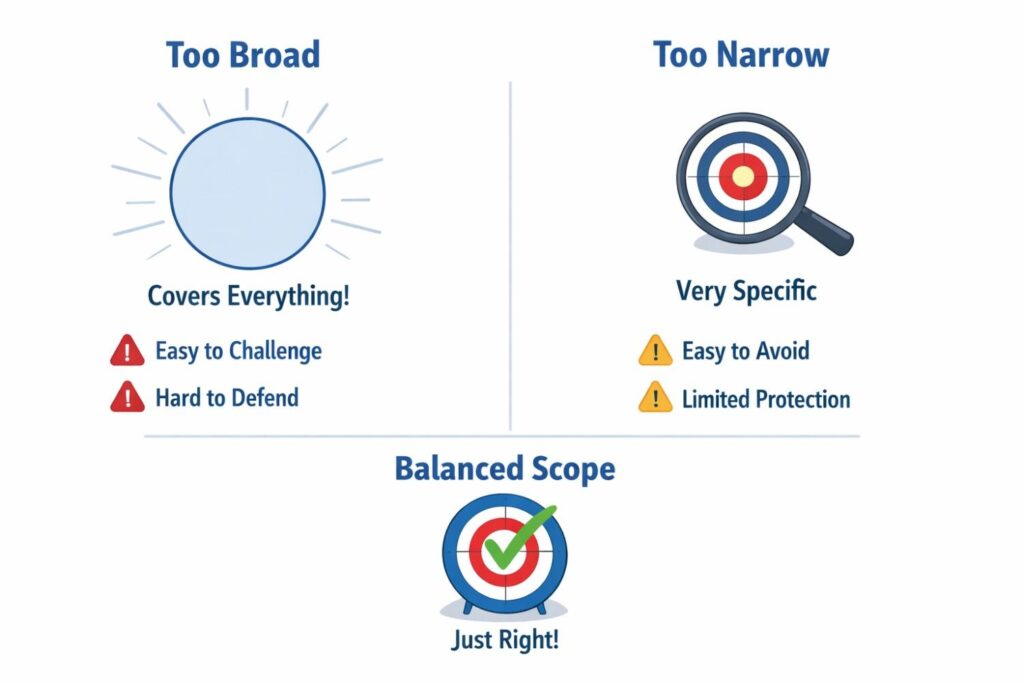
Most founders think claim scope is about being broad. They believe the wider the claim, the stronger the protection. That sounds logical. But in practice, it is rarely true. The real game is balance.
You need protection that is wide enough to block competitors, yet precise enough to survive review.
Let’s break this down in a very practical way.
The Claim Is Not a Description
Many founders confuse claims with explanations. They try to retell their product story inside the claims. That is a mistake.
The claims are not there to explain your product. They are there to define legal boundaries. The description tells the story. The claims draw the line.
If you treat claims like a technical walkthrough, you will accidentally lock yourself into details that do not need to be there. Every extra detail shrinks your fence.
Here is something you can do right now. Look at your product and ask yourself what truly makes it different. Not what makes it impressive. Not what makes it complete.
What makes it distinct. That core difference is usually where your strongest claim should live.

If your claim reads like a feature checklist, it is probably too narrow. If it reads like a vague idea, it is probably too broad. The sweet spot is somewhere in between.
Scope Is About Control, Not Length
Many founders think longer claims mean stronger claims. That is not how this works.
Scope is not about how many words you use. It is about how much ground you cover.
Imagine your product has three layers. The core engine. The workflow. The interface. If you claim only the interface, someone can rebuild your engine and bypass you.
If you claim only the engine, someone can wrap it in a new experience and compete.
Smart scope looks at the control points in your system. Where does real value happen? Where is the hard part? Where would a competitor struggle to copy without hitting your patent?
That is the area you want to hold firm.
A simple exercise can help. Ask yourself this question: if someone wanted to build around my patent, what would they remove first?
That answer shows you what part of your claim is weak. It also shows you what part must be strengthened.
Broad Does Not Mean Vague
There is a big difference between being broad and being unclear.
Broad claims protect many variations of your invention. Vague claims get rejected or ignored.
Founders often try to stay broad by using soft language. They avoid specifics because they are afraid of narrowing the claim. But without structure, the claim has no anchor. And without an anchor, it drifts.
The right approach is to anchor your claim in a technical structure, but avoid tying it to one narrow example.
For example, if your invention uses machine learning, do not claim only the specific model you use today.
Instead, claim the functional system that processes inputs in a defined way to produce a defined output. That gives you room to evolve your model over time.
You are not protecting today’s version. You are protecting the concept that drives the value.
The Founder Trap: Overclaiming Early
Early-stage founders often make one of two mistakes. They either claim too much or too little.
When you overclaim, you try to cover the entire industry. You say your invention covers all systems that do X. The patent office will push back. Hard. That leads to long delays and forced narrowing under pressure.
When you underclaim, you focus only on your exact build. You write claims that mirror your code. That may pass faster, but it leaves space for competitors to copy your idea with small tweaks.
The right move is to think in layers.
Your first layer should protect the core concept. The next layer can protect specific technical improvements. The final layer can protect implementation details.
This layered mindset gives you flexibility. If pressure comes on one layer, you still have others holding the line.
This is where strategy matters. And this is where having software plus real attorney oversight makes a difference. With the right guidance, you can shape claims before filing instead of fixing them after rejection.
If you want to see how that works in practice, you can explore how PowerPatent guides founders through this process at https://powerpatent.com/how-it-works.
It is built to help you think strategically from day one, not after problems show up.
The Real Question: What Are You Trying to Stop?
Most founders focus on what they built. Very few focus on what they want to stop.
Claim scope is not about celebrating your invention. It is about blocking competition.
Before drafting claims, ask yourself a simple but powerful question: if a well-funded competitor entered this space tomorrow, what version of my product would hurt me the most?
That is the version you want your claims to catch.
Think about alternative inputs. Think about swapped components. Think about changed labels. Would your claim still read on that version?
If not, your scope is too fragile.
This mindset shift changes everything. You stop writing for today. You start writing for defense.
Why Founders Miss the Business Angle
Many engineers approach patents like technical puzzles. They focus on correctness. They focus on precision. That is good, but it is not enough.
Patents are business tools.
The claim scope should align with your business model. If your revenue depends on licensing a core algorithm, your claims should protect that algorithm broadly.
If your revenue depends on a specific hardware setup, your claims should lock down that configuration.
Too many patents are written without thinking about how the company will make money.
Here is a strategic move that most founders skip. Before finalizing claims, map them to your revenue drivers. Ask yourself which claim protects which revenue stream. If a claim does not support a business goal, reconsider it.
This keeps your patent aligned with growth.
The Danger of Defensive Narrowing
During review, it is common to face objections. Many founders panic and start narrowing quickly just to get approval.
That is understandable. You want the patent granted. But every narrowing move is permanent. Once you give up territory, you cannot easily take it back.
This is where thinking in heatmap terms helps. Not every rejection means you should shrink your core claim. Sometimes you adjust around the edges. Sometimes you clarify without surrendering ground.
The key is knowing which elements are critical and which are flexible.
If your claim includes five parts, and only one is truly central to your invention, protect that one fiercely. Be open to adjusting the others if needed.
This is strategy, not surrender.
PowerPatent was designed to help founders navigate this balance with clarity. Smart software helps you see how claim changes affect scope. Real attorneys review and guide the strategy.
That mix helps you avoid cutting too deep just to move forward. If you are serious about protecting your tech without losing control, take a look at how it works at https://powerpatent.com/how-it-works.
Claim Scope Is a Living Strategy
Many founders treat patent filing as a one-time event. File it. Forget it. Move on.
That approach leaves value on the table.
As your product evolves, your claim strategy should evolve too. New features, new markets, new threats all change the heatmap.
Smart companies revisit their claim coverage over time. They look at what competitors are doing. They see where gaps may exist. They file follow-up applications to reinforce weak zones.
This does not mean filing blindly. It means thinking ahead.
If you are building something that will scale, your patent strategy should scale with it.
At the end of the day, claim scope is about power. It decides whether you can raise with confidence. It decides whether you can defend your space. It decides whether your invention becomes a real asset or just paperwork.

And most founders get it wrong not because they lack intelligence, but because no one explains it in simple, strategic terms.
Now you know better.
The Heatmap Mindset: Finding the Pressure Points in Your Claims
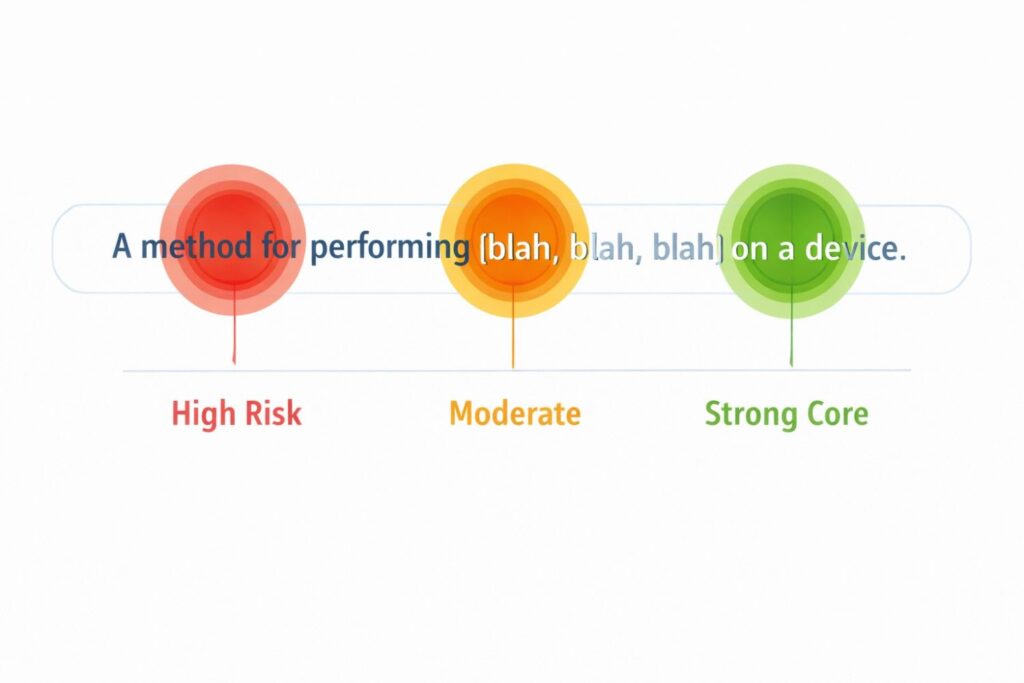
When you look at your claims, do not see text. See temperature.
Some parts are hot. They attract scrutiny. They trigger rejection. They draw attention from competitors. Other parts are cool. They are stable. They are less likely to be attacked.
The heatmap mindset means you stop treating every word the same. You learn to see where the pressure lives. Once you see that clearly, you can decide where to narrow and where to stand firm.
Most founders never look at claims this way. They react to feedback instead of predicting it. That is why they end up shrinking protection in the wrong places.
Let’s change that.
Where Heat Comes From
Heat does not appear randomly. It usually comes from three sources.
First, prior art. If similar ideas already exist, the parts of your claim that overlap with those ideas will get attacked. Second, abstraction. If your claim sounds too general, it may be challenged for being too broad.
Third, value concentration. If a certain feature drives real market value, competitors will try to design around it.
Understanding these forces helps you spot risk before it becomes a problem.

When drafting or reviewing your claims, ask yourself which elements are likely to face pushback. Those are your hot zones. They require careful wording, strong support in the description, and strategic thinking.
Mapping Your Core Innovation
Every strong patent has a center of gravity. This is the technical move that makes your invention different.
Your first task is to identify that center clearly.
Do not think about branding. Do not think about user interface. Focus on the technical shift. What is the real change in how something works?
Once you isolate that shift, mark it as high priority. That is the area you want to hold strong. That is where you avoid unnecessary narrowing.
Now look at the surrounding elements. Are they essential to make the invention work, or are they just current implementation details?
If an element is replaceable without breaking the core idea, it is likely a cooler zone. That may be an area where narrowing can happen without harming your overall protection.
This exercise is simple, but it forces clarity.
Seeing Prior Art as a Heat Signal
Many founders fear prior art. They see it as a threat. But it is actually a signal.
When prior art is cited, it tells you exactly where the heat is concentrated. It shows which parts of your claim overlap with existing ideas.
Instead of reacting with frustration, treat this as a map.
Look at the cited material and compare it carefully to your claim. Where is the real overlap? Is it in the overall system? Or just in one specific component?
Often, the overlap sits in a general element. That means the specific way you improve or combine elements is your true leverage point.
You may decide to narrow around the general element while protecting the improvement. That way, you address the objection without losing your core advantage.
This is where founders who use modern tools have an edge. When you can see your claims clearly, version by version, and understand how changes affect scope, you make smarter moves.
PowerPatent was built for this exact moment. It helps you track how each change shifts your protection, while real attorneys guide the strategy so you do not give up ground you should defend. You can see how that works at https://powerpatent.com/how-it-works.
Hot Words and Hidden Risk
Certain words carry more heat than others.
Words like system, platform, engine, module, and processor may seem harmless. But if they are used without structure, they can trigger challenges. Broad functional language without technical anchors often becomes a target.
The solution is not to avoid these words. It is to support them with structure.
If you claim a processing module, define what it receives, what it transforms, and what it outputs. Ground it in action. That reduces unnecessary heat while keeping scope meaningful.
Another risk area is overuse of absolute terms. Words like always, only, or exclusively can box you in. They create limits that competitors can exploit.
Instead, describe relationships in a way that protects flexibility. Leave room for variations without losing clarity.
Competitor Design-Around as a Heat Source
Heat does not come only from examiners. It also comes from competitors.
Imagine a competitor reading your granted patent. Where would they try to escape? What small change would allow them to say they do not infringe?
Those escape routes are weak points.
Take time to mentally design around your own claims. Change one component at a time. Replace algorithms. Swap data sources. Adjust workflow order.
If a small tweak avoids your claim entirely, that area is too cool. It needs more coverage.
On the other hand, if avoiding your claim requires major changes that hurt performance or cost, that area is well protected. That is where you are holding strong.
This mindset turns you into your own adversary. It is one of the most powerful exercises you can do before filing.
Claim Layers as Heat Buffers
A single claim cannot carry all your protection. That is why layered claiming is critical.
Your independent claim should cover the broad concept. Dependent claims can add specific features. Together, they create a gradient of scope.
Think of this like a buffer zone. If the broad claim faces heavy heat and must narrow slightly, your dependent claims can still provide fallback positions. You do not collapse entirely.
But layering only works if planned carefully.
Do not add dependent claims randomly. Each one should protect a meaningful variation or enhancement that a competitor might use.
This layered approach gives you flexibility during prosecution. It also strengthens your position later if enforcement becomes necessary.
Using Business Data to Read the Heat
Your market insights are part of the heatmap.
Look at where customers care most. Look at which features drive sales conversations. Look at what investors ask about.
Those areas likely hold competitive value. That means they may attract attention and pressure.
Align your claim strength with those zones.
If your edge in the market is speed, make sure your claims protect the technical mechanism that enables that speed. If your edge is data accuracy, protect the processing structure that ensures that accuracy.
This keeps your patent aligned with real-world stakes.
At PowerPatent, founders often realize that their original claim drafts protect the wrong parts of their system. With guided review, they shift focus to the true business drivers.
That alignment is what turns a patent from paperwork into leverage. If you want to see how founders do this without slowing down product development, visit https://powerpatent.com/how-it-works.
Reading Examiner Behavior Strategically
Examiners follow patterns. They often focus first on broad system language. They compare high-level structure before diving into details.
If your independent claim relies heavily on general framing without highlighting your unique technical move, it may attract early rejection.
A strategic approach is to anchor your independent claim in your core improvement while still keeping it broad. That means you do not hide your innovation in a dependent claim. You bring it forward.
This reduces early heat and makes your position clearer from the start.
It also signals confidence. You are not claiming everything under the sun. You are claiming your real contribution.
The Emotional Side of Heat
There is also a human element.
When founders see rejection, they often feel pressure to compromise quickly. That emotional heat can lead to over-narrowing.
Step back. Separate emotion from strategy.
Ask whether the requested change truly impacts your core innovation. If it does not, adjust calmly. If it does, push back with reasoned arguments and clear technical distinctions.
Patents reward patience and clarity.
With the right support, you do not have to navigate this alone. Combining smart software with experienced legal oversight helps you respond thoughtfully instead of reactively.
That is the core idea behind PowerPatent’s model. You move fast, but you move smart.

The heatmap mindset is about awareness. It teaches you to see where pressure will build and prepare before it explodes. It helps you protect what matters and adjust what does not.
Once you see claims this way, you stop guessing.
You start choosing.
Where to Narrow Without Losing Power
Narrowing is not failure. It is surgery.
When done with care, it can make your patent stronger. When done in panic, it can weaken your entire position.
The goal is not to avoid narrowing. The goal is to narrow in places that do not touch your core leverage. If you understand where your real value lives, you can trim around the edges without cutting into muscle.
Most founders narrow in the wrong spots because they never defined what must stay protected. They focus on getting approval instead of protecting advantage. That is how strong inventions turn into fragile patents.
Let’s fix that.
Narrow the Replaceable Parts
Every product has parts that can change without breaking the main idea.
Maybe you use a specific data format today. Maybe you rely on a certain hardware component. Maybe your workflow runs in a particular order because that is how your team built it.
Ask yourself this: if you rebuilt your product from scratch next year, what parts would likely change?
Those are safer areas to narrow.
If an examiner pushes back on a general processing step, you might add a structural detail that reflects your implementation but does not define your core concept.
That kind of narrowing can reduce friction while preserving strategic control.

The mistake founders make is narrowing around their differentiator instead of around their supporting pieces.
Your differentiator is sacred. Supporting mechanics are negotiable.
Clarify Without Conceding
Not all narrowing is about adding limitations. Sometimes it is about clarifying relationships.
If a claim is rejected as too broad, you may not need to shrink the idea. You may simply need to make the technical flow clearer.
For example, instead of saying a system processes data, you can define how the data is transformed and what structural interaction happens. That clarity can overcome objections without boxing you into one narrow embodiment.
This is a subtle but powerful move. It strengthens the claim’s foundation without shrinking its reach.
The key is knowing the difference between adding detail and surrendering ground.
When you use a modern drafting system that lets you test claim variations before filing, you can see how wording changes affect scope.
With real attorney input layered on top, you avoid silent damage to your protection. That is the edge founders gain when they use PowerPatent’s model. You can explore how it works at https://powerpatent.com/how-it-works.
Add Boundaries Around Known Ideas
If prior art shows similar systems, do not panic. Look closely at what those systems actually teach.
Often, prior art covers a broad concept but lacks a specific improvement that your invention introduces. Instead of narrowing your entire system, isolate that improvement and emphasize it.
You can narrow around the known idea while keeping your improvement broad.
For example, if basic data processing exists in prior art, but your invention introduces a unique feedback loop or adaptive layer, center your narrowing around that adaptive feature.
You are not shrinking your invention. You are carving out space from what already exists.
This is strategic narrowing. It does not weaken you. It focuses your claim on what is truly new.
Protect the Function, Not the Decoration
Founders often fall in love with how their product looks or flows. But cosmetic elements are easy to change.
If you narrow around visual elements, user interface details, or branding terms, you risk protecting something that competitors can bypass with minor changes.
Instead, focus narrowing on technical structure.
If you must add detail, tie it to how the system operates internally. Protect the mechanism that creates value, not the wrapper that presents it.
This mindset prevents you from shrinking into irrelevance.
Narrow in Dependent Claims First
One of the smartest ways to handle pressure is to keep your independent claim strong while shifting specificity into dependent claims.
Dependent claims act like controlled fallbacks. They allow you to add detail without giving up the broad foundation.
If you are forced to narrow your main claim, try to narrow gradually. Move one feature at a time. Avoid stacking multiple new limitations at once unless absolutely required.

Each added limitation should serve a purpose. It should either overcome a specific objection or strengthen clarity. It should not be random filler.
This approach keeps your patent flexible and layered.
Use Data to Guide Narrowing
Your product data can help you decide where narrowing is safe.
Look at usage metrics. Which features are critical to customers? Which parts of the system drive retention or revenue?
If a feature is rarely used or not central to your business, narrowing around it may not hurt you. But if a feature drives most of your value, narrowing around it could limit your ability to stop competitors.
Align narrowing decisions with business reality.
This is why patent strategy cannot live in isolation. It must reflect your roadmap and revenue plan.
At PowerPatent, founders often upload technical materials, code snippets, and product notes. The system helps organize the invention clearly, and real attorneys review it with business context in mind.
That integration reduces the risk of narrowing blindly. It ensures every adjustment supports long-term goals. If you are building something serious, you should understand how this process protects you at https://powerpatent.com/how-it-works.
Avoid Emotional Narrowing
There is a moment during prosecution when frustration peaks. You may feel pressure to accept examiner suggestions quickly just to move forward.
Pause.
Ask whether the suggested change touches your core differentiator. If it does, consider alternative arguments first. If it does not, then narrowing may be acceptable.
You are playing a long game.
A patent is not about winning one exchange. It is about preserving leverage for years.
Emotional narrowing often leads to regret. Strategic narrowing builds resilience.
Keep Future Versions in Mind
Your current product is version one. Your patent should not lock you into version one forever.
Before agreeing to any narrowing language, imagine your product two years from now. Will the new language still cover that version?
If not, you may be cutting off your own evolution.
A smart approach is to draft claims that focus on functional relationships rather than rigid structures. That way, even as your internal implementation improves, your claims still apply.
This future-proof mindset is critical for startups that move fast.
Narrow to Strengthen Enforcement
Sometimes narrowing can actually make enforcement easier.
If a claim is so broad that it becomes abstract, proving infringement later may be difficult. Adding a clear structural anchor can make the claim stronger in court.
The goal is balance. You want breadth, but you also want clarity.
Strategic narrowing can improve that clarity without sacrificing meaningful scope.
The difference lies in intent. If you narrow to survive review, you may weaken yourself. If you narrow to sharpen your position, you may gain power.
That distinction matters.
In the end, narrowing is not about shrinking. It is about shaping. It is about refining your protection so that it reflects what truly makes your invention valuable.

When you know where your heat is concentrated and where your business depends on control, you can narrow with confidence.
You are not giving up.
You are choosing.
Where to Hold Strong and Protect What Truly Matters
This is the line that defines your future.
There are parts of your claim you can adjust. There are parts you can reshape. And then there are parts you must defend with discipline.
If you narrow in the wrong place, you may never feel the damage right away. But years later, when a competitor copies your core idea and avoids your claim by a small tweak, you will see the cost.
Holding strong is not about ego. It is about protecting leverage.
Identify the Economic Engine
Every serious product has an economic engine. This is the technical mechanism that drives revenue.
It might be a data transformation process. It might be a control loop. It might be a model training structure. It might be a hardware interaction that improves speed or efficiency.
Whatever it is, this is the heart of your business.
Your claims must protect that engine at a meaningful level of abstraction. Not just the exact code you wrote. Not just the current configuration. But the core technical relationship that makes the system work.
If a competitor builds something that captures the same economic engine, your claim should read on it.
This is where you hold strong.
Before agreeing to any narrowing, ask yourself a direct question. If I accept this change, could someone still use my core engine and avoid my patent?

If the answer is yes, pause.
You are about to give away territory that matters.
Protect the Technical Advantage, Not Just the Outcome
Outcomes are easy to copy in new ways.
If your claim focuses only on results, like improved accuracy or reduced latency, you risk leaving room for alternative technical paths that achieve the same outcome.
Instead, protect the technical advantage that produces the outcome.
For example, if your system improves speed because of a specific distributed processing structure, your claim should anchor in that structure. If accuracy improves because of a feedback mechanism that updates model weights in a novel way, that mechanism must stay protected.
This is not about writing more words. It is about holding onto the cause, not just the effect.
When examiners push back, they may try to shift your focus toward general results. Resist that drift. Keep your technical edge visible.
This is where having both smart drafting tools and real attorney guidance makes a difference. You need clarity about what you are defending.
At PowerPatent, the system helps founders isolate their technical advantage early, so it does not get buried or diluted during review. You can see how this structured approach works at https://powerpatent.com/how-it-works.
Hold the Core Combination
Sometimes your novelty is not a single component. It is a specific combination.
Individually, the parts may be known. Together, they create something new.
In these cases, the combination is sacred.
If you are forced to narrow, be careful not to break apart the very combination that creates your advantage. Do not let pressure isolate components and treat them separately if your real value lies in how they interact.
Competitors often try to copy combinations while swapping minor pieces. Your claims should protect the integrated system.
If you weaken the combination, you weaken your moat.
A good test is this. Can someone rearrange the order of steps or swap a minor element and avoid your claim while still delivering the same integrated benefit?
If yes, your hold is too weak.
Defend the Broad Concept When It Is Truly Yours
Not all broad claims are reckless. Sometimes you genuinely invented a new category.
If your invention introduced a new architecture or workflow that did not exist before, you may deserve broad protection.
In those cases, do not rush to narrow just because broad claims feel risky.
If the prior art does not teach your concept, defend it.
That defense requires strong explanation in your specification. It requires clear technical framing. It may require careful argument during prosecution.
But if you earned that breadth, hold it.
Founders often underestimate how novel their ideas are. They assume similar things must exist. That assumption leads them to narrow too quickly.

Take time to study the landscape. If your core idea is truly distinct, protect it boldly.
Anchor Around Future Growth
Holding strong is also about the future.
Your patent should not only cover what you built. It should cover where you are going.
If you plan to expand into new data sources, new integrations, or new deployment models, your core claims should be flexible enough to cover those paths.
This does not mean writing vague claims. It means focusing on functional relationships rather than rigid constraints.
When you review a proposed narrowing amendment, imagine your roadmap.
Will this language still apply when you scale to enterprise customers? When you move from cloud to edge? When you integrate with external platforms?
If not, you may be locking yourself into yesterday’s version of your company.
Strategic founders think ahead.
Hold Strong During Negotiation
Patent prosecution is a negotiation.
Examiners suggest changes. You respond. There is room for discussion.
Do not treat examiner comments as final verdicts. They are starting points.
If an objection targets your core innovation, respond with technical reasoning. Show how your invention differs. Clarify misunderstandings. Provide context from your specification.
Many founders assume they must accept the first narrowing suggestion. That is not always true.
With proper guidance, you can often preserve broader language while resolving concerns.
This is one of the hidden benefits of combining AI-powered drafting with experienced patent attorneys. The software helps you track language and logic.
The attorney helps you decide when to push back and when to adjust. That partnership prevents overcorrection. It keeps your core intact. If you want to see how this balanced model works in practice, explore https://powerpatent.com/how-it-works.
Think About Enforcement From Day One
Holding strong is not only about getting a patent granted. It is about enforcing it later if needed.
Ask yourself how easy it would be to detect infringement.
If your core claim requires hidden internal processes that are impossible to observe, enforcement may be difficult. In some cases, it makes sense to hold strong around externally observable interactions or system configurations.
This does not mean exposing trade secrets. It means being strategic about what you claim.
If a competitor cannot realistically build your product without practicing your core claim elements, you are in a strong position.
If they can replicate your economic engine while hiding behind minor technical differences, your hold is weak.
This perspective forces you to think beyond filing and into real-world impact.
Protect What Makes You Investable
Investors look for defensibility.
When they review your patent, they are not counting words. They are asking one question. Does this stop competitors from copying the core idea?
If your strongest claims protect minor details while leaving the main economic engine exposed, sophisticated investors will see that gap.
Holding strong around your core technical advantage increases confidence. It shows you understand your moat.
A well-structured patent strategy signals maturity.
PowerPatent was built with this in mind. Founders can move fast without sacrificing depth. They can shape claims around what truly matters, with oversight from real attorneys who understand business impact.
That mix gives you protection you can explain confidently in a boardroom. If you are building for long-term growth, take time to understand how this approach works at https://powerpatent.com/how-it-works.
The Final Line
Your claim scope is a living boundary around your invention.
Some areas deserve flexibility. Others demand strength.
When you see your claims as a heatmap, you stop reacting blindly. You start making deliberate moves.
You narrow where details are replaceable. You hold where your economic engine lives. You clarify without surrendering. You defend combinations that create value.
This is not about gaming the system. It is about protecting what you built with intention.
A patent should give you confidence. It should let you build, raise, and compete without fear that someone can clone your idea with minor edits.
If you are serious about turning your invention into real, defensible IP without slowing down your startup, now is the time to act.

Learn how PowerPatent combines smart software and real attorney oversight to help you draw the right line from the start at https://powerpatent.com/how-it-works.
You are building something important.
Wrapping It Up
Claim scope is not a formality. It is not a paperwork step you rush through so you can say you filed a patent. It is the boundary around your advantage. If you draw that boundary too tight, competitors step around you. If you draw it too loose, it collapses under pressure. The skill is knowing where to adjust and where to stand firm. When you think in terms of a heatmap, everything becomes clearer.