Keeping patent rights alive in China, Japan, and Korea sounds simple from far away. Pay the annuity. Stay protected. Move on. But anyone who has filed in these markets knows it never works out that clean. Each country plays by its own rulebook. Deadlines shift. Payment windows behave differently. Grace periods aren’t the same. One missed step can quietly kill a patent you spent years building. And the worst part is that most founders don’t even realize something went wrong until it’s too late to fix it.
Why Annuity Rules in China, Japan, and Korea Feel So Different
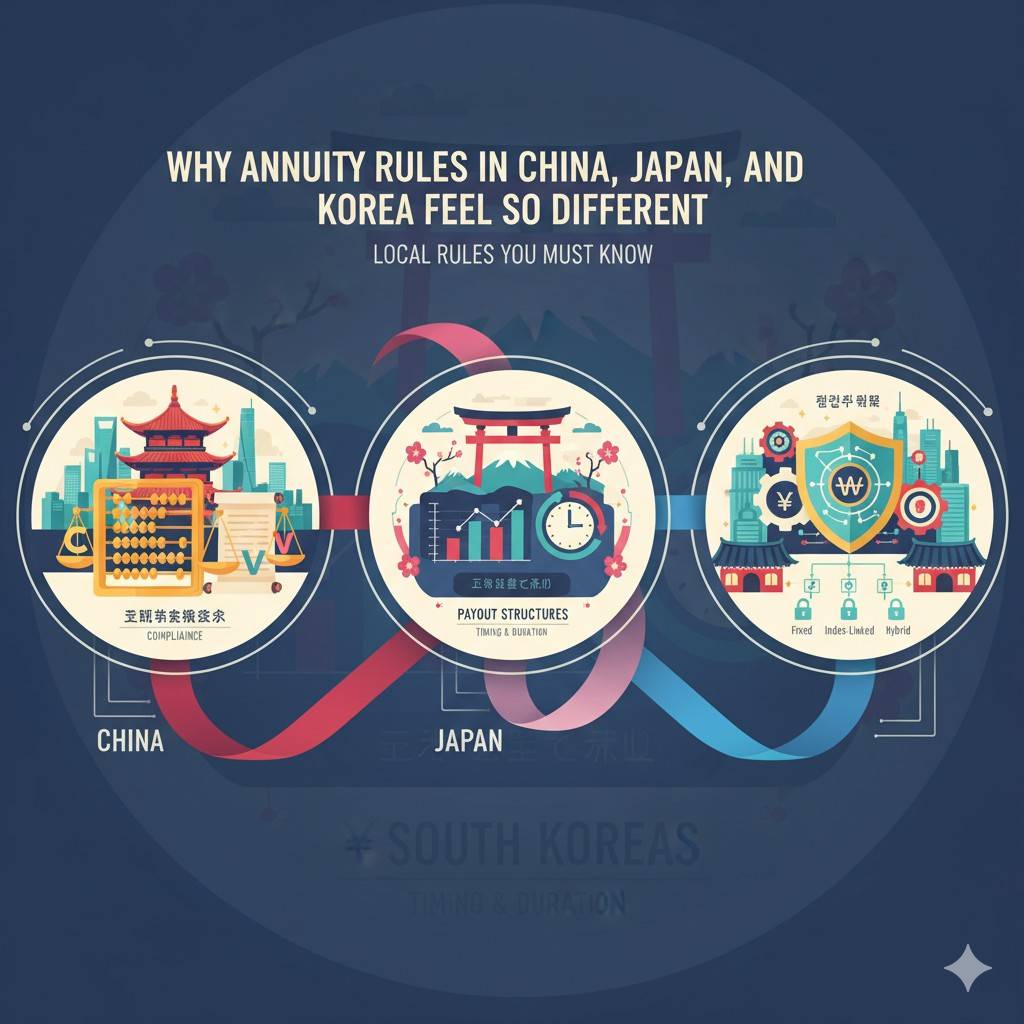
The moment you step into East Asia’s patent system, you feel the shift right away. China, Japan, and Korea are three advanced markets that sit close on the map but operate with completely different rhythms, expectations, and enforcement styles when it comes to annuities.
Businesses that treat these three countries as if they share one set of rules almost always end up paying more, filing corrections, or fighting to restore rights they never meant to lose.
This section helps you understand why the differences exist and how to navigate them with confidence so your patent stays alive without pulling you away from running your company.
The Three Systems Move at Different Speeds
At first glance, all three countries require annual fees to keep patent rights active.
But once you examine how each office handles timing, reminders, and missed payments, you notice the tempo is completely different in each place.
China moves quickly and cares about strict adherence to deadlines. Japan uses a more structured rhythm but expects precise payment timing.

Korea gives a bit more flexibility but still penalizes delays sharply. You never want to run your global IP strategy on guesswork or memory when dealing with three such different clocks.
Local Lawmakers Built These Rules for Local Business Behavior
One of the biggest reasons these rules feel so different is that each system was built to match how its local industries operate. China’s system rewards fast action and punishes slow follow-through because its local market moves at incredible speed.
Japan’s style favors structure and predictability because its local companies depend on precise operational planning.
Korea strikes a balance by allowing some breathing room while still ensuring that inventors keep their claims up to date.
The more you understand the cultural logic behind each system, the easier it becomes to prepare for the patterns instead of reacting to them.
Why This Matters for Global Companies Scaling Fast
If your company is growing and filing in multiple countries, these rule differences matter more than you think.
Every missed payment in China comes with the risk of complete loss of rights unless you fix it quickly. Every delay in Japan can snowball into costly restoration steps.
Every oversight in Korea creates a chain reaction that eats time and slows your product roadmap. When you scale into Asia, staying active in all markets is not optional.
These markets often host your suppliers, your manufacturers, or your early adopters. Losing a patent there is more than paperwork. It directly affects your competitive edge.
The Silent Risk of Relying on Email Reminders
Many founders rely on scattered emails from agents across different countries. This works fine until one message lands in a spam folder or arrives during a busy month.
Each country sends reminders differently, and none guarantee safety from human error. China sends fewer reminders than expected. Japan expects you to know your timeline.
Korea offers notices, but they are not designed for fast-moving startups. Without a structured system watching these deadlines, you leave valuable IP exposed.
The Real Cost of Misalignment Across Three Systems
Running three sets of annuity rules without a unified view often leads to confusion. Teams mix up timelines. Finance departments misread fee cycles. Legal teams scramble to restore rights.
Leadership assumes everything is handled until they learn otherwise. When the rules vary this much, the only way to avoid misalignment is to create a single, clear internal process that treats all three markets with equal weight.
You never want to rely on memory or guesswork, especially when the stakes are so high.
Local Currencies Add an Extra Layer of Complexity
Most founders don’t think about the fact that annuity payments in each country must be paid in local currency. China uses RMB. Japan uses JPY. Korea uses KRW.
These values fluctuate. Exchange rates create unexpected swings. Sometimes a currency move can make a routine payment suddenly more expensive than last year.
If you do not track these cost shifts across all three markets, your finance team may be caught off guard. Predictability matters for budgeting, especially when you manage a portfolio across multiple regions.
The Market Value of a Patent Changes Faster in East Asia
One thing that surprises many companies is how quickly the value of a patent changes in China, Japan, and Korea. These markets evolve fast. Product categories shift. Competitors appear earlier than expected. Local players study foreign filings closely.
If your patent lapses even briefly, someone else may step into the space you left open.
Sometimes a short lapse becomes a long-term competitive loss. Understanding annuity rules helps you stay ahead of competitors who are watching your every move.
Your Patent Agents in Each Country Follow Local Habits
Even if you hire good local agents, each one will follow the norms of their system.
Chinese agents may act quickly but communicate briefly. Japanese agents may be precise but expect you to know your timing.
Korean agents may offer helpful guidance but still follow their statutory windows strictly. These differences do not mean your agents are doing anything wrong.

They are simply working within their local structure. The challenge is coordinating all these expectations in a way that fits your own workflow.
Why Internal Alignment Matters More Than Ever
As your company grows, your design team, product team, and leadership team will all move at different speeds. Your patent deadlines need to stay aligned with your internal roadmap.
But because China, Japan, and Korea each have unique rules, you cannot rely on a simple annual check-in.
You need a system that brings all these rules into one place so your team knows exactly when something is due and what action must happen next. Without that, you risk pushing a product launch while your IP quietly slips out of protection.
How Smart Tools Remove This Confusion Entirely
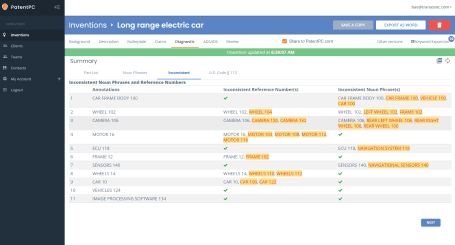
This is exactly why many high-growth companies move toward tools like PowerPatent. Instead of guessing or relying on scattered emails, you get a single dashboard showing every deadline across China, Japan, Korea, and all the other countries you care about.
The system predicts each fee, the timing, and the risks and makes everything easy to follow. And because you have real attorneys reviewing everything behind the scenes, you never feel like you’re doing this alone.
If you want to see how a tool like this simplifies international annuities, you can explore the workflow anytime at https://powerpatent.com/how-it-works
Staying Ahead Means Reducing Stress, Not Adding More
When you understand why these systems differ, you stop fighting the rules and start planning around them. You gain more control. You move faster. You avoid panic moments.

And you protect the inventions you worked so hard to build. In fast-moving Asian markets, clarity is power. When your annuities stay fully aligned, nothing slows you down.
The Real Cost of Missing a Payment in Each Country
Every company thinks it will never miss an annuity payment. You tell yourself the dates are saved somewhere, the reminders will come, or your agent will catch anything urgent.
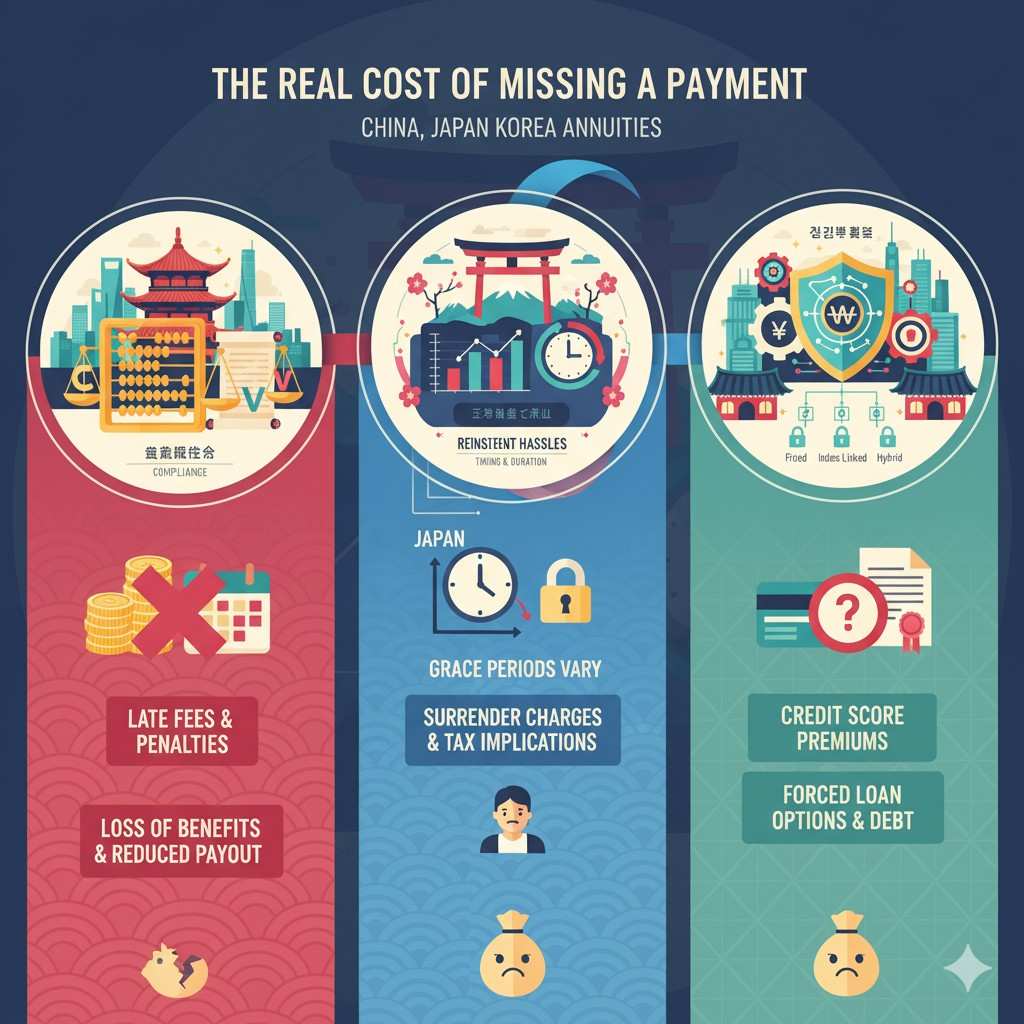
But China, Japan, and Korea have zero interest in giving you mercy when you slip. Each country handles late fees, grace windows, and reinstatement in its own way, and none of them make the process forgiving.
This section helps you understand the true cost of missing even one payment so you can see why staying ahead is far easier—and far cheaper—than trying to fix the damage later.
Why One Missed Payment Can Become a Chain Reaction
A missed annuity in East Asia rarely stays a single issue. Once you fall behind, the clock starts running fast. Offices send notices, deadlines shrink, fees rise, and your team becomes distracted by urgent legal work.
While you are trying to restore rights, your competitors get more time to study your technology. They see delays as weakness.

They see silence as an opening. When you miss a payment, you are not just dealing with paperwork. You are signaling to the market that your protection may be slipping.
The Psychological Cost of Uncertainty Inside Your Team
Most founders notice the emotional impact before they notice the financial one.
A simple missed deadline creates a cloud of uncertainty. Your leadership team starts worrying about whether you still own the rights you thought you owned.
Your engineers slow down product decisions because they are unsure if the core idea is still protected. Your investors start asking pointed questions about IP management.
This stress pulls attention away from building. And when attention shifts, growth slows down.
Why China Punishes Delays So Quickly
China treats timeliness like a core rule. If your payment is late, the office does not wait around for explanations. It triggers a fixed process with clear penalties.
The grace window is strict. The fees rise quickly. And if you miss the back-up window, your patent is gone. There is no emotion in the decision. China expects you to be ready, organized, and aware.
If you slip, the consequence is simple: loss of rights. This makes China one of the most unforgiving places to manage annuities if you rely on memory or manual tracking.
Why Japan Demands Both Precision and Follow-Through
Japan’s system does not move as fast as China’s, but it is far more precise. Missing a payment in Japan usually leads to a quiet panic because the country expects exact compliance.
If you do not hit the window, you must go through a structured reinstatement process that takes time and forces you to give reasons for your delay. Even if you get your rights back, the experience slows your team and adds internal work you never planned for.
Many companies assume Japan’s system is soft because it seems orderly. It is not. It simply has its own rhythm, and you must follow it closely.
Why Korea Gives the Appearance of Flexibility but Still Bites Hard
Korea is often viewed as the most flexible of the three. It offers grace periods and gives you room to recover from a slip.
But the penalties stack up fast, and the restoration process is not friendly to rushed teams. If you miss your chance to fix the problem, reinstatement becomes nearly impossible.
And because Korea is a fast-growing market with strong local competition, even a short lapse can give rivals a clear picture of where you might be weak.
Korea rewards companies that stay organized, not companies that hope the grace period will save them.
The Hidden Financial Cost You Do Not See Right Away
When businesses think about missing annuity payments, they usually imagine a late fee. But in East Asia, the real financial cost spreads across your entire operation. Your legal team spends extra hours chasing documents. Your outside agents bill you for reinstatement steps.
Your internal teams lose momentum because they must slow down until the issue is resolved.

You might even face extra translation costs if you need to file renewal explanations or legal statements. By the time everything is done, the real cost is far higher than the annuity itself.
The Risk of Losing Rights in Supply Chain Markets
China, Japan, and Korea are not just places where you sell products. They are places where you build them.
Many hardware startups depend on supply partners in these regions. If your patent lapses, even briefly, your supplier may rethink your project.
They may shift attention to a competitor. They may lose confidence in your ability to protect your technology. This makes annuity management more than just a legal step. It is a core part of partner trust and operational stability.
The Danger of Competitors Watching Your Portfolio
In these regions, competitors pay close attention to foreign filings. If you miss a payment, they see it in the public record. They notice the gap. They watch the reinstatement window.
If they see you fail to correct it, they act fast. Sometimes they file similar ideas.
Sometimes they enter your market with confidence. Sometimes they use your lapse to argue that your team is not serious about protecting its technology. Competitors treat your mistakes as openings.
This is why staying active matters far more than founders think.
Why Restoration Rarely Feels Like Restoration
Even when you restore a patent, the process often leaves scars. You spend money you never planned to spend. Your team spends time it never planned to spend.
You feel relief, but not confidence. And because every restoration leaves a trace, you never truly return to the same clean position you had before the lapse.
The goal should always be simple: avoid the need for restoration altogether.
How Better Tools Prevent These Problems Entirely
This is why many founders shift from manual tracking to automated systems like PowerPatent. A tool that shows every deadline across every country saves you from late surprises. It tracks windows. It predicts fees. It alerts your team before anything is due.
And because real attorneys monitor everything behind the scenes, you never feel like you are guessing. You stay ahead of the process instead of chasing mistakes.
If you want to see how this works in practice, you can explore the system here anytime: https://powerpatent.com/how-it-works
Staying Compliant Means Staying Strong in the Market
Missing a payment is not just a paperwork error. It is a sign that your internal system needs structure.
When you get your annuity strategy under control, your company moves with more certainty. Your investors feel safer. Your team feels protected.

Your competitors see fewer openings. You gain speed, clarity, and peace of mind. Staying compliant is not about being perfect. It is about building a process that protects your future.
How to Stay Fully Compliant Without Losing Focus on Building
Every growing company eventually hits the point where its patent portfolio becomes too big, too global, and too fast-moving to manage through scattered emails or personal reminders.
China, Japan, and Korea each run on their own timelines, and staying compliant in all three is not simply a legal task. It becomes a strategic advantage when handled well, and a silent threat when handled poorly.
This section shows you how to stay fully compliant without slowing down product development, fundraising, hiring, or market expansion.
The goal is to create a system that protects your inventions while keeping your team focused on building the future you care about.
The Importance of Predictability in Fast-Growth Companies
Every founder knows that startups run best when the future feels predictable. You can deal with tough work, long hours, and complex challenges as long as the ground under you feels stable.
Patent compliance creates that stability. When your annuity schedule is clear, your team can make product decisions without worrying about whether your underlying protection will hold.
When your deadlines are predictable, your financial planning becomes cleaner.

When your global IP stays alive without drama, your company can grow without friction. Compliance is not about chasing dates. It is about creating a stable foundation that supports everything else your business is trying to do.
Why You Need a Single Source of Truth for All Three Countries
Once you file in China, Japan, and Korea, your deadlines start growing like branches on a tree. Each patent has its own timeline. Each country has its own payment expectations.
Each fee behaves differently as the years pass. If you rely on email threads, spreadsheets, or manually tracked notes, you will eventually miss something.
A single source of truth keeps every date visible, every country aligned, and every team member on the same page. When you see everything in one place, compliance stops feeling like a burden and becomes something you can handle effortlessly.
The Value of Setting Internal IP Ownership Early
One of the smartest moves a business can make is assigning clear ownership for patent upkeep. When everyone thinks someone else is handling it, deadlines vanish.
When ownership is defined, the process becomes smooth. You can assign this responsibility to a founder, a legal lead, or an operations manager. The key is to give someone full visibility into the calendar and full authority to take action ahead of schedule.
With a single person watching over China, Japan, and Korea, even complex portfolios stay under control. This alignment keeps your rights strong and your team calm.
The Power of Automating What You Should Not Do Manually
Manual processes break when companies grow. They break when fundraising gets intense. They break when you enter a new market. They break when your team gets busy with a major launch.
Automation exists so your protection never depends on someone having a quiet week or remembering a date from months ago.
When your annuities update automatically, and your reminders come from a system built to never forget, you protect your company even when life gets chaotic.

And because these countries enforce deadlines so strictly, automation becomes more than convenience. It becomes safety.
Why Attorney Oversight Matters Even When You Use Smart Tools
Technology gives you speed, clarity, and organization. But real attorneys give you judgment, accuracy, and protection from hidden errors. East Asian offices are strict, and even small mistakes can lead to legal trouble.
When real attorneys oversee each action, you get the best of both worlds: the precision of software and the safety of human review. This is exactly why platforms like PowerPatent combine automation with attorney oversight.
You get a system that moves fast but still protects you from the traps that software alone might miss. If you ever want to see how this hybrid model works, you can explore it anytime at https://powerpatent.com/how-it-works
Making Compliance Part of Your Product Strategy, Not an Afterthought
Many founders treat patent upkeep as something separate from product development. But in reality, every new feature, every new technology layer, and every new market you enter connects back to your IP.
When your patents stay active, your product gains more room to evolve without interference. When your annuities stay current, your roadmap stays protected from competitors.
When compliance becomes part of how you build, your company gains more long-term security. The trick is to make compliance simple enough that it fits naturally into your product rhythm without slowing anything down.
Shrinking the Time You Spend on IP to Almost Zero
Most founders do not want to think about annuity deadlines. They want to think about users, growth, product, engineering, and revenue. The best compliance systems reduce the time founders spend on IP tasks to minutes per month.
You get reminders, confirmations, and clear next steps with no confusion. You click once instead of coordinating across multiple countries. You receive updates without reading long legal explanations.
When the system does the heavy lifting, you get the freedom to focus on the work that drives your company forward.
Turning Compliance Into a Competitive Edge in Asia
If you protect your patents consistently in China, Japan, and Korea, you send a strong signal to the market. Competitors see you are serious. Investors see you are protected. Partners see you are reliable.
Teams see you are organized. This creates confidence in every direction. Strong compliance makes your business harder to copy, harder to attack, and harder to ignore.

And because East Asian markets move fast, your consistency becomes a competitive advantage that stays invisible to the untrained eye but powerful to anyone who understands the region.
Why Early Compliance Pays Off During Expansions and Exits
When your company expands into new markets, partners and acquirers always check your IP status. If they see lapses, inconsistencies, or missing annuities in core countries like China, Japan, or Korea, the value of your company drops.
But when they see that your patents are healthy, current, and fully protected, your valuation rises because your risk profile shrinks. Proper compliance today pays off years later when your company hits a milestone moment.
It is one of the few operational habits that increase the long-term value of everything else you are building.
How PowerPatent Removes Complexity and Gives You Full Control
PowerPatent gives you one place to see every deadline and every fee for China, Japan, Korea, and all your other countries. It predicts costs, tracks timelines, and prevents surprises.
You get simple explanations, fast action steps, and real attorneys watching over each detail. When you use a system built for founders, you stop worrying about mistakes and start focusing on growth.
The platform was designed to make patents feel simple and manageable so you never lose momentum. If you want to see it in action, you can take a look here anytime: https://powerpatent.com/how-it-works
Compliance Works Best When It Becomes Effortless
Your goal is not to memorize rules or monitor deadlines.
Your goal is to build. Compliance should support that, not distract from it. When you adopt a system that keeps your patents safe across China, Japan, and Korea without requiring constant attention, you create more room for innovation.

More room for invention. More room for growth. And more room to protect the future you’re building.
Wrapping It Up
Every founder wants to protect what they’re building, but few want to get pulled into the messy details of annuity rules in China, Japan, and Korea. These three markets sit at the center of global innovation, manufacturing, and competition. They reward companies that stay organized and prepared, and they punish companies that rely on good intentions or loose tracking. When you understand how each system behaves, you gain the power to stay protected without slowing down your growth.