Patents fail more often because of bad words than bad ideas, and one of the most dangerous problems is something called 112(f), which can be triggered by accident when you use certain innocent-looking terms known as “nonce words.” These words sound helpful and flexible, but courts often treat them as placeholders that secretly limit your patent to only the exact structure described in the spec, shrinking what you actually own. Most founders never intend this to happen, and many do not even realize it until enforcement time, when the patent suddenly feels weak or easy to design around. This article explains how nonce words slip into claims, why they trigger 112(f), and how to avoid them so your patent stays broad, strong, and useful as your technology evolves.
Why 112(f) Is a Hidden Risk for Modern Tech Patents
112(f) is one of those patent rules that almost never comes up in casual conversations, yet it quietly shapes whether a patent is strong or fragile.
For modern tech companies, especially those building fast and iterating often, this risk shows up more than most people realize.
It hides inside normal language, everyday engineering terms, and habits picked up from specs, code comments, and internal docs. That is what makes it dangerous.
The Rule Most Founders Never Hear About
Most founders are told that patents are about novelty and usefulness. Very few are told that word choice alone can decide how much protection they get.
Section 112(f) is a legal rule that says if you describe part of your invention in a certain vague way, the law will assume you only own the exact version you described, and nothing more.
This matters because founders almost never mean to lock themselves into one narrow version. They want protection that grows as the product grows. 112(f) quietly does the opposite.
Why Modern Tech Is More Exposed Than Old Hardware
Older patents often described physical machines with clear parts. A gear was a gear.
A lever was a lever. Today’s inventions are different. Software, AI systems, data pipelines, and cloud services are built from logic, behavior, and interaction. Founders naturally reach for abstract words to explain them.
That is where the risk creeps in. When a claim relies on vague placeholders instead of clear functional language, courts are more likely to say 112(f) applies. The more abstract the technology, the easier it is to fall into this trap.
The Gap Between Engineering Language and Patent Language
Engineers are trained to think in systems. They talk about modules, components, engines, layers, and handlers. Inside a company, everyone knows what those words mean. In a patent, courts do not assume shared context.
This gap causes problems. A word that feels precise in a design review can feel empty in a courtroom.
When that happens, the law steps in and narrows the claim. The founder never intended that outcome, but intent does not matter here. Only the words on the page do.
How 112(f) Sneaks In Without Warning
The most frustrating part of 112(f) is that it does not announce itself. There is no red flag when you draft the claim. The claim may read smoothly and feel broad.
Years later, during enforcement or due diligence, someone points out that a key phrase likely invokes 112(f).
By then, it is too late to fix. The patent is locked. This is why catching the issue early is so important and why strategy at the drafting stage matters more than most people think.
The Cost Shows Up When It Matters Most
A narrow patent might still get granted. It might still look impressive in a pitch deck. The real test comes when a competitor builds something similar but slightly different.
If 112(f) applies, your patent may only cover the exact method or structure you described years ago. A small tweak by a competitor can be enough to avoid infringement. That is when founders realize the patent is not pulling its weight.
Why Investors and Acquirers Care Quietly
Sophisticated investors and acquirers look closely at claim scope. They often run internal reviews to see how easy a patent is to design around. 112(f) issues raise red flags because they signal fragility.
Founders are rarely told this directly. Instead, valuations get adjusted, deals slow down, or interest fades. The founder wonders why the IP did not create more leverage. Often, the answer traces back to early drafting choices.
The Illusion of Safety in Generic Claim Language
Many people assume that vague language equals broad protection. In patent law, that assumption is often wrong. Generic placeholders can actually trigger rules that force narrow interpretation.
This is counterintuitive, especially for software founders. The instinct is to avoid specifics to stay flexible.
The trick is learning how to be functionally clear without being structurally boxed in. That balance is where strong patents live.
Actionable Thinking for Founders Before Filing
Founders should read claims with one simple question in mind: if someone else read this without context, would they know what the invention does, or just see empty labels? If the answer is the latter, there is risk.
Another practical habit is to imagine future versions of your product. Ask whether those versions would still fall under the claim language. If the protection only fits today’s implementation, that is a warning sign.
Why Early Review Beats Late Repair
Once a patent is filed and published, fixing 112(f) problems becomes difficult or impossible. This makes early review critical. Catching risky language before filing is far cheaper than trying to work around a weak patent later.
This is where modern tools and structured review help. At PowerPatent, we combine software analysis with real attorney review to spot these issues early, while changes are still easy.
That approach saves founders from painful surprises down the road. You can see how that process works here: https://powerpatent.com/how-it-works
The Strategic Advantage of Awareness
Simply knowing that 112(f) exists already puts founders ahead of most peers. Awareness changes how you write, how you review drafts, and how you ask questions. It turns patents from a checkbox into a strategic asset.
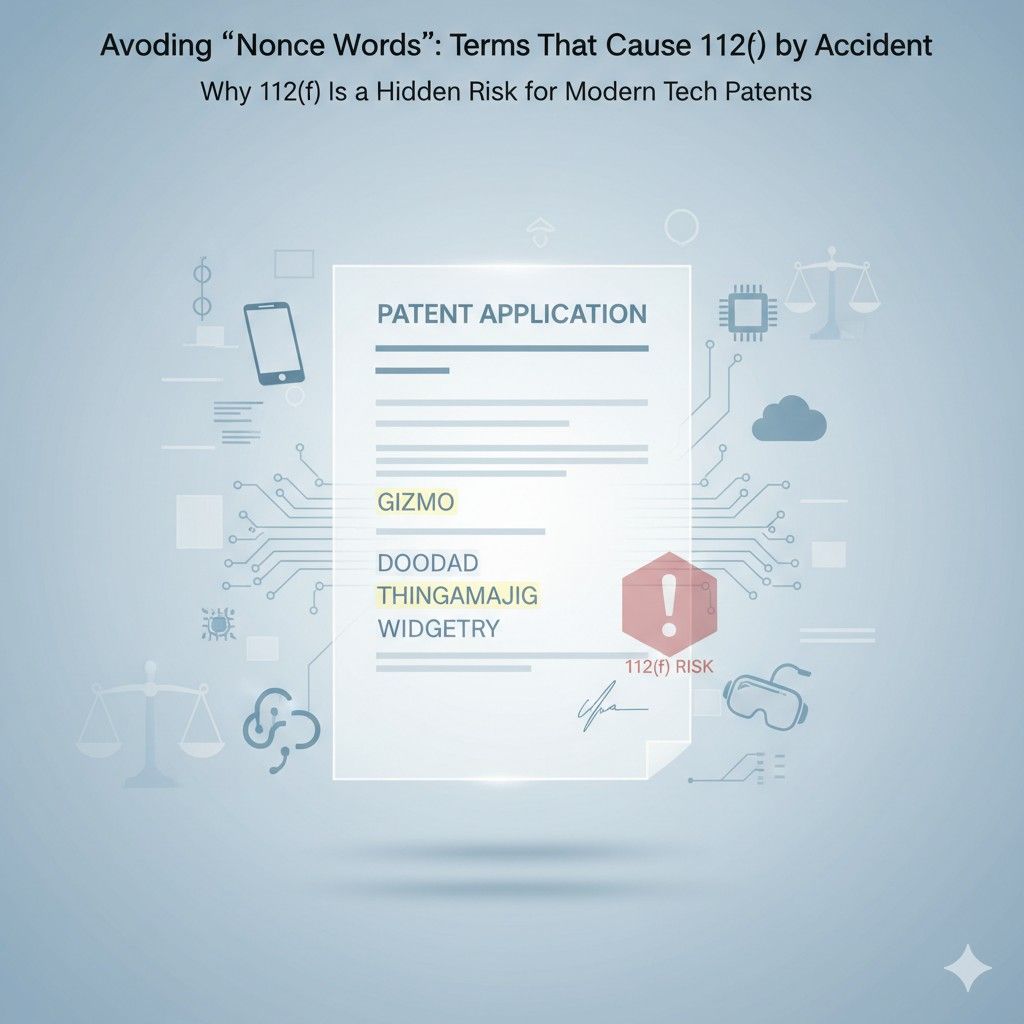
In the next section, we will dig into what nonce words actually are, why courts treat them with suspicion, and how they became such a common problem in modern patent drafting.
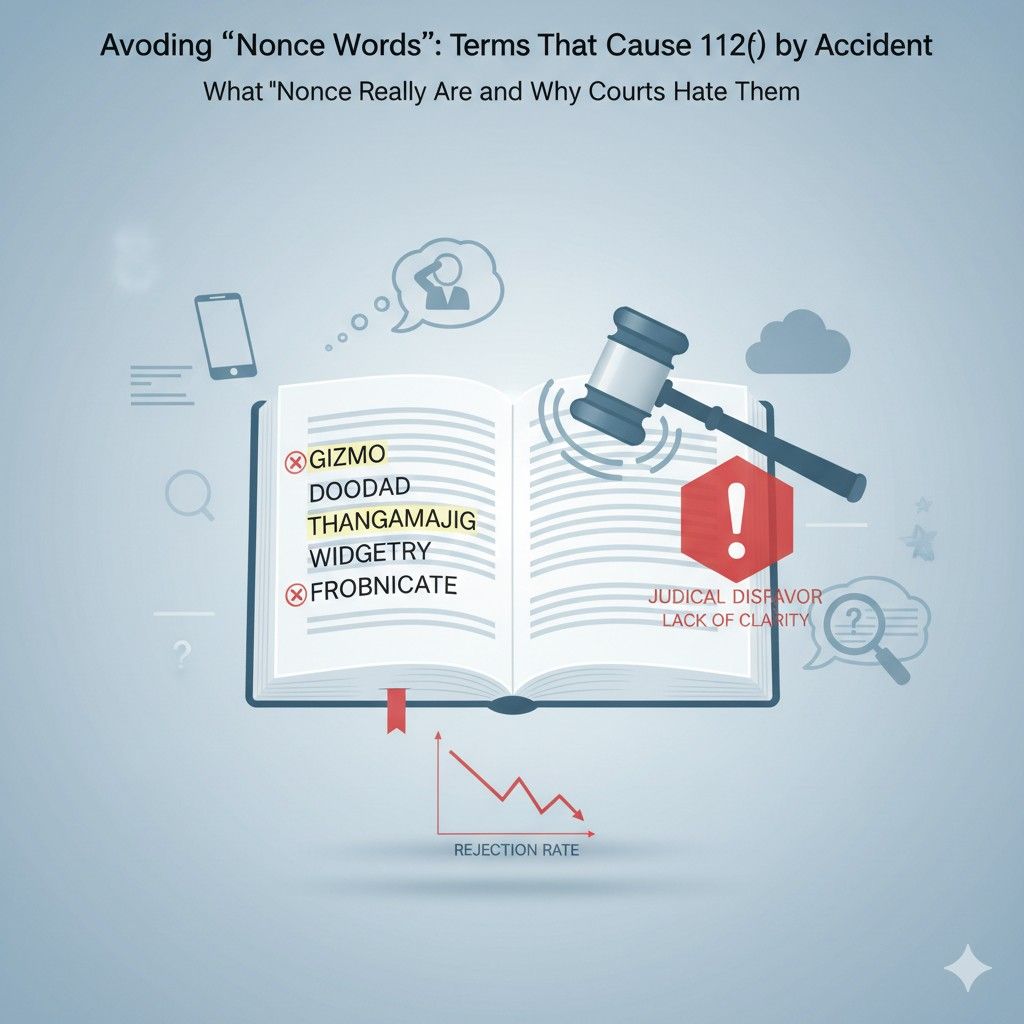
What “Nonce Words” Really Are and Why Courts Hate Them
Nonce words sound harmless. They often feel technical, flexible, and safe.
That is exactly why they cause so much trouble. Courts see these words very differently than founders and engineers do, and that mismatch is where patents quietly lose strength.
The Plain Meaning of a Nonce Word
A nonce word is a stand-in. It is a label that points to something without clearly saying what that thing is or how it works. In normal writing, this is fine. In patents, it can be fatal.
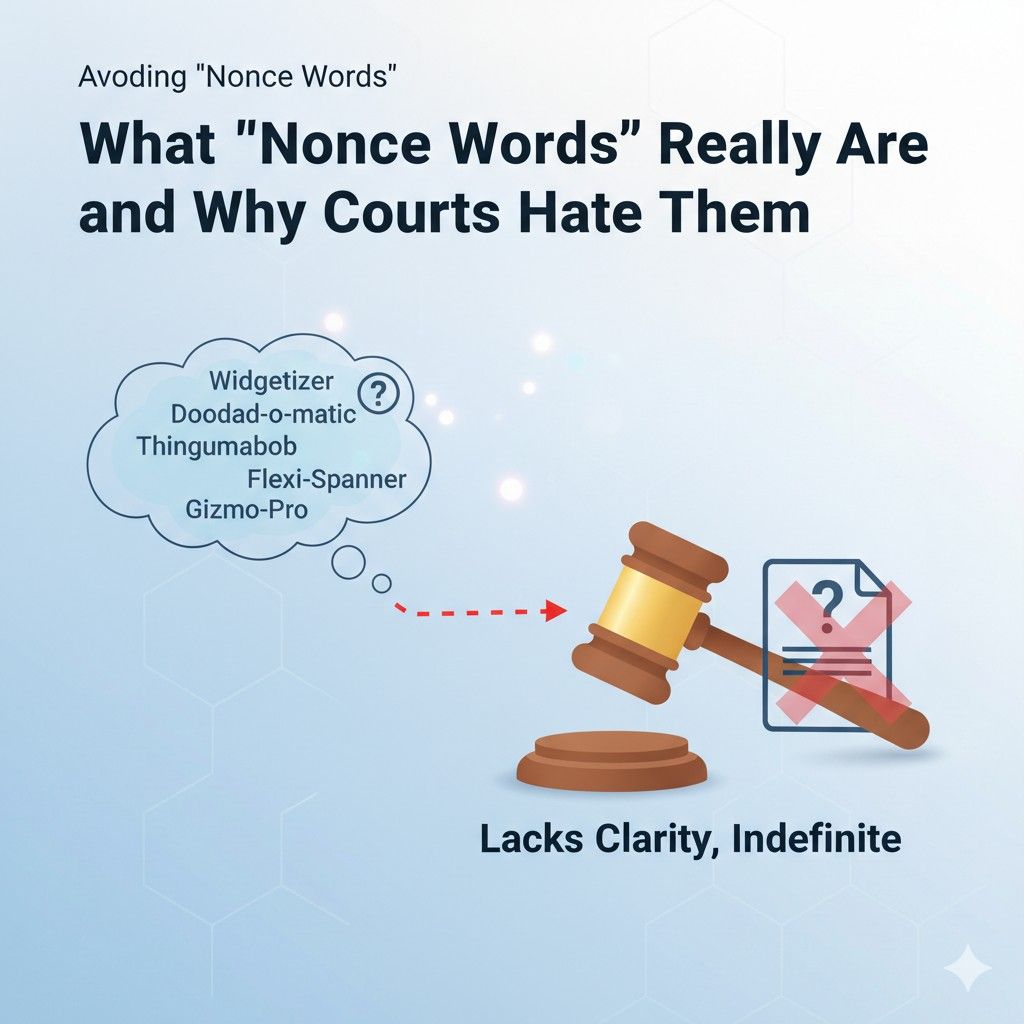
Courts view these words as empty containers. If a word does not carry real structure or clear meaning by itself, judges assume it is just a placeholder. When that happens inside a claim, 112(f) is triggered almost automatically.
Why These Words Feel So Natural to Use
Founders use nonce words because they mirror how teams talk internally. Product specs, design docs, and architecture diagrams are full of terms that summarize big ideas in small labels.
Everyone on the team understands them, so they feel precise.
Patents do not work that way. A patent must stand on its own, years later, in front of people who have never seen your product. When a word only makes sense with inside knowledge, courts treat it as vague, even if it felt clear at the time.
The Court’s Core Question
When judges review a claim, they ask a simple question: does this word tell me what the thing is, or just what it does? If the word only describes a result or function, without grounding it in real meaning, it raises alarms.
Courts are not trying to punish inventors. They are trying to avoid granting patents that claim ideas without limits. Nonce words fall into that danger zone because they look like shortcuts around real description.
Why Software Claims Are Hit the Hardest
Software patents rely heavily on functional language. Software is behavior, not metal or plastic. That makes it easy to slip into abstract naming.
Words like engine, module, unit, system, or component often appear helpful. In practice, courts often see them as empty shells unless the surrounding language gives them clear weight.
This is why software and AI patents see 112(f) disputes far more often than mechanical ones.
The False Sense of Breadth
Many founders believe that using broad labels keeps their patent broad. The reality is the opposite. When a court decides a word is a nonce word, the claim collapses inward.
Instead of covering all ways of achieving a result, the claim only covers the exact method described in the patent text. That means your protection freezes in time, stuck on an early version of your tech.
How This Plays Out in Real Disputes
In litigation, accused infringers hunt for weakness. They look for claim terms that can be framed as nonce words. Once they find one, they argue that 112(f) applies and that their product uses a different structure.
Many cases turn on this argument alone. The invention may be clever. The market impact may be huge. None of that matters if the claim language gives the court a reason to narrow it.
Why Intent Does Not Save You
Founders often say they never meant to claim just one structure. Unfortunately, patent law does not care about intent. Only the words matter.
Even if the rest of the patent suggests broader ideas, a single poorly chosen term in a claim can override that. This is why careful drafting is not optional. It is strategic defense.
The Long Shadow of Early Drafts
Nonce words often enter during early drafts. Maybe a founder writes a first version. Maybe an engineer contributes language. Maybe a template is reused. Those words can survive all the way to issuance.
Years later, no one remembers why a term was chosen. But the legal effect remains. This is why early review and intentional wording matter more than last-minute polish.
How Awareness Changes Drafting Behavior
Once founders understand nonce words, they start reading claims differently. They stop asking whether a sentence sounds smart and start asking whether each key term stands on its own.
This shift alone reduces risk. It leads to clearer claims, stronger coverage, and fewer surprises later. It also makes conversations with patent counsel more productive because founders know what to push on.
Building Claims That Age Well
A strong patent should still make sense ten years later. Nonce words often age poorly because they rely on context that fades. Clear functional language, tied to real behavior, holds up better over time.
This is not about adding complexity. It is about choosing words that carry meaning without hand-waving. That skill separates fragile patents from durable ones.
Why This Is a Fixable Problem
The good news is that nonce word issues are avoidable when caught early. With the right review process, risky terms can be spotted and rewritten before filing. This is far cheaper and easier than fighting about scope later.
At PowerPatent, this is a core focus. Our tools and attorney review are designed to flag these subtle risks before they become permanent.
That gives founders more confidence that their patents will actually protect what they build.
You can learn more about that approach here: https://powerpatent.com/how-it-works
In the next section, we will look at how innocent claim language quietly shrinks patents in practice, even when everything else seems right.
How Innocent Claim Language Can Quietly Shrink Your Patent
Most weak patents do not look weak on the surface. They read cleanly. They feel professional.
They often get approved without much resistance. The problem is not obvious until someone tries to rely on them. That is when innocent language choices reveal their real cost.
How Scope Is Decided After Filing
Once a patent is filed, its claims become fixed. Years later, when a court looks at those claims, it does not ask what the inventor hoped to protect. It asks what the words objectively mean.
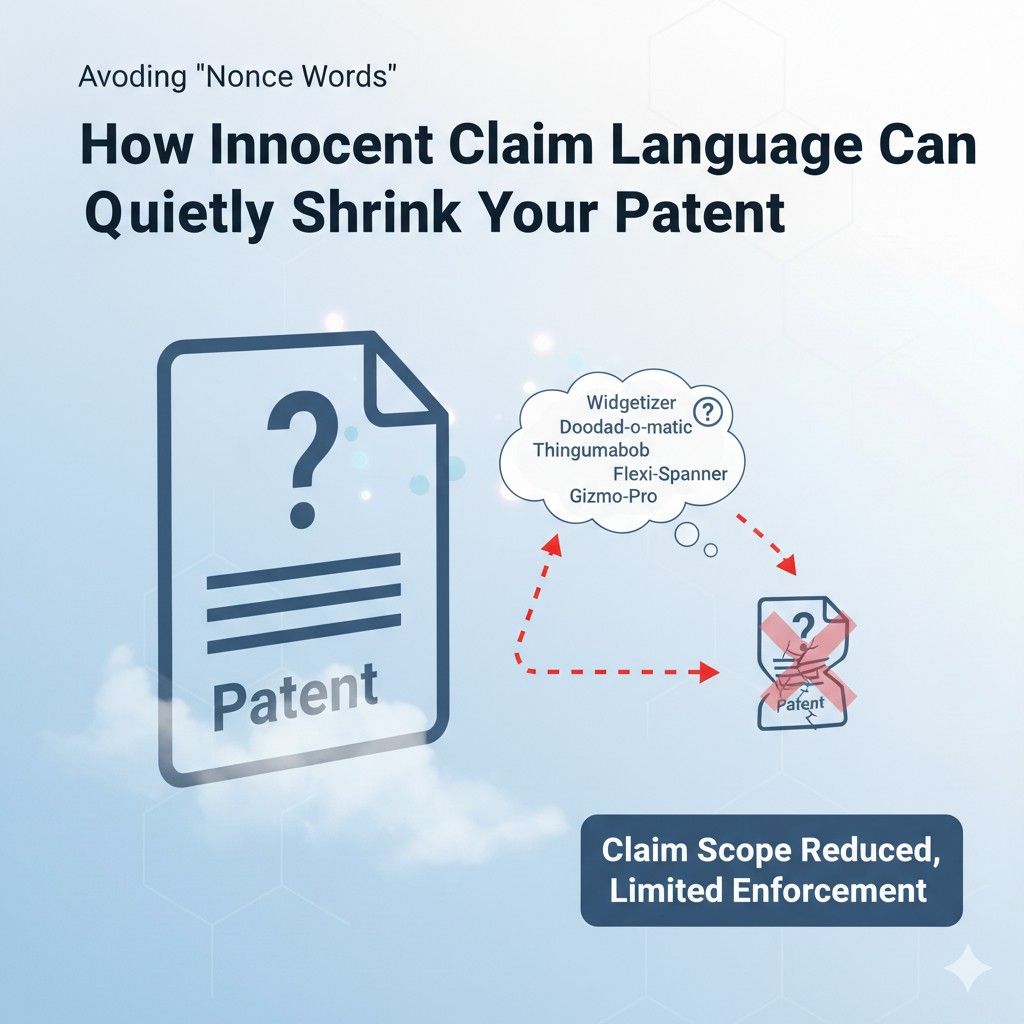
If a claim term is seen as vague or empty, the court will narrow it. This narrowing does not require bad faith or confusion. It is a standard legal move meant to avoid giving inventors more than they clearly described.
The Quiet Shift From Broad to Narrow
A claim can start broad and end narrow without changing a single word. This happens during interpretation. When 112(f) is triggered, the court ties the claim to specific examples in the patent text.
Suddenly, what felt like a general concept becomes a single pathway. Competitors who use different approaches may fall outside your protection, even if they copy the core idea.
Why This Is Hard to Spot Early
During drafting, everything feels flexible. The invention is fresh. The language still feels connected to the idea in your head. That makes it hard to see which words are doing real work and which are just labels.
Because patents are long-term assets, this gap between present clarity and future interpretation becomes dangerous. What feels obvious today may look vague years later.
The Problem With Relying on the Specification
Some founders assume that as long as the patent description is detailed, the claims will be safe. That is not always true. Claims stand on their own.
When 112(f) applies, the court uses the description to limit the claim, not expand it. That means your own examples become a ceiling instead of a floor. The more specific they are, the easier it is for others to step around them.
How Competitors Use This Against You
Competitors do not need to attack your entire patent. They only need to find one weak point. A single nonce word can become the lever they use.
By arguing that a term triggers 112(f), they shift the debate from what your invention is to how narrowly it must be read. This often changes the outcome of infringement analysis.
The Illusion of Safety in Approved Patents
Approval does not mean strength. Patent examiners are focused on novelty and prior art. They are not always focused on future claim interpretation battles.
Many patents with 112(f) issues are approved without comment. Founders assume everything is fine. The real test comes much later, when the cost of weakness is much higher.
Why Iterative Products Suffer the Most
Startups rarely stop evolving. Features change. Architectures shift. Use cases expand. A patent that is tied too closely to an early version can quickly fall behind the product.
When claim language shrinks scope, it often locks the patent to a snapshot in time. That misalignment between product growth and patent coverage creates risk during scale.
How Small Words Control Big Outcomes
In patents, small words carry heavy weight. A single term can decide whether your patent covers a category or just a single example.
Founders who treat claims as strategic tools, not formalities, gain an edge. They review each term with an eye toward future enforcement, not just present approval.
Practical Thinking During Review
A useful exercise is to imagine a smart competitor reading your claim. Ask whether they could design around it with a small change. If the answer is yes, look closely at the language enabling that escape.
Another approach is to explain your claim to someone unfamiliar with your tech. If they struggle to understand what a key term actually is, that term may be too vague to protect you well.
Strength Comes From Intentional Clarity
Clarity does not mean narrowness. The best patents are clear about what they cover while staying open to many implementations.
This requires deliberate word choice and early challenge of assumptions. It is not about writing more. It is about writing with purpose.
Why Modern Drafting Needs Modern Tools
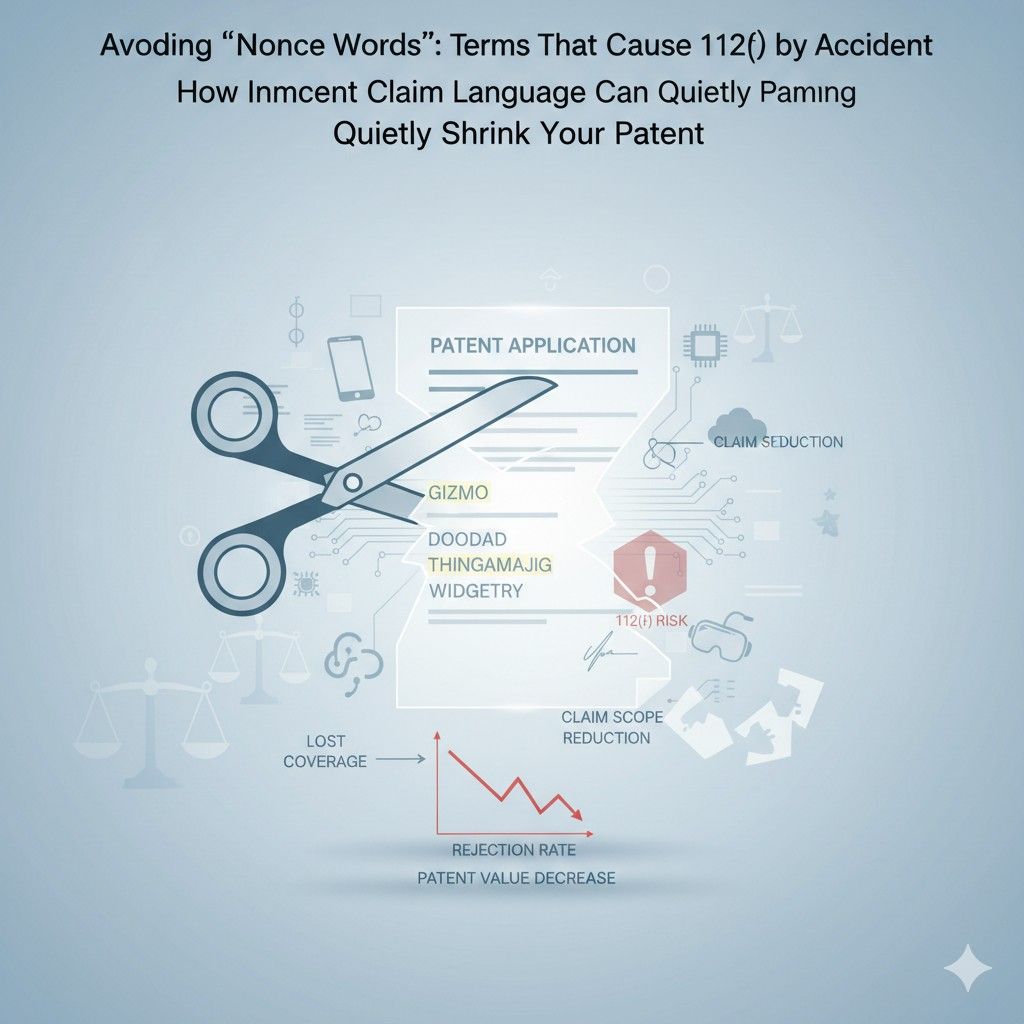
Given how subtle these issues are, relying on intuition alone is risky. Structured review, pattern detection, and experienced oversight help surface problems before they are locked in.
At PowerPatent, we focus on these exact pressure points. Our platform helps founders spot language that could quietly shrink their patents and fix it early. That way, the protection grows with the company, not against it.
You can see how that works here: https://powerpatent.com/how-it-works
In the next section, we will explore how to write claims that stay broad without triggering 112(f), and how to balance clarity with flexibility.
Writing Claims That Stay Broad Without Triggering 112(f)
Writing strong patent claims is less about sounding technical and more about being intentional. The goal is to protect the core idea in a way that survives time, competition, and product changes.
This section focuses on how founders and teams can think differently when shaping claim language so it stays broad without falling into the 112(f) trap.
Starting With Behavior, Not Labels
Strong claims begin with what the invention does, not what you call it. Labels are tempting because they feel tidy. Behavior is safer because it carries meaning.
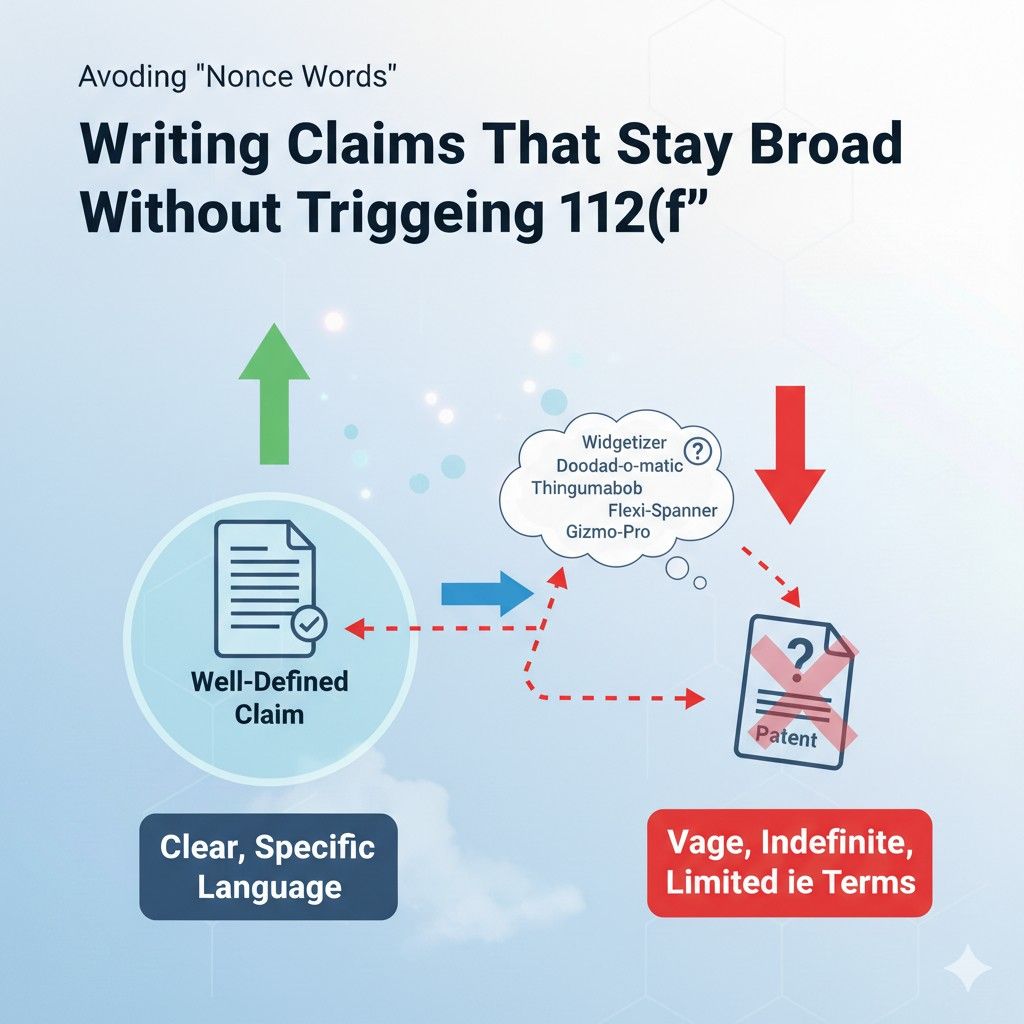
When a claim describes actions, relationships, and outcomes in clear terms, courts have less reason to assume hidden structure. This keeps the claim anchored in function without relying on empty placeholders.
Giving Words Real Weight
A term becomes dangerous when it floats on its own. A term becomes safe when the surrounding language gives it substance.
This does not require long explanations. It requires thoughtful phrasing. When a term is immediately tied to how it operates or interacts, it stops looking like a stand-in and starts looking like a real part of the invention.
Avoiding the Shortcut Mindset
Many nonce words enter claims because they feel like shortcuts. They seem to cover more with fewer words. In practice, they often do the opposite.
Founders should resist the urge to compress big ideas into vague nouns. Taking a few extra words to describe behavior can dramatically improve long-term protection.
Thinking Like a Future Court
A helpful mental shift is to imagine your claim being read by someone with no stake in your success. That person is not trying to help you. They are trying to interpret.
If a term depends on context, assumptions, or insider knowledge, it is risky. If the term stands on its own and points clearly to behavior, it is safer.
Designing for Product Evolution
Claims should be written with tomorrow’s product in mind. Ask whether a major refactor would still fall under the language. If not, the claim may be too tied to today’s implementation.
This forward-looking approach often exposes weak terms. Fixing them early keeps the patent aligned with growth instead of freezing it in place.
Reviewing Claims as Strategic Assets
Claims deserve the same attention as architecture decisions. They define boundaries. They shape leverage. They influence valuation.
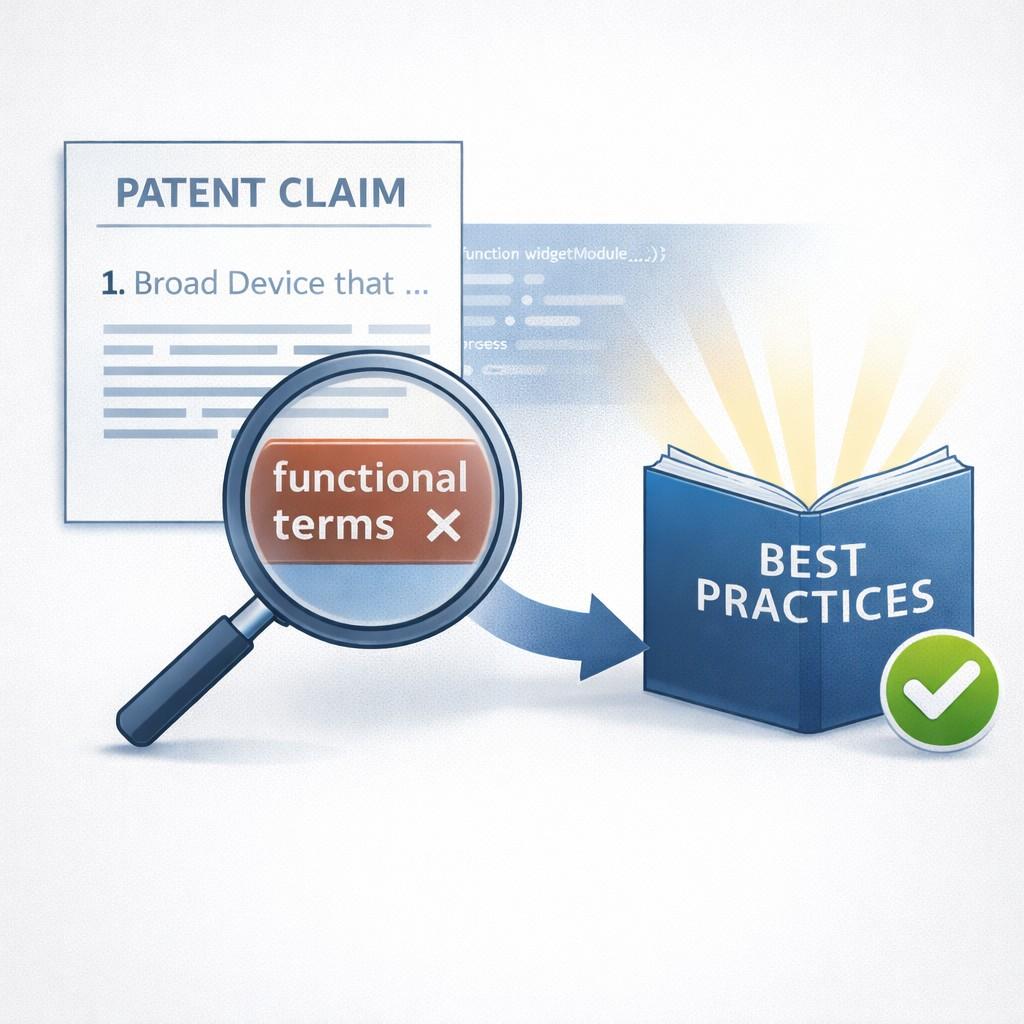
Founders who review claims carefully, even without deep legal knowledge, often catch issues others miss. Simply asking why a word is there can uncover hidden risk.
When Simpler Language Wins
Complex words do not make patents stronger. Clear words do. Courts prefer plain language that explains behavior over fancy terms that obscure it.
This aligns well with how PowerPatent approaches drafting. We focus on clarity that holds up under pressure, not complexity that collapses when challenged.
Using Examples Without Locking Yourself In
Examples are valuable, but they should not define the limits of the claim. When claims rely too heavily on specific examples, they invite narrowing.
A balanced approach uses examples to support understanding while keeping the core claim language flexible. This balance protects against 112(f while still satisfying disclosure requirements.
Building a Habit of Claim Testing
Founders can build a simple habit of testing claims by asking how many different ways the invention could be built under the same language. The more answers, the better.
If only one path fits, the claim may be too narrow. Adjusting language early is far easier than discovering this problem later.
Why Process Matters More Than Talent
Avoiding 112(f) is not about being a brilliant writer. It is about having the right process. Structured review, clear goals, and early feedback catch issues that raw talent often misses.
This is why PowerPatent combines smart software with real attorney oversight. The process is designed to surface subtle risks and fix them while founders still have control.
You can learn more about that approach here: https://powerpatent.com/how-it-works
Turning Awareness Into Advantage
Founders who understand nonce words and 112(f) gain a quiet advantage. They ask better questions. They make better drafting decisions. Their patents age better.
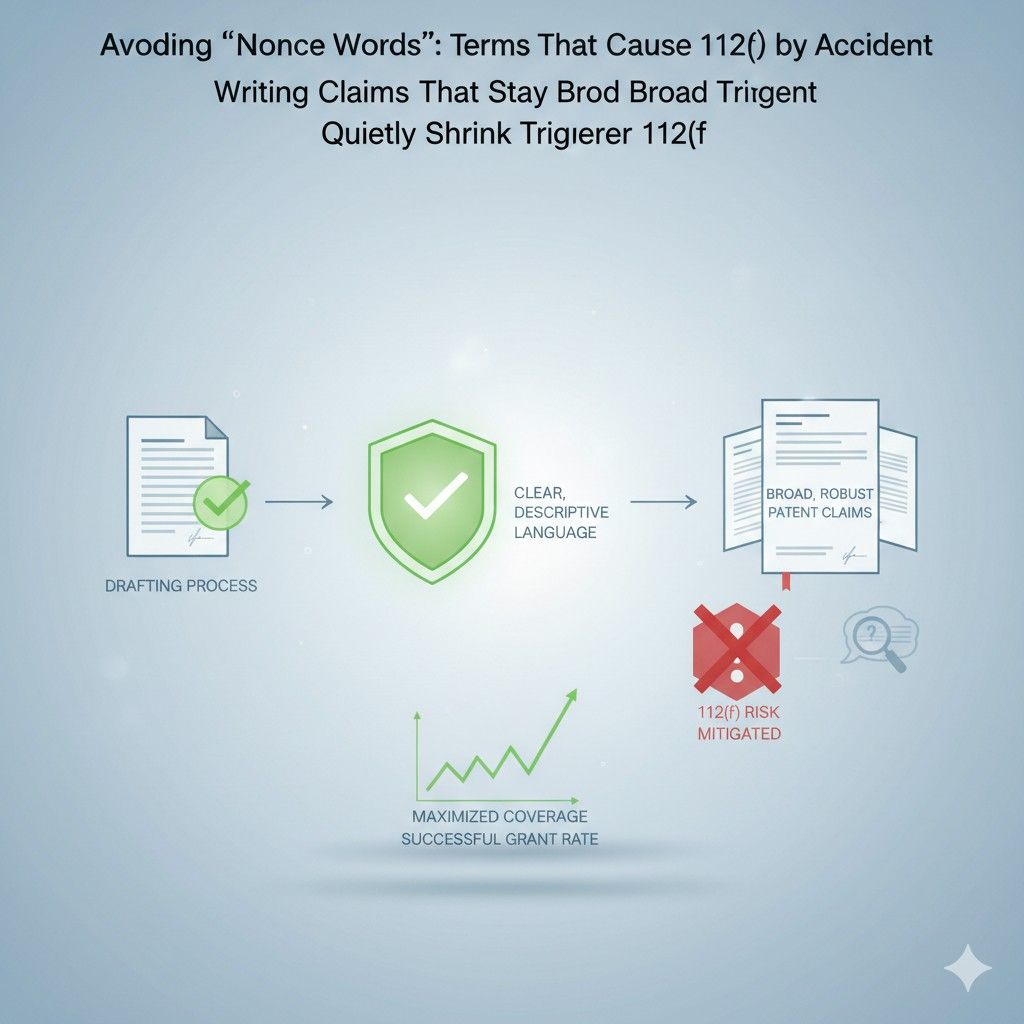
Strong patents are not accidents. They are the result of deliberate choices made early, when those choices are easiest to change.
Wrapping It Up
112(f) problems rarely come from bad intentions or weak inventions. They come from normal language choices that feel safe in the moment but carry hidden consequences over time. Nonce words are especially dangerous because they look harmless and familiar, yet courts often treat them as empty placeholders that quietly shrink patent scope. For modern tech businesses, this risk is amplified. Software, AI, and platform-based products evolve fast, and patents that are tied too closely to early wording struggle to keep up. When claims are narrowed by accident, patents lose their power right when founders need them most—during competition, fundraising, or acquisition talks.