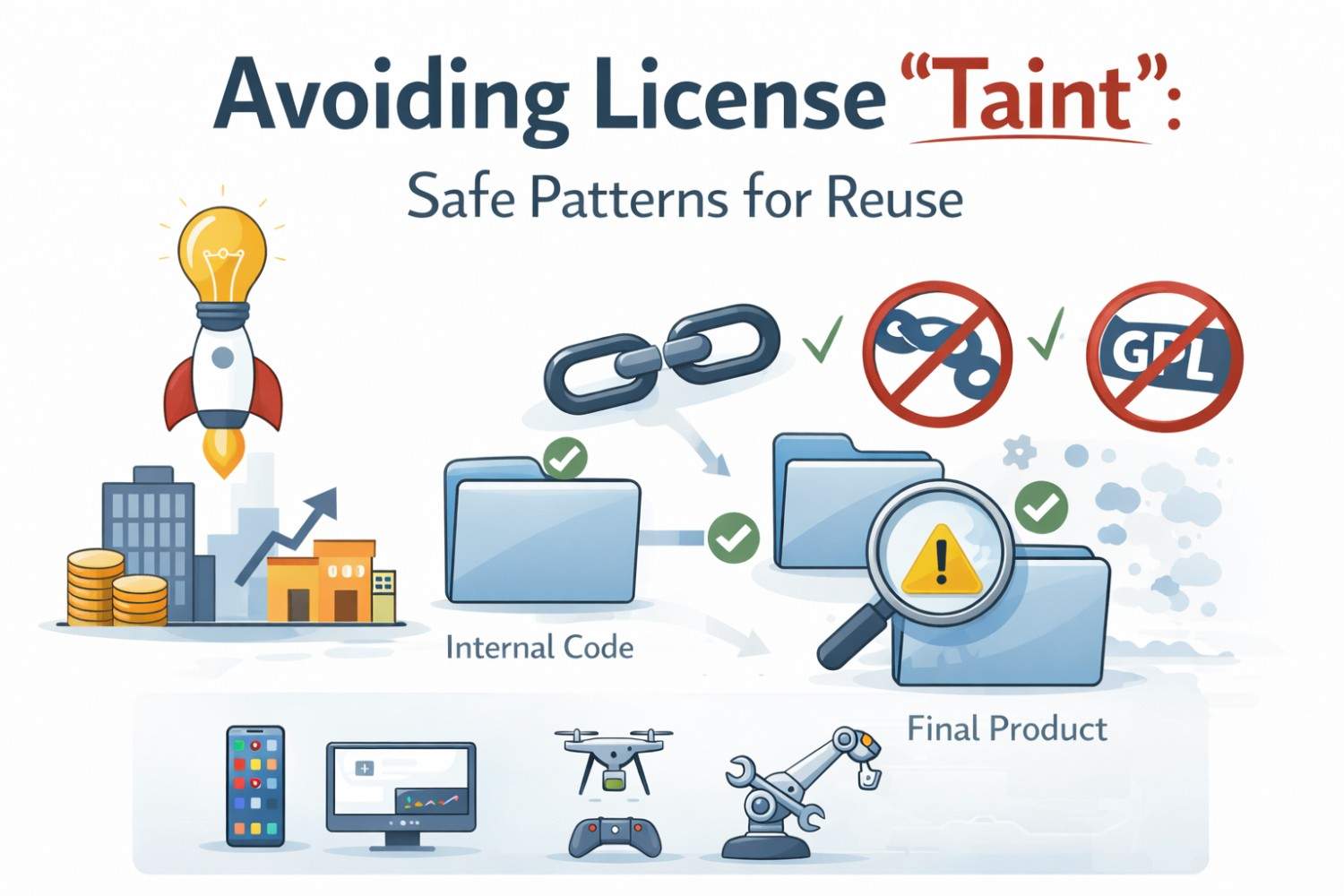
You move fast because you have to. You reuse code because that is how real products get built. But one wrong reuse choice can quietly infect your product and later blow up a deal, a fundraise, or an acquisition. This article is about how to reuse safely, stay clean, and protect what you are building without slowing down.
Before we go deep, keep this in mind: strong patents and clean ownership go hand in hand. If you want to build with confidence, this is exactly why founders use PowerPatent.
Why License “Taint” Is a Silent Startup Killer
License taint is dangerous because it does not feel dangerous when it happens. It feels like progress. Code compiles. Features ship. Demos work. Customers sign up.
Everything looks fine on the surface. The problem is that license taint does its damage quietly, in the background, and usually shows up only when the stakes are high.
This section explains why this issue hurts startups more than anyone else, how it sneaks into real products, and what founders can do early to protect their company without slowing down development.
It Does Not Break Your Product, It Breaks Your Leverage
Most technical risks break things fast. A bad architecture causes outages. A scaling issue causes slowdowns. License taint is different. It does not break your app. It breaks your leverage.
When you sit across from an investor, a buyer, or a partner, they care about one thing more than your tech stack.
They care about who owns what. If you cannot clearly say that you own the core of what you built, your power in that room drops instantly.
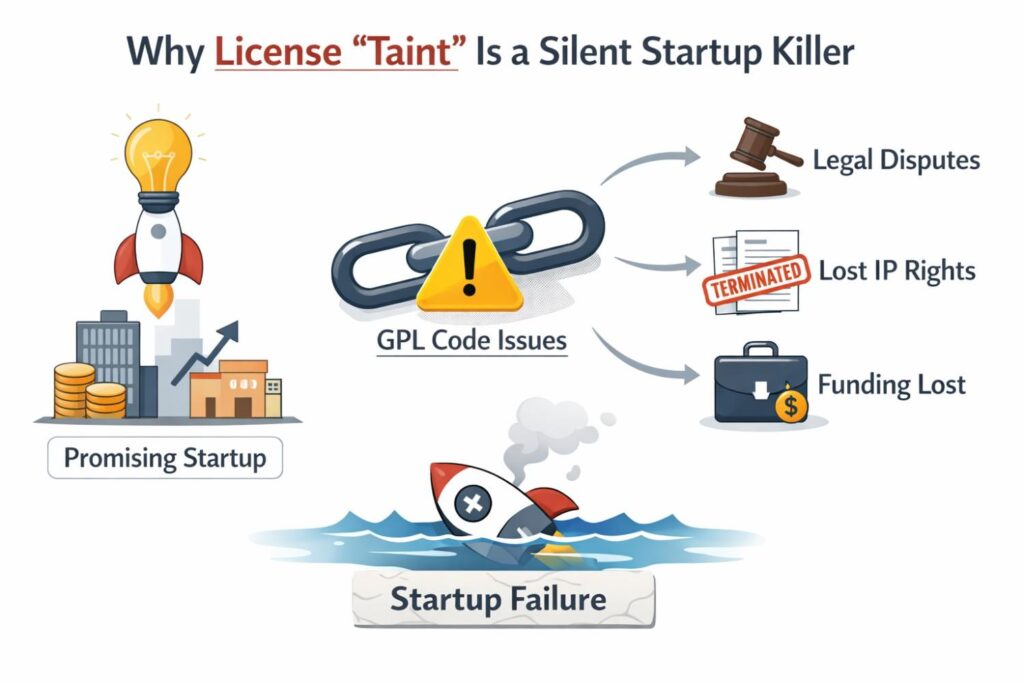
This is why license taint is so dangerous. You can spend years building momentum and still lose control in one meeting because a reused component pulled in rules you did not understand.
It Shows Up at the Worst Possible Time
License problems almost never surface during building. They surface during diligence. That is when lawyers start asking hard questions and looking closely at how your product was made.
This timing is brutal for startups. At that point, you are tired, busy, and emotionally invested. You may already have a term sheet or a buyer on the hook.
When a license issue appears then, you are negotiating from a weak position.
The worst part is that fixing license taint late is slow and expensive. Code may need to be rewritten.
Features may need to be removed. In some cases, deals fall apart entirely. All of this could have been avoided with better reuse habits early on.
Engineers Reuse for Speed, Licenses Care About Control
Engineers reuse code to move faster. That instinct is correct and necessary. Startups cannot survive without reuse. The problem is that licenses do not care about speed. They care about control and boundaries.
Some licenses are friendly. Others come with strings that pull on your product in ways that are hard to see.
A single dependency can quietly force you to share source code, limit how you sell your product, or restrict how you license it later.
The danger is not reuse itself. The danger is reuse without understanding how that reuse spreads through your codebase and into your business model.
Taint Spreads, It Rarely Stays Contained
One of the most misunderstood parts of license taint is how it spreads. Founders often assume that if reused code is a small part of the system, the risk is small. That assumption is often wrong.
Code touches code. Interfaces blur. Over time, reused components become tightly connected to your core logic. When that happens, it becomes very hard to separate what you own from what you borrowed.
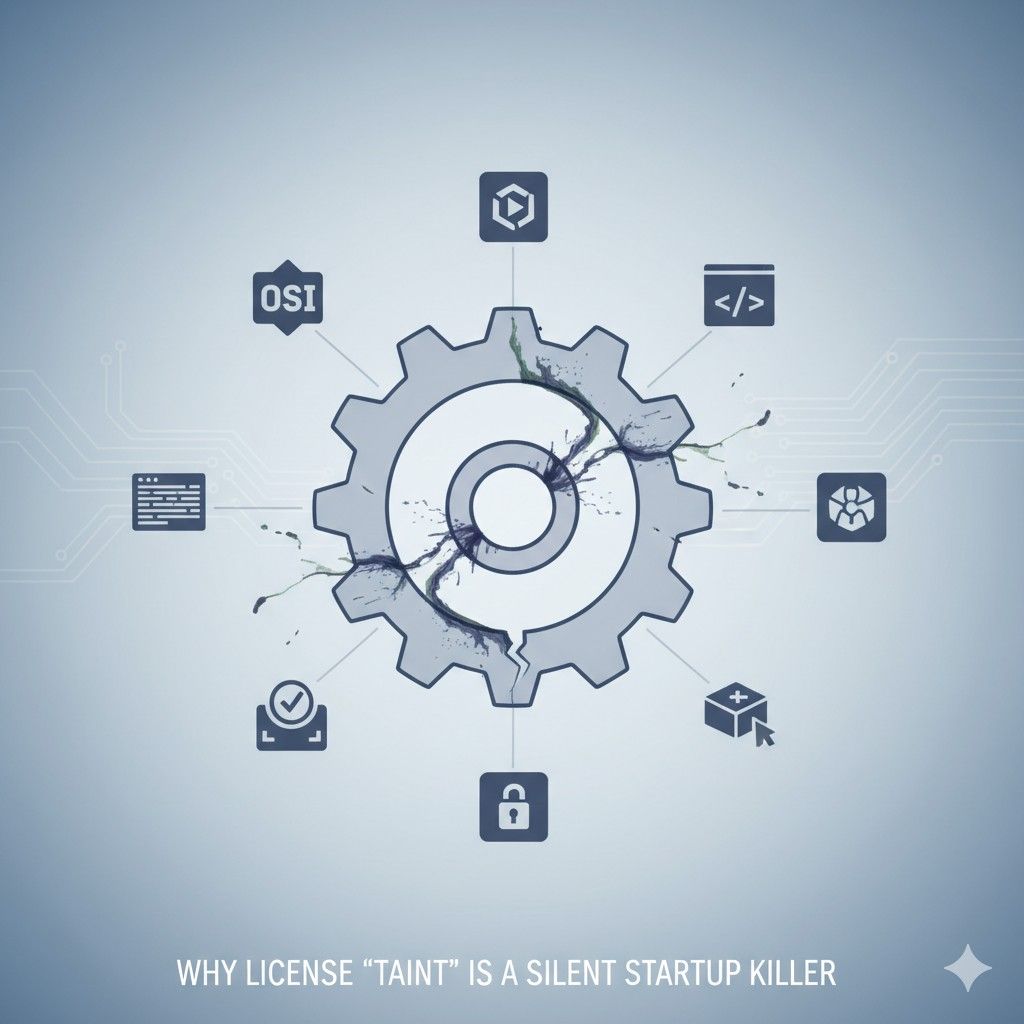
This is why early decisions matter so much. What feels like a harmless shortcut today can become deeply embedded in your product a year from now.
Investors Do Not Need Perfect Code, They Need Clear Ownership
Investors know that startups reuse open code. That is not the problem. The problem is uncertainty.
If you cannot clearly explain what licenses you are using, why you chose them, and how they affect ownership, investors assume risk.
And when investors assume risk, they protect themselves by lowering valuation, adding conditions, or walking away.
Clear ownership stories win trust. Messy stories raise red flags. License taint turns what should be a simple story into a confusing one.
Acquisition Teams Look for Reasons to Say No
Buyers are risk managers. Their job is not to fall in love with your product. Their job is to avoid surprises.
License taint is a surprise waiting to happen. If a buyer believes that acquiring your product could expose them to legal or compliance risk, they will either lower the price or stop the deal.
This happens even when the product works and customers love it. Ownership issues override product quality because they can create long-term problems for the buyer.
The Cost Is Not Legal Fees, It Is Lost Options
Founders often think the cost of license mistakes is legal fees. That is not the real cost. The real cost is lost options.
You lose the option to license your tech freely. You lose the option to sell to certain buyers. You lose the option to pivot your business model without rewriting core systems.
Options are everything in a startup. License taint quietly removes them one by one.
Early Discipline Creates Long-Term Freedom
The good news is that avoiding license taint does not require heavy process or slow development. It requires early discipline.
This means making conscious reuse choices, understanding how licenses behave, and treating core technology differently from supporting tools. It also means documenting decisions while they are still fresh and easy to explain.
Doing this early creates freedom later. You move faster because you are not afraid of what might surface down the road.
Founders Should Own the Risk, Not Just the Code
License decisions are not just engineering decisions. They are business decisions. Founders should understand the basics well enough to ask the right questions and set expectations.
This does not mean founders need to read license text line by line. It means they need systems that make ownership clear and defensible.
This is where having the right tools and guidance matters. Platforms like PowerPatent help founders think about protection early, so technical choices do not accidentally weaken their position later.
You can see how that works at https://powerpatent.com/how-it-works.
Clean Foundations Make Patents Stronger
There is a direct link between clean reuse and strong patents. When you clearly own your core ideas and implementations, it becomes much easier to protect them.
Patent attorneys need clarity. They need to know what is yours, what is borrowed, and how your invention stands apart. License taint muddies that picture and can weaken what should be strong intellectual property.
Clean foundations make patents cleaner, stronger, and easier to defend.
The Best Time to Fix This Is Before It Feels Urgent
Most startups only think about license taint when someone asks about it. By then, the pressure is high and the options are limited.
The best time to address this is when it still feels boring. When the product is young. When changes are easy. When decisions can be made calmly.

If you are building something valuable, it deserves a foundation that will not collapse under scrutiny. That is what safe reuse patterns are really about.
How Reuse Goes Wrong Without You Noticing
Most license problems are not caused by bad intent or careless teams. They are caused by normal behavior in fast-moving companies. Reuse feels harmless because it usually is harmless in the short term.
The danger comes from how small decisions stack up over time without anyone stepping back to look at the full picture.
This section walks through the common ways reuse quietly drifts into risky territory, even in strong engineering teams, and how founders can spot these patterns early while they are still easy to fix.
It Starts With a Single Helpful Snippet
Almost every license issue begins the same way. An engineer finds a snippet online, copies it in, tweaks it, and moves on. The snippet solves a real problem. It saves time. It works.
At that moment, nothing feels risky. The code is small. The change is quick. No one thinks of it as a dependency.
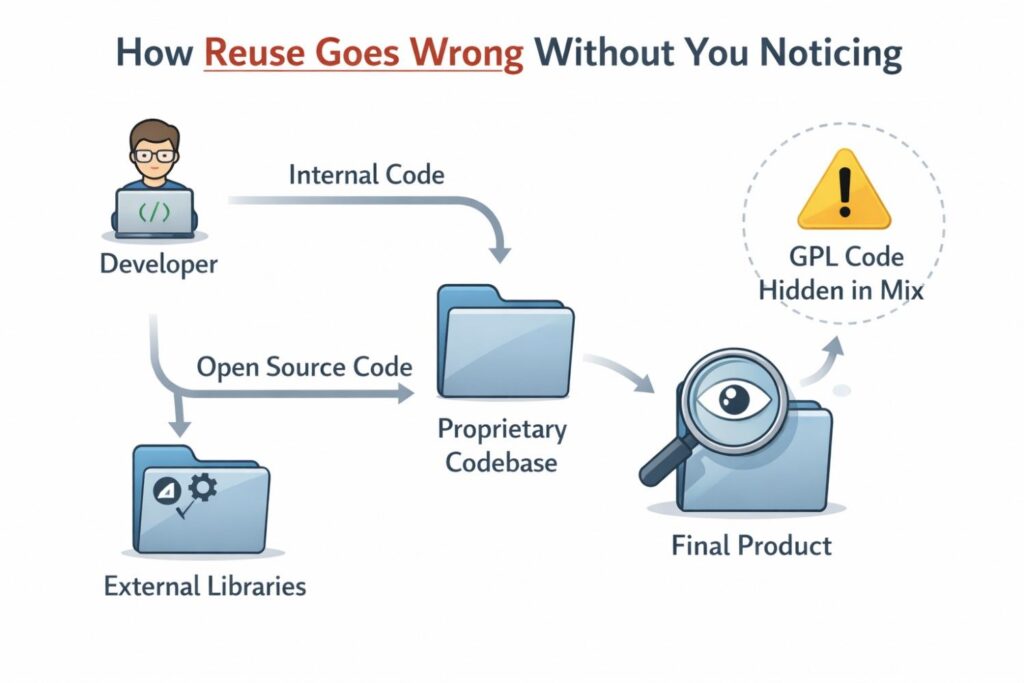
But that snippet often becomes a seed. Other parts of the system start relying on it. Logic grows around it. Tests assume it exists.
Over time, that small piece becomes part of your product’s spine, even though no one remembers where it came from or what rules came with it.
Dependencies Grow Faster Than Awareness
Modern development relies heavily on packages and libraries. This is normal and healthy. The problem is that dependencies grow faster than awareness.
Teams add packages to solve narrow problems, but few people track how those packages interact or what obligations they carry.
Some licenses behave differently when code is linked, modified, or distributed. These details matter, but they are easy to miss when you are focused on shipping.
What makes this worse is that dependencies often pull in other dependencies. A simple install can bring in dozens of indirect components, each with its own rules.
Reuse Happens in the Gray Areas of Ownership
One of the most dangerous zones for license taint is the gray area between experiments and production.
Early prototypes often reuse code freely. That is fine at the start. The problem is when prototypes quietly become the product. Code that was never meant to ship ends up serving real users.
When this happens, reuse decisions made casually become permanent. The license context of that early code is often forgotten, and no one goes back to clean it up.
Founders should treat any code that survives past experimentation as production code and revisit its origins before it becomes core.
Internal Tools Slowly Become Customer Features
Another common pattern is internal tools turning into customer-facing features. This happens naturally in startups. A script becomes a service. A dashboard becomes part of the product.
Internal tools often use relaxed reuse rules because they are not meant to leave the company. But once they cross that boundary, the rules change.
If reused code was never reviewed with external use in mind, it can bring unexpected obligations the moment customers interact with it.
No One Owns License Decisions Explicitly
In many startups, license decisions are no one’s job. Engineers assume founders are handling it. Founders assume engineers know what they are doing. Legal is not involved yet.
This gap is where problems grow. Without clear ownership, decisions happen by default instead of by design.
The fix is not bureaucracy. The fix is clarity. Someone needs to be responsible for knowing what goes into the product and why.
Convenience Tools Can Create Long-Term Constraints
Some tools feel so convenient that teams stop questioning them. They become part of the workflow. They feel harmless because they are widely used.
But popularity does not equal safety. Some tools are designed for openness, not ownership. When these tools touch core logic, they can quietly shape what you are allowed to do later.
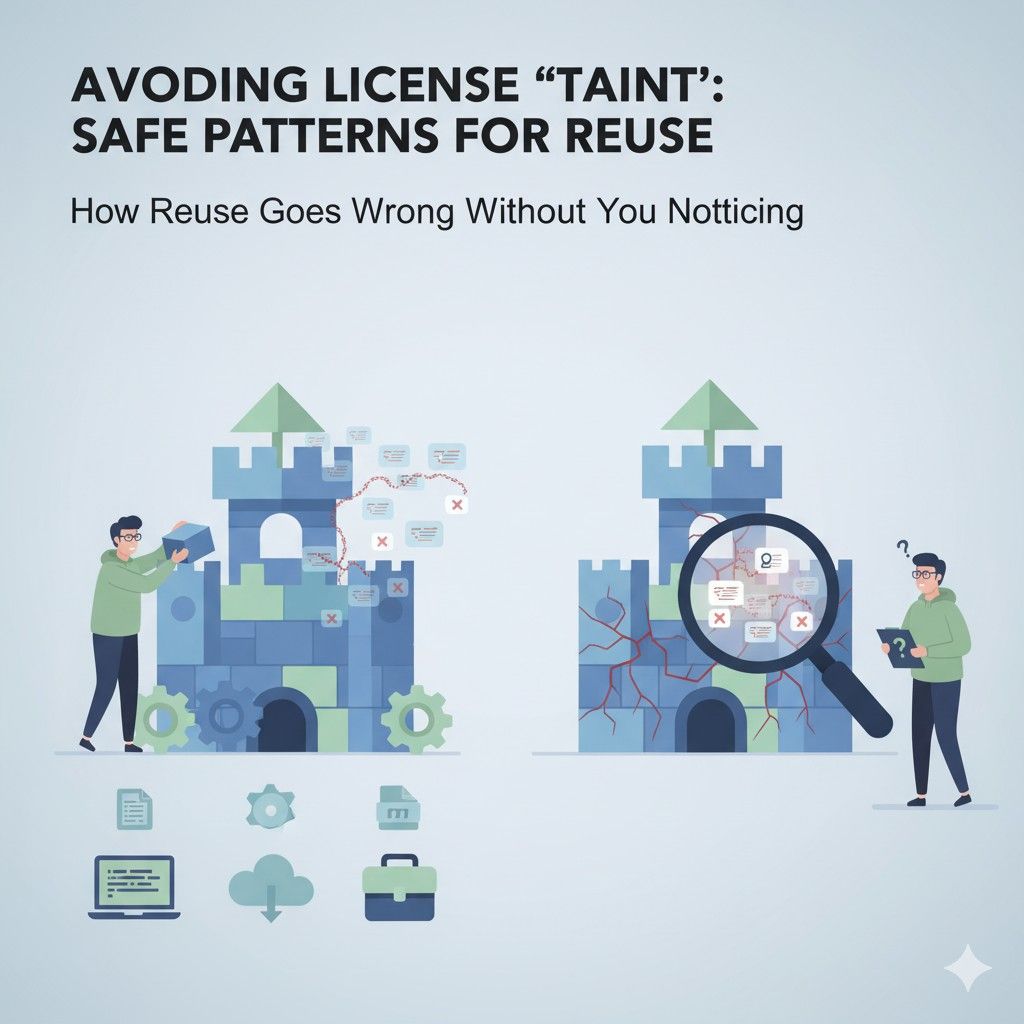
Founders should be especially careful about anything that touches the heart of their product. Convenience should never outrank control in those areas.
Reuse Blurs the Line Between Idea and Implementation
From a business perspective, what matters most is not the code itself but the idea behind it. The problem is that reuse can blur this line.
If your implementation is deeply tied to reused components, it becomes harder to argue that the innovation is truly yours. This matters not just for deals but also for patents.
Clear separation between your ideas and reused building blocks makes your story stronger and easier to defend.
Speed Today Can Cost Months Tomorrow
Every reuse decision saves time today. Some of those decisions cost months later.
Rewriting tainted code under pressure is far slower than making clean choices early. It also distracts teams at the worst possible moment, when focus should be on growth or closing a deal.
The goal is not to avoid reuse. The goal is to reuse with intent and visibility.
Small Reviews Prevent Big Surprises
The simplest way to avoid reuse problems is to pause briefly before code becomes permanent. A short review of where code came from and how it will be used can prevent years of pain.
This does not require legal training. It requires asking basic questions early, when answers are easy.
Teams that build this habit rarely face surprises later.
Clean Reuse Supports Strong IP Strategy
When reuse is handled cleanly, everything downstream becomes easier. Patents are clearer. Diligence is smoother. Conversations with investors feel confident instead of defensive.
This is why smart founders think about reuse and IP together. They are two sides of the same foundation.
PowerPatent was built for founders who want that clarity without slowing down.

The platform helps you build protection alongside your product, not after the fact. You can explore how it works at https://powerpatent.com/how-it-works.
What “Clean Reuse” Actually Looks Like in Real Products
Clean reuse is not about being strict or slow. It is about being intentional. Teams that reuse cleanly do not reuse less. They reuse with clearer lines, clearer stories, and clearer control.
This section explains what that looks like in real companies that move fast and still protect what they build.
Clean Reuse Starts With Knowing What Is Core
Every strong product has a core. This is the part that makes your company valuable. It might be an algorithm, a workflow, a system design, or a way of combining data that others do not have.
Clean reuse begins by treating this core differently. Teams that do this well avoid pulling outside code directly into the heart of their product.
They build the core themselves, even if it takes a little longer, because that is where ownership matters most.
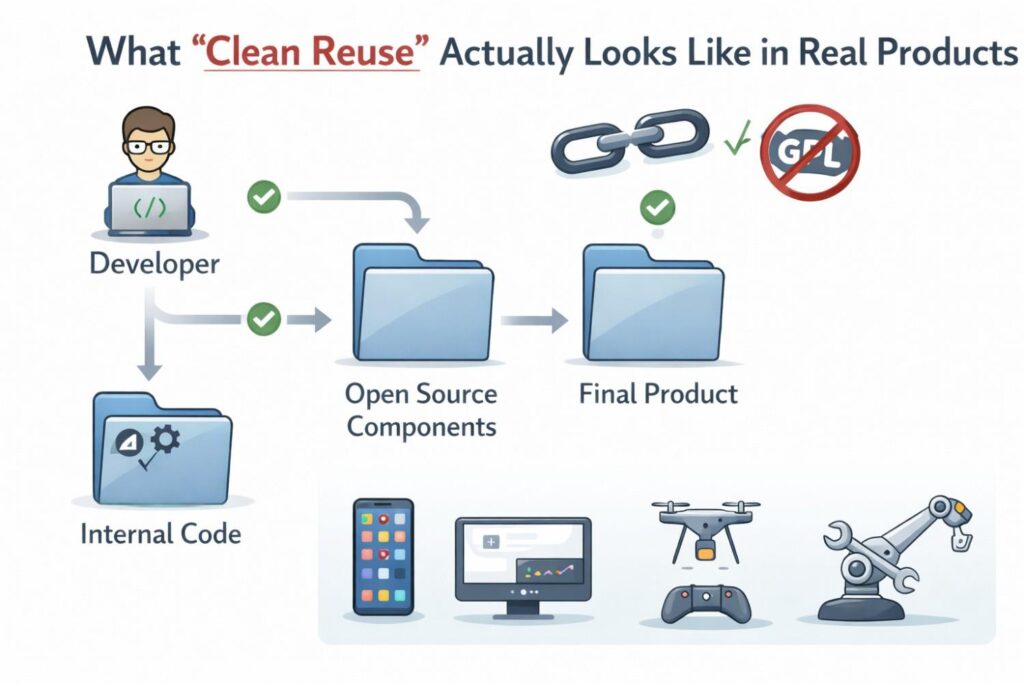
This does not slow teams down in the long run. It prevents future rewrites and keeps strategic control where it belongs.
Supporting Code Is Where Reuse Shines
Clean teams reuse heavily around the core. They reuse for logging, testing, UI elements, data handling, and infrastructure. This is where reuse is safest and most effective.
The key is separation. Supporting code stays supporting code. It does not creep into decision-making logic or define how the product truly works.
This separation makes it easy to explain what your company owns and what it uses. That clarity is gold during diligence.
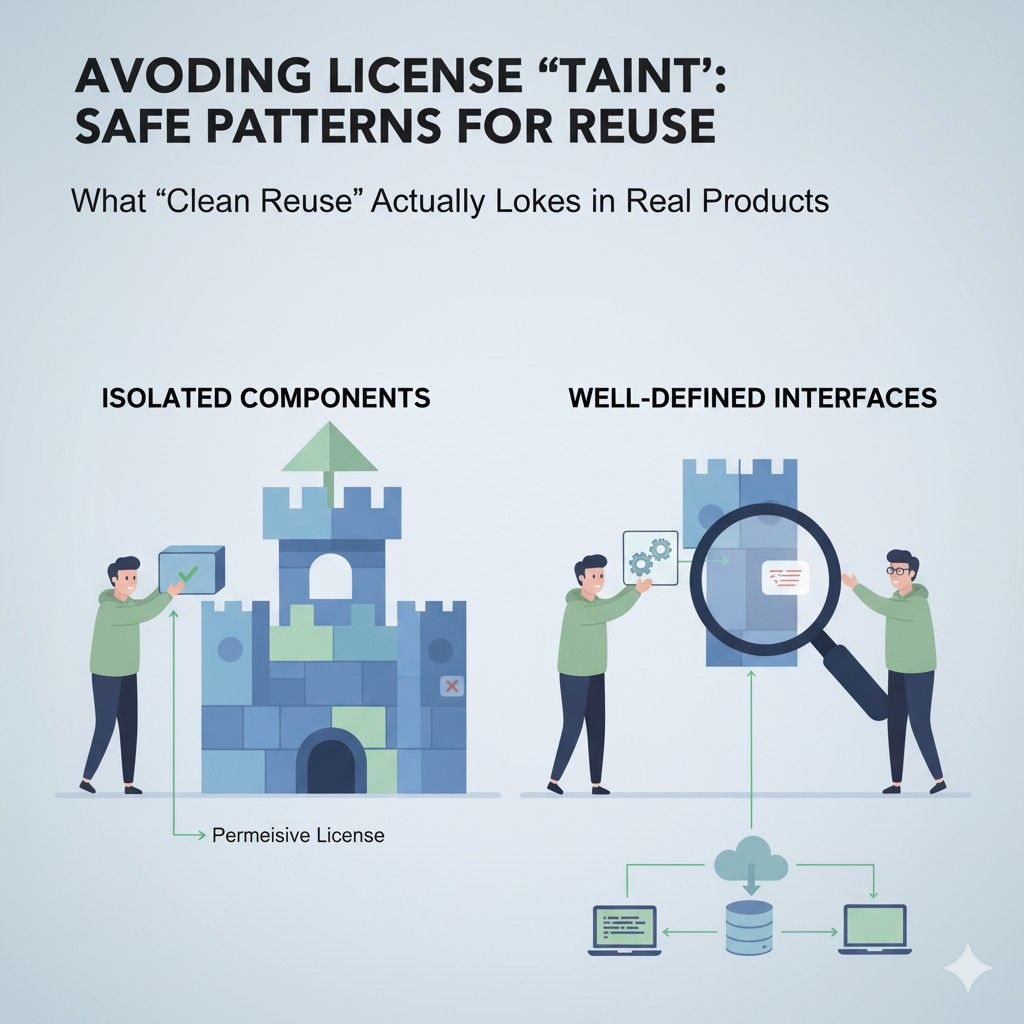
Boundaries Are Clear in the Codebase
In clean systems, boundaries are visible. You can look at the codebase and quickly see what is internal and what is external.
This happens through structure, naming, and discipline. Reused components are not mixed casually into everything else. They are wrapped, isolated, and treated as replaceable.
When boundaries are clear, risk stays contained. If something needs to be swapped out later, it can be done without tearing the product apart.
Decisions Are Documented While They Are Fresh
Clean reuse includes light documentation, done at the right time. When a dependency is added or reused code becomes important, the reason is captured.
This is not about paperwork. It is about memory. Startups move fast, and people change roles. Decisions made today should still make sense to someone reading them a year later.
This habit turns reuse from a mystery into a story you can tell with confidence.
Clean Teams Assume Code Will Be Questioned Later
One mindset shift makes a huge difference. Clean teams assume that everything will be questioned later.
They assume an investor will ask where something came from. They assume a buyer will ask who owns it. They assume a patent attorney will ask what is novel.
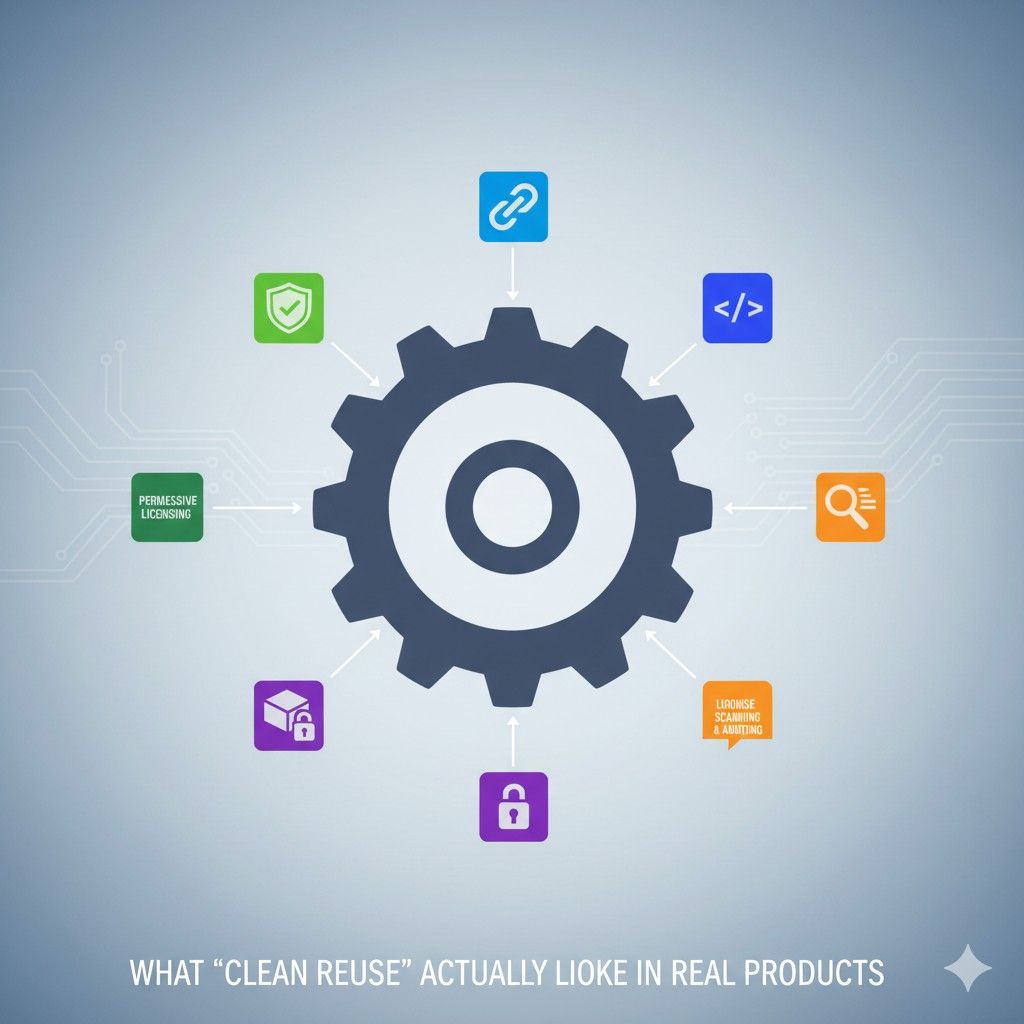
Because they assume this, they build answers into the product as it grows. Nothing feels rushed or defensive later because clarity was built in early.
Prototypes Are Cleaned Before They Become Products
In healthy teams, prototypes are treated honestly. They are allowed to be messy, but they are not allowed to quietly become permanent.
Before prototype code ships to customers or becomes core, it is reviewed. Origins are checked. Risky reuse is removed or isolated.
This moment is one of the highest leverage points in a startup. A small cleanup here can prevent massive problems later.
Internal Use and External Use Are Clearly Separated
Clean reuse respects the difference between code used inside the company and code shipped to customers.
Teams that do this well pause when internal tools start leaking outward. They treat that transition as a real change, not a small tweak.
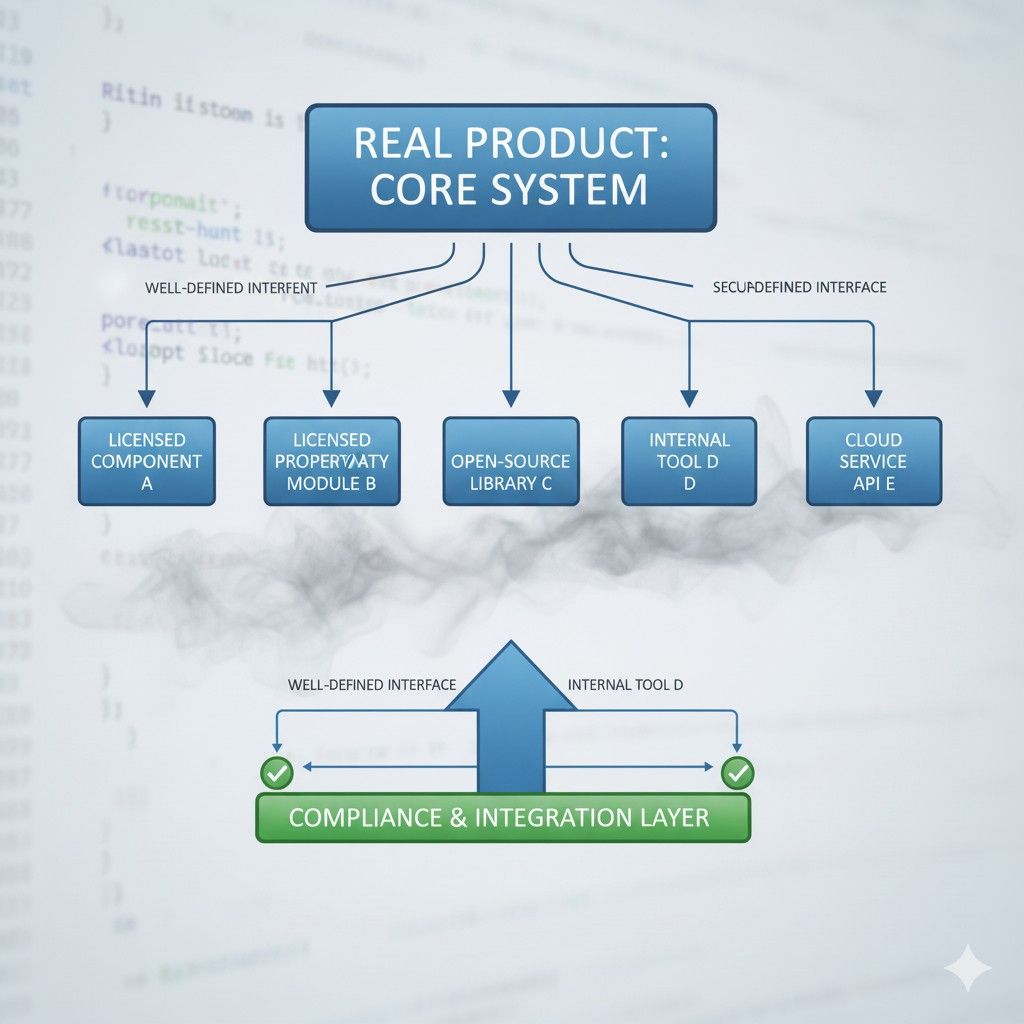
This pause is often where risks are caught and corrected while the cost is still low.
Clean Reuse Makes Patent Work Easier, Not Harder
When reuse is clean, patent work becomes simpler. Attorneys can focus on the invention, not untangling where code came from.
Clear ownership allows stronger claims and clearer explanations. This directly affects the strength and speed of patent filings.
This is why founders who care about IP should care deeply about reuse patterns, even early on.
Founders Set the Tone, Even Without Writing Code
In clean teams, founders set expectations. They make it clear that speed matters, but ownership matters too.
This does not require micromanagement. It requires signaling that reuse choices are part of building a real company, not just a demo.
When founders care, teams follow.
Clean Reuse Is a Competitive Advantage
Most startups do not think about this early. That makes clean reuse a quiet advantage.
When diligence starts, clean teams move faster. When deals get serious, clean teams stay calm. When patents are filed, clean teams are ready.
This confidence shows. It builds trust. It changes outcomes.
Tools and Guidance Make This Easier Than Ever
Founders do not have to figure this out alone. Modern tools exist to support clean ownership and strong protection from the start.
PowerPatent is designed for exactly this reality. It helps founders build, document, and protect what matters while they are still moving fast.
It fits into how startups actually work. You can see how it works at https://powerpatent.com/how-it-works.
Wrapping It Up
Startups do not fail because they reuse code. They fail because they give away control without realizing it. License taint is not a technical flaw. It is a business risk that hides inside technical decisions.
The founders who win long term are not the ones who write every line themselves. They are the ones who know, with confidence, what they own and why. They move fast, but they move with intention. They treat reuse as a tool, not a shortcut that comes with unknown costs.