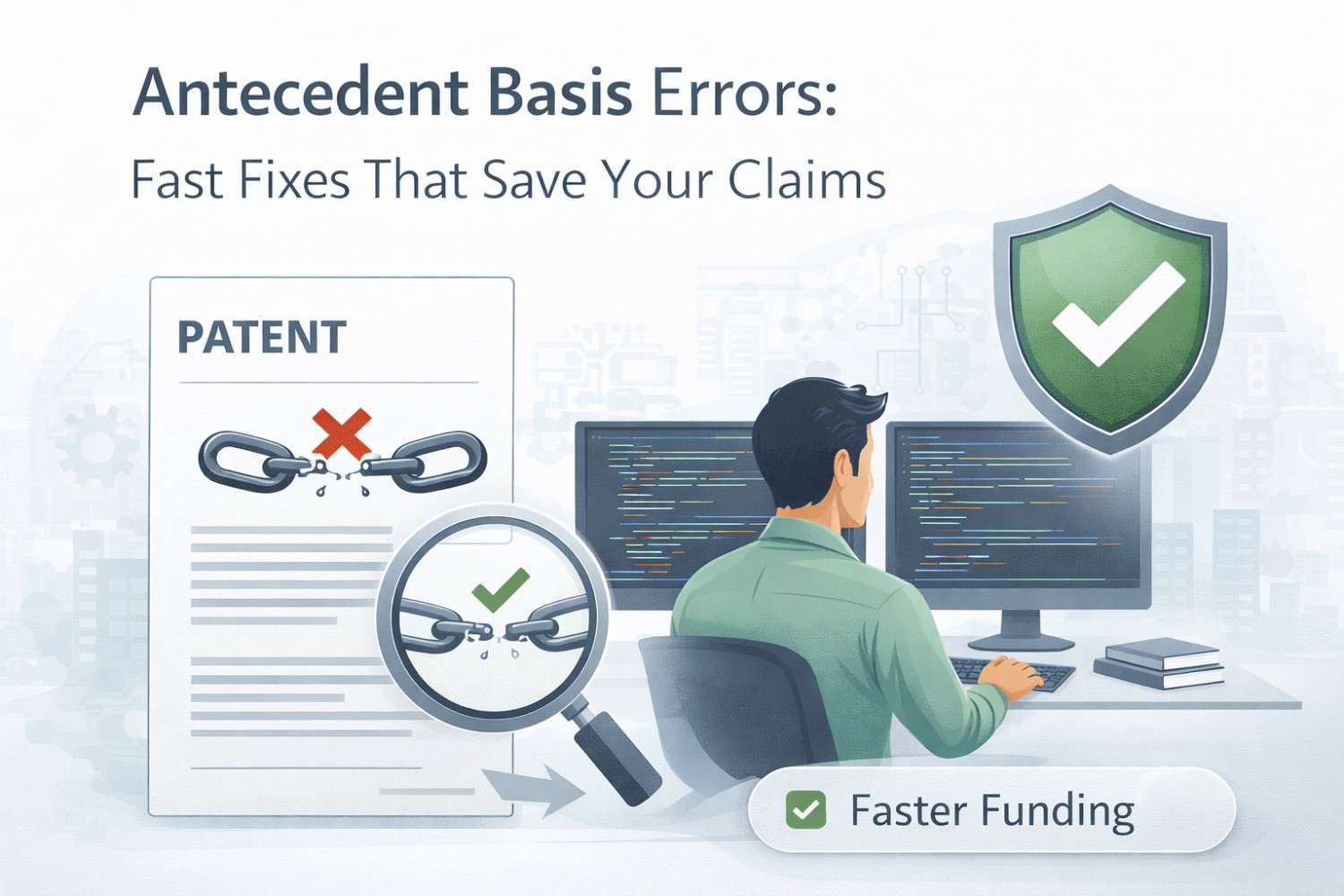
Patents often fail because of small writing mistakes, not because the invention is weak. One of the most damaging mistakes is an antecedent basis error. This happens when a claim mentions something before clearly introducing it. That single issue can create confusion and give others room to attack your protection. This matters for founders and engineers because claims are the walls that protect what you built. Even a small gap can delay approval or weaken enforcement. The good news is that these errors are easy to fix once you know how to spot them.
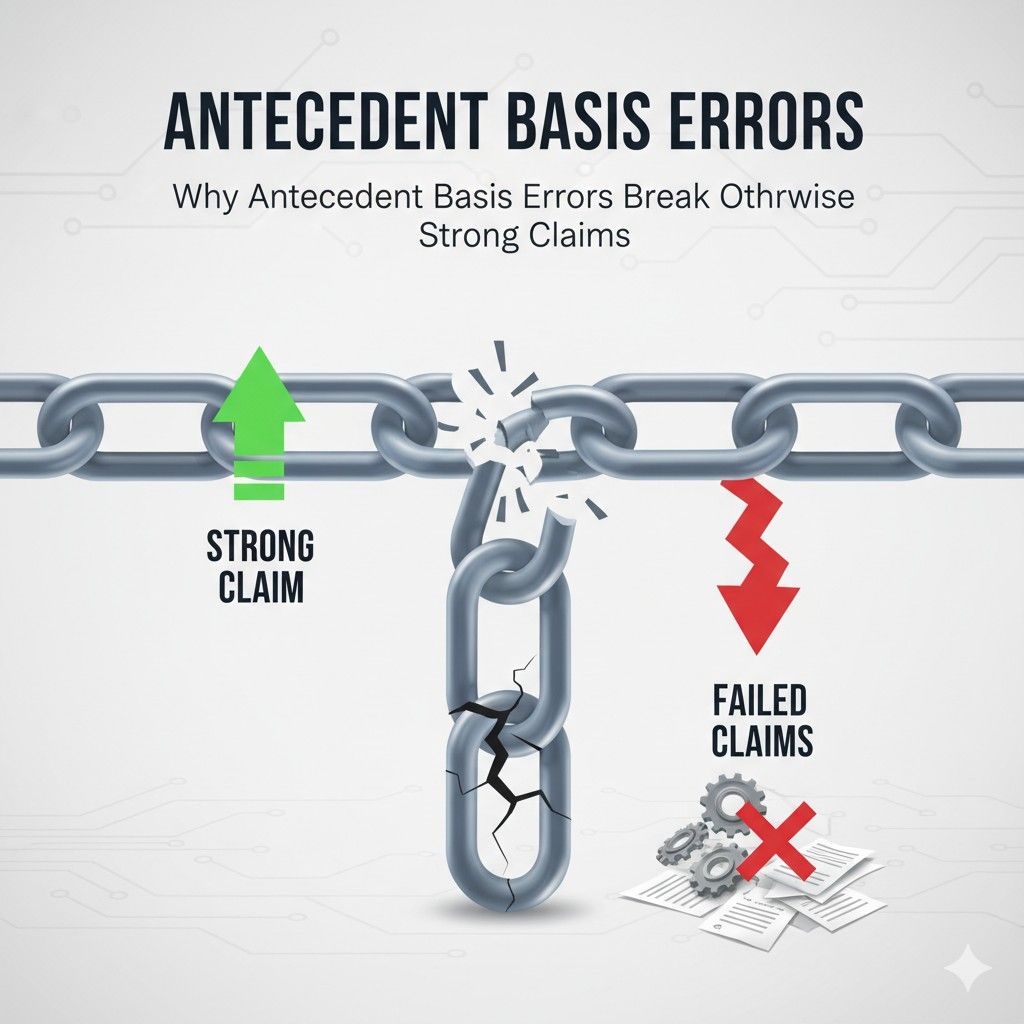
Why Antecedent Basis Errors Break Otherwise Strong Claims
Even strong inventions can end up with weak patents. This usually does not happen because the idea is bad.
It happens because the claims are unclear. Antecedent basis errors are one of the fastest ways clarity breaks down. They quietly damage claims that would otherwise be solid, enforceable, and valuable to a business.
At a business level, this is not just a writing issue. It is a risk issue. Claims are what investors review, what competitors read, and what courts enforce. When claims are unclear, everything downstream becomes shaky.
How Examiners Read Claims Differently Than Founders Expect
Patent examiners do not read claims like founders do. Founders read with context. They know the product, the system, and the intent. Examiners read line by line, with no assumptions.
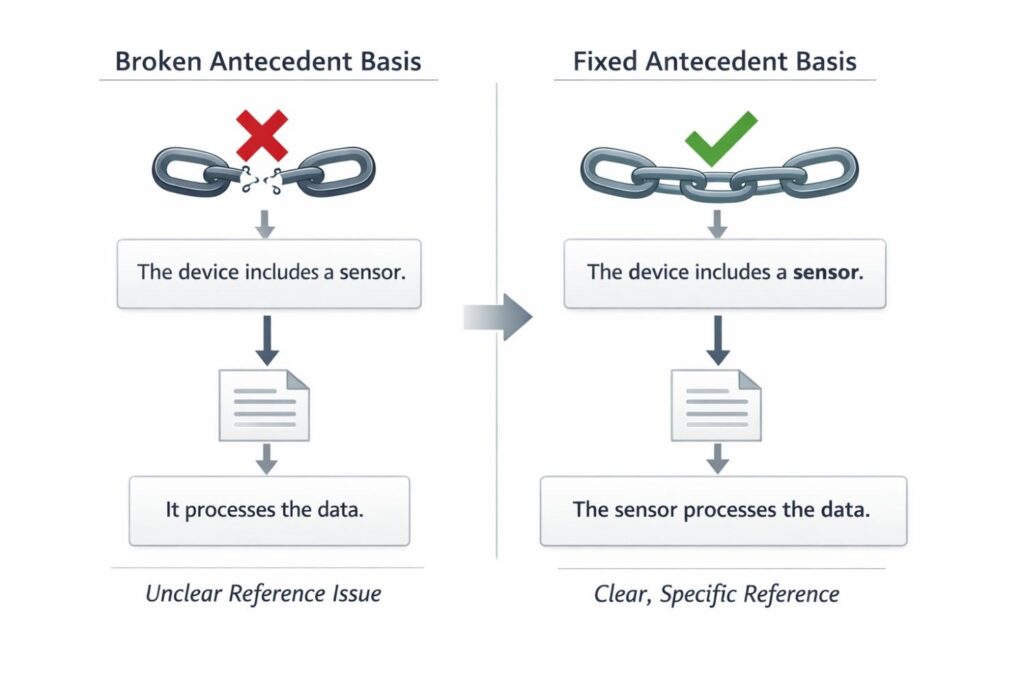
When a claim refers to “the module” or “the system” without clearly introducing it first, the examiner does not fill in the gap. Instead, they mark the claim as unclear.
This leads to office actions that slow prosecution. More importantly, it forces you to rewrite claims later, often under pressure and with less flexibility.
A smart move is to assume the reader knows nothing and will not give you the benefit of the doubt. Every element must be clearly introduced before it is reused. That mindset alone prevents many errors.
Why Small Clarity Issues Turn Into Big Business Delays
Antecedent basis errors often seem harmless. The invention still works. The diagrams still make sense.
But patent law runs on precision. When a claim is unclear, it gives the examiner a simple reason to reject it without even reaching the core invention.
For a business, this means delays. Delays mean more legal fees, longer timelines, and uncertainty around protection. If you are fundraising or preparing for launch, that uncertainty matters.
Clean claims move faster. Fast-moving claims give you confidence when talking to investors, partners, and acquirers.
How These Errors Create Weak Spots Competitors Look For
Competitors do not need to copy your entire product to hurt you. They only need to find a weak claim. Antecedent basis errors are easy targets because they are visible on the face of the patent.
If a claim refers to something that was never properly introduced, an opponent can argue that the scope is unclear or unenforceable.
From a strategic standpoint, this means your patent may exist on paper but fail in practice.
Strong claims should leave no doubt about what is covered. Clear introduction and consistent reference to each element makes it harder for others to design around or challenge your protection.
The Hidden Cost of Fixing Errors Too Late
Fixing antecedent basis issues early is simple. Fixing them late is not. Once claims are examined, amended, or allowed, your room to adjust language shrinks. Changes made later can narrow scope or introduce new problems.
For businesses, late fixes can reduce the value of the patent itself. A narrow claim might protect less than what you built. This is why reviewing claims carefully before filing is not a formality.
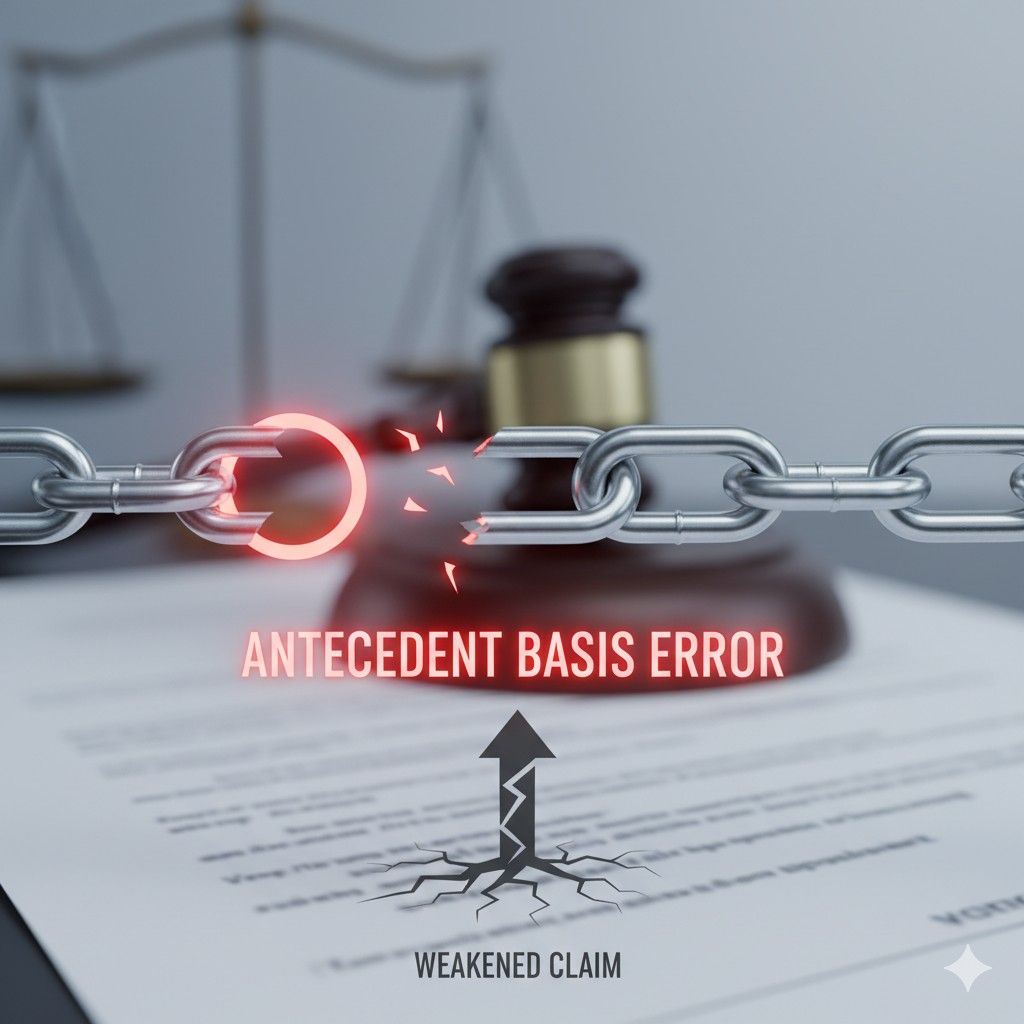
It is a value-preserving step. Reading each claim as if it were a contract, and checking that every term is introduced before reuse, saves real money and real protection.
How Clear Claims Signal Quality to Investors and Buyers
Experienced investors and acquirers know how to spot weak patents. They may not use the term antecedent basis, but they recognize unclear claims. Sloppy writing signals rushed work. Clean, precise claims signal discipline and quality.
From a business lens, this matters because patents are often reviewed during diligence. Clear claims reduce questions. Fewer questions mean smoother deals.
One actionable habit is to read claims out loud. If a term appears suddenly and feels confusing even to you, it will confuse everyone else too.
Why Software and AI Patents Are Especially Vulnerable
Software and AI patents often involve many components interacting at once. Models, data, processors, and outputs are all referenced quickly.
This makes it easy to mention an element before formally introducing it. When speed is the priority, clarity can slip.
A practical approach is to slow down claim drafting just enough to track each element. Treat each new component like a character in a story. Introduce it once, clearly, then refer back to it consistently.
This habit dramatically reduces errors and makes complex systems easier to protect.
Turning Claim Review Into a Repeatable Business Process
Businesses that file patents regularly benefit from treating claim review as a process, not a one-time task. Antecedent basis checks should be part of that process. This does not require legal training. It requires discipline.
One effective method is to scan each claim and circle every “the.” Then check whether the thing following it was introduced earlier with “a” or “an.” If not, you found a problem. This simple check catches most issues before filing and costs nothing to apply.
Platforms like PowerPatent are built to support this kind of structured review. By combining software guidance with attorney oversight, founders get fast feedback without slowing development.
If you want to see how that works in practice, you can explore it at https://powerpatent.com/how-it-works.
Antecedent basis errors break strong claims not because they are complex, but because they are ignored. When businesses treat clarity as a strategic asset, patents become faster, stronger, and more defensible from day one.
How These Errors Sneak Into Software and Tech Patents
Antecedent basis errors rarely come from carelessness. They usually come from speed. Software and tech teams move fast.
Claims are often written while products are still evolving. That mix makes it very easy for small clarity gaps to slip in without anyone noticing.
This section explains where these errors really come from in modern tech patents and how businesses can prevent them before they turn into delays or weak protection.
Building First and Writing Later Creates Blind Spots
Most founders build first and document later. That is normal and often smart. The problem starts when claims are written from memory instead of structure.
When you know the system well, your brain fills in missing pieces automatically. The claim text does not.
A claim might say “the server sends the response” even though “a server” was never introduced. To the founder, it feels obvious. To an examiner, it is not. The fix is to shift mindset.
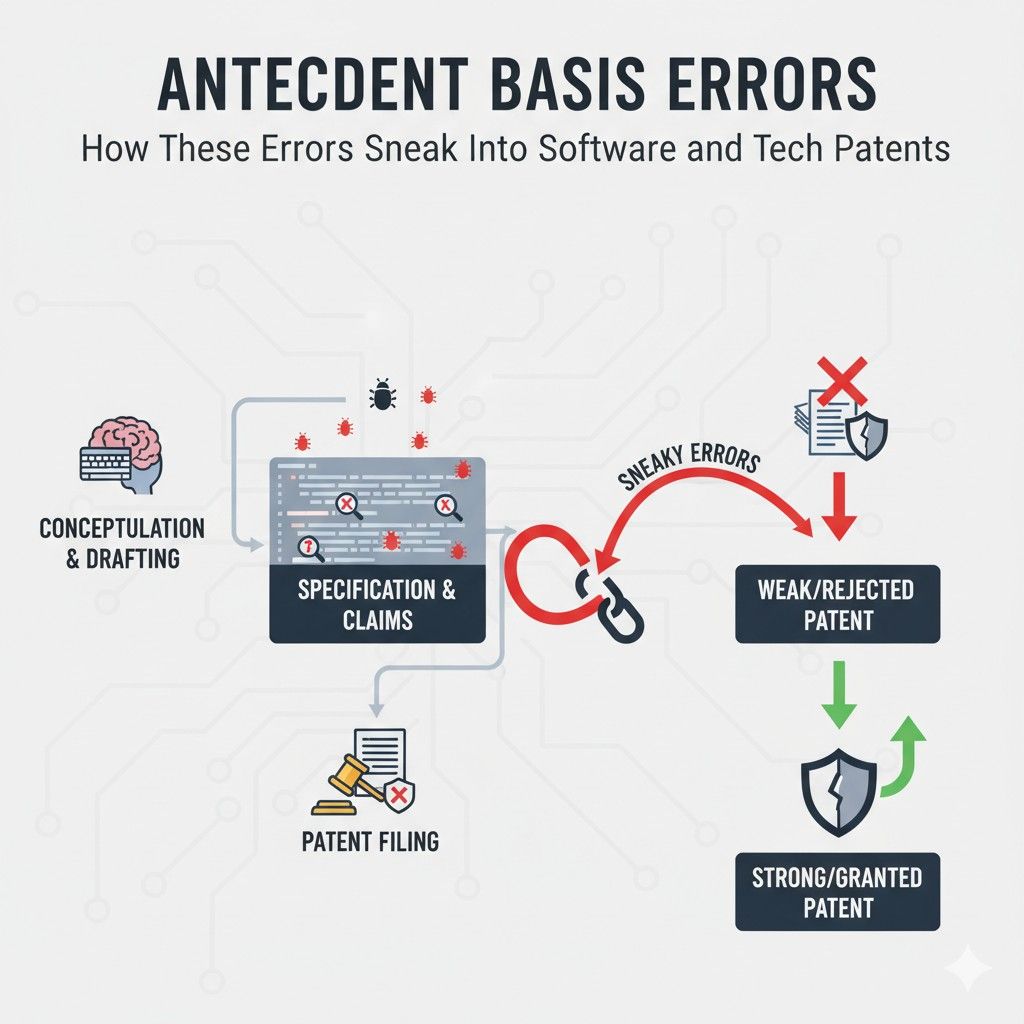
Claims are not explanations. They are definitions. Every part must be formally introduced before it can act.
Reusing Language From Specs Without Adjusting It
Many teams pull phrases directly from the description section into claims. That feels efficient, but it often causes antecedent basis errors. The spec is allowed to be loose. Claims are not.
In the description, you might say “the system may include multiple modules.” In a claim, saying “the module processes the data” without first introducing “a module” creates a problem.
A smart habit is to treat claims as a clean-room rewrite. Even if language exists elsewhere, claims need their own internal logic.
Iterating on Claims Without Resetting the Structure
Tech products change. Claims change with them. Antecedent basis errors often appear during revisions. A new element is added in the middle of a claim, but the earlier introduction is forgotten or removed.
For businesses, this happens most when claims are edited under time pressure. One way to reduce risk is to do a full read-through after every major edit. Not a skim.
A slow read. Each time a new term appears, ask whether it was formally introduced earlier in that claim.
Complex Systems With Many Moving Parts
Software, AI, and platform patents often involve layers. Data sources, processors, models, outputs, and interfaces all interact.
The more components you have, the easier it is to lose track of what has been introduced.
This is where many strong inventions stumble. The solution is not shorter claims. It is cleaner structure. Introduce elements in a logical order that mirrors how the system works. When the flow makes sense, antecedent basis issues drop sharply.
Claims Written by Engineers Without Claim Training
Engineers are excellent at precision, but patent claims are a different kind of precision. Engineers often write claims the way they would write documentation or code comments. That style assumes shared understanding.
Patent claims assume none. For businesses, this is not about blaming engineers. It is about giving them the right tools and review process. When engineers draft and attorneys review, clarity improves fast.
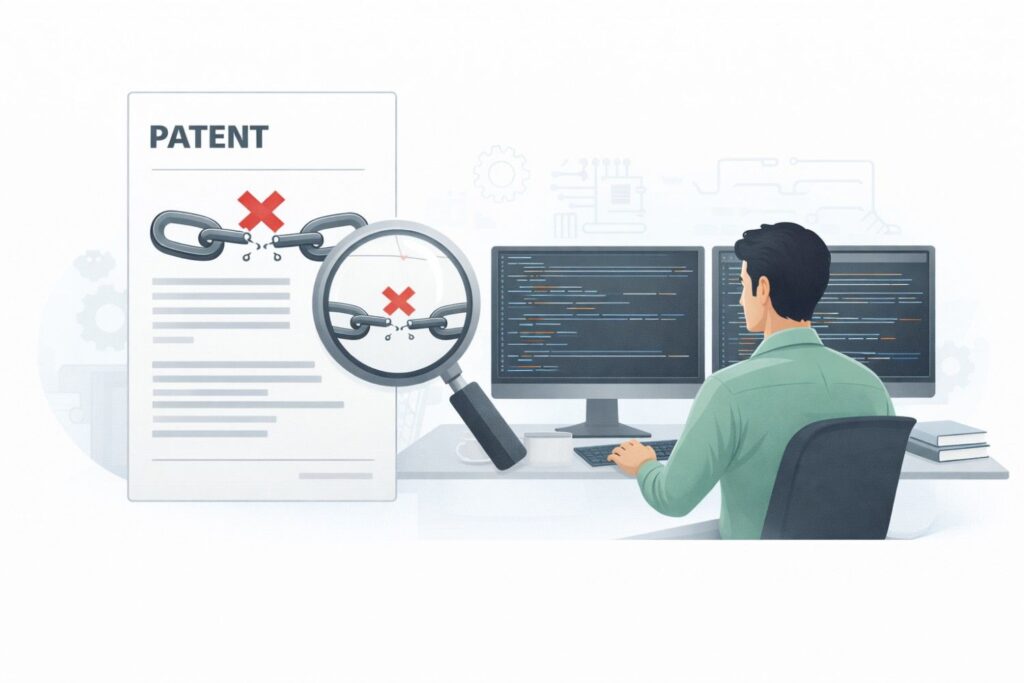
This is exactly the gap modern platforms like PowerPatent are designed to close by combining software guidance with attorney oversight.
Overusing Shortcuts Like “Said” and “The”
Words like “said” and “the” are common in claims. They are also the source of many problems. These words only work when the thing they point to already exists in the claim.
A practical business habit is to temporarily remove these words during review. Replace them mentally with the full phrase.
If you cannot trace it back to a clear introduction, you found a weakness. Fixing it early is fast. Fixing it after rejection is slow.
When Templates Create False Confidence
Templates are useful, but they can create blind spots. A template may introduce “a system” early on, but later edits may change the structure enough that the reference no longer lines up.
Businesses that rely heavily on templates should treat them as starting points, not safety nets. Every claim still needs a fresh clarity check. Templates do not understand your invention. You do.
The Compounding Effect Across Multiple Claims
Antecedent basis errors are rarely isolated. One unclear introduction can ripple across dependent claims. That multiplies the problem. What could have been a small fix becomes a larger rewrite.
From a strategy perspective, this means the cost of missing one error is higher than it looks. Catching issues at the independent claim level protects the entire claim set. This is where careful upfront review saves exponential time later.
Turning Prevention Into a Speed Advantage
Many teams think clarity slows them down. In reality, it speeds everything up. Clean claims move through examination faster. They receive fewer objections. They require fewer rewrites.
Businesses that build clarity checks into their patent process gain a real advantage. They file once, revise less, and protect more of what they build.
Tools that flag issues early and bring attorney feedback in quickly make this practical without adding overhead. You can see how that approach works at https://powerpatent.com/how-it-works.
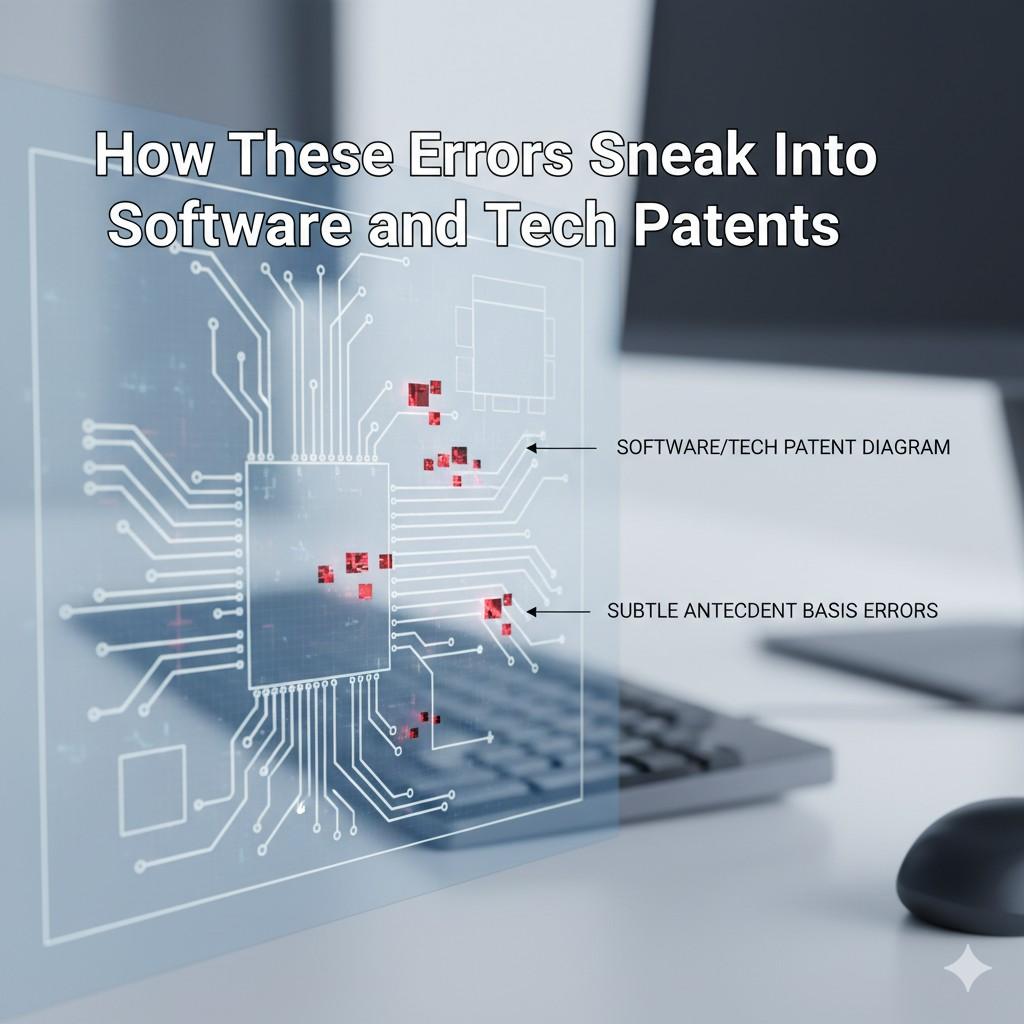
Antecedent basis errors sneak in quietly, especially in fast-moving tech companies. The teams that win are not the ones who write the fastest. They are the ones who write clearly from the start.
Simple Ways to Spot and Fix Antecedent Basis Problems Fast
Catching antecedent basis errors does not require deep legal training. It requires a clear method and the discipline to slow down for a few minutes. For businesses, this is one of the highest return activities in patent work.
A short review can prevent months of delay and protect the value of the invention from day one.
This section focuses on practical, fast techniques that founders and teams can actually use, even under tight timelines.
Reading Claims as If You Were an Outsider
The most effective way to spot these errors is to read claims as if you had never seen the product. Forget the diagrams. Forget the code. Focus only on the words in front of you.
When a claim suddenly mentions “the component” or “the processor,” pause. Ask whether that item was clearly introduced earlier in that same claim. If the answer is no, you have found a problem.
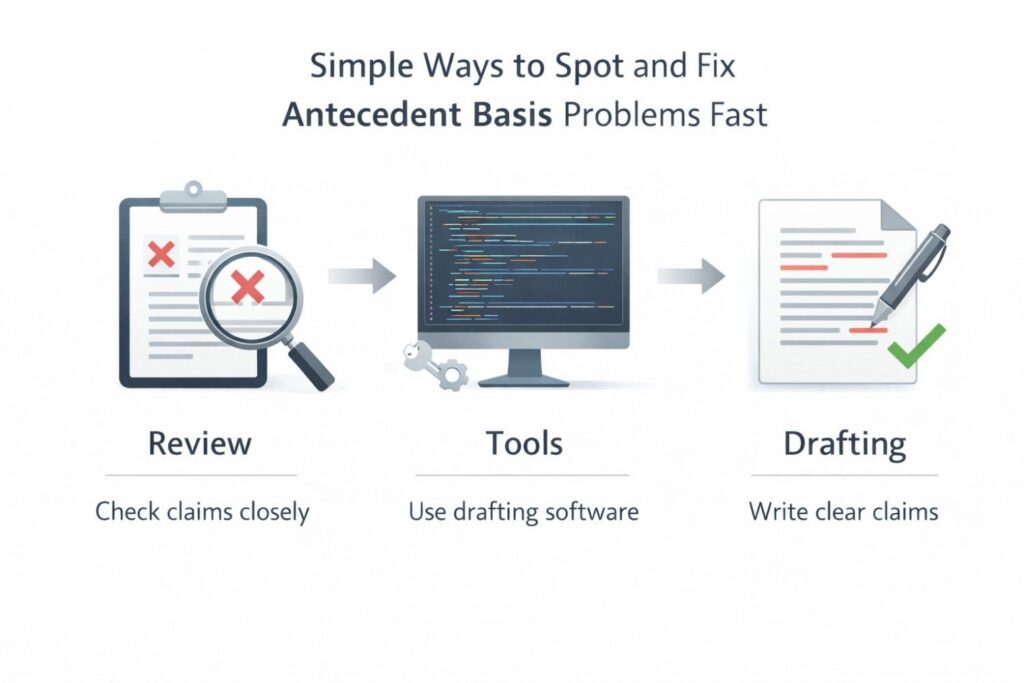
This outsider reading style removes assumptions and forces clarity.
Slowing Down at the First Appearance of Every Term
Antecedent basis issues almost always appear at the first mention of an element. That first moment is where mistakes hide. A strong habit is to slow down every time a new noun appears.
If it is the first time the term shows up, it should be introduced in a clear, formal way. If it is not the first time, it should clearly point back to an earlier introduction.
This simple mental check catches issues quickly without needing special tools.
Using Grammar as a Diagnostic Tool
Grammar is not just about style in patent claims. It is about meaning. Words like “a” and “an” introduce new things. Words like “the” point back to something already introduced.
During review, pay attention to these small words. If you see “the” without remembering when that thing first appeared, stop and trace it. This technique turns grammar into a fast diagnostic tool for clarity.
Fixing Errors Without Narrowing Your Claims
Many founders worry that fixing claim language will make their protection smaller. That is not true when antecedent basis is the issue. These fixes are about clarity, not scope.
Introducing an element properly does not limit what it can cover. It simply defines it clearly.
Businesses should view these fixes as strengthening the fence, not shrinking it. Clear definitions make claims easier to defend, not weaker.
Making One Clean Pass Instead of Many Small Edits
Quick edits often create new problems. A better approach is to make one clean review pass focused only on antecedent basis. Do not change anything else. Do not optimize language. Just check introductions and references.
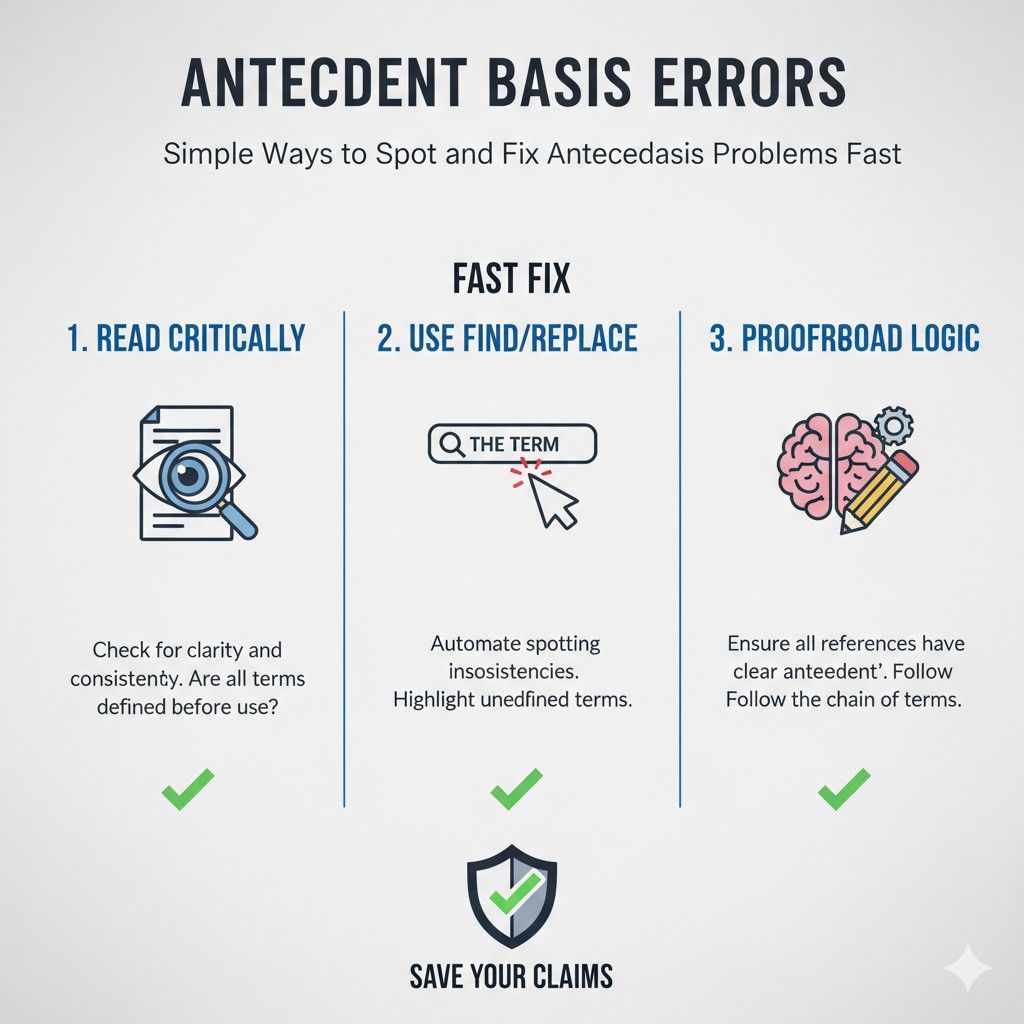
This focused pass is fast and effective. It reduces the risk of creating new errors while fixing old ones. Teams that separate clarity checks from creative drafting tend to produce stronger claims.
Aligning Claim Language With How the System Actually Works
Claims are strongest when their structure mirrors the system. When elements are introduced in the order they appear in the real process, references feel natural and clear.
If a claim jumps ahead and refers to outputs before inputs are introduced, antecedent basis problems often follow. Reordering language to match real-world flow is both a clarity fix and a strength upgrade.
Training Teams to Catch Issues Early
For growing companies, patent work often involves multiple people. Engineers draft. Founders review. Attorneys finalize. Everyone benefits from basic clarity awareness.
A simple internal rule like “nothing gets referenced before it is introduced” goes a long way. When teams share this rule, errors drop before they ever reach an examiner. This saves time, cost, and frustration.
Using Software to Flag Problems Before Filing
Manual review works, but it is easy to miss things when moving fast. This is where modern patent software helps. Tools that guide claim structure and flag unclear references reduce human error.
PowerPatent was built around this idea. By combining software checks with real attorney review, it helps teams fix issues early without slowing development.
If you want to see how that process works, you can explore it at https://powerpatent.com/how-it-works.
Turning Clarity Into a Competitive Advantage
Businesses that file clean patents move faster through examination and face fewer objections. That speed compounds. It frees founders to focus on building instead of revising paperwork.

Antecedent basis problems are small, but the advantage of fixing them early is large. When clarity becomes part of your process, strong claims stop being a risk and start becoming an asset.
How Clean Claims Protect Your Startup From Costly Delays
Speed matters for startups. Every delay costs focus, money, and momentum. Patent delays are especially painful because they sit in the background, unresolved, while everything else moves forward.
Clean claims, free from antecedent basis errors, are one of the simplest ways to keep your patent process moving without friction.
This section explains how clarity directly protects your timeline and why businesses that invest in clean claims early avoid problems later.
Why Examiners Default to Rejection When Claims Are Unclear
Patent examiners have limited time. When a claim is unclear, they do not try to guess your intent. They issue a rejection. Antecedent basis errors give them an easy reason to do that.
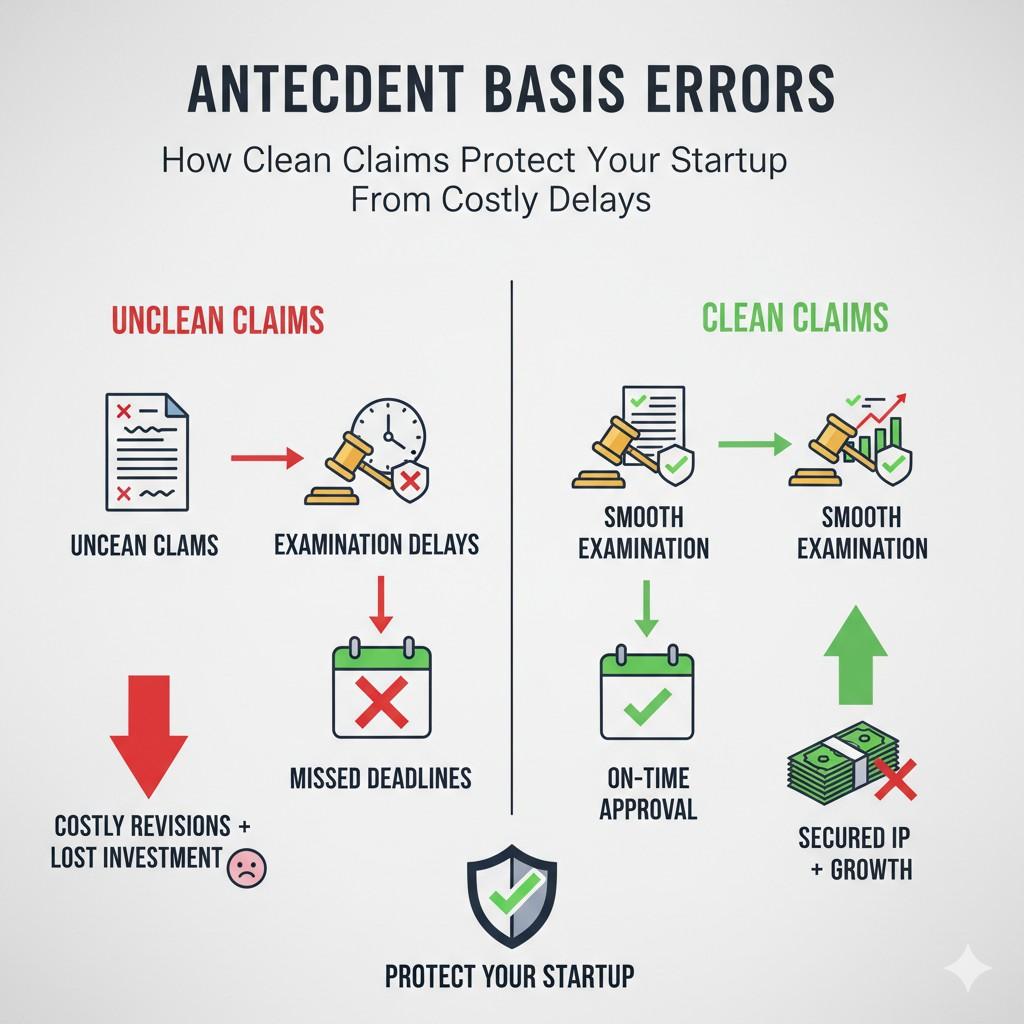
For a startup, this means your application enters a back-and-forth cycle. Each round adds months. Clean claims remove these easy rejection paths. When clarity is high, examiners focus on the invention itself, not the writing.
How One Office Action Can Push Timelines by a Year
Many founders underestimate how long even a simple rejection can slow things down. Responding takes time. Reviewing changes takes time. Waiting for the next action takes even more time.
All of this compounds. A single avoidable issue like an antecedent basis error can push allowance far into the future. Clean claims reduce the number of office actions and keep the process moving forward.
Protecting Fundraising and Partnership Conversations
Patents often come up during fundraising. Investors ask whether protection is filed, pending, or granted. Delays create uncertainty. Uncertainty weakens leverage.
When claims are clean and moving smoothly, you can speak with confidence. You can show progress instead of excuses. From a business perspective, that confidence matters as much as the patent itself.
Avoiding Costly Rewrite Cycles
Every rewrite costs money. Even when attorney fees are controlled, the time spent reviewing and approving changes adds up. Antecedent basis errors often trigger rewrites that add no new value.

Fixing these issues upfront is far cheaper than fixing them later. A short review before filing can save multiple rounds of revision after filing. This is one of the clearest cost-saving moves a startup can make.
Keeping Claim Scope Intact Under Pressure
When claims are amended after rejection, they are often narrowed. That happens because time is short and pressure is high. Founders just want the patent to move.
Clean claims reduce that pressure. When clarity issues are handled early, later amendments can focus on strategy instead of repair. This helps preserve the full value of what you built.
Making International Filings Smoother
Many startups file internationally. Problems in the original claims often carry over. Antecedent basis errors that seem small in one jurisdiction can cause bigger issues elsewhere.
Starting with clean claims makes global expansion easier. It reduces translation issues and interpretation problems. From a growth standpoint, this creates smoother paths into new markets.
Supporting Long-Term Enforcement
A patent is not just a document. It is a future tool. If enforcement ever matters, clarity will be examined closely. Antecedent basis errors can be used to argue that claims are unclear or unenforceable.
Businesses that plan for long-term protection should treat clarity as insurance. Clean claims are easier to enforce and harder to attack. This protects value long after filing.
Building a Reputation for Quality IP
Companies known for strong IP attract better partners. Clean claims contribute to that reputation. They show care, discipline, and seriousness.
Over time, this reputation compounds. Each strong filing builds confidence with investors, acquirers, and legal teams. Antecedent basis errors do the opposite. They signal rushed work and weak process.
Why Modern Tools Matter for Modern Teams
Startups move too fast for old processes. Relying only on manual review increases risk. Modern tools that guide claim structure and surface issues early fit how teams actually work.
PowerPatent was built for this reality. By blending software guidance with real attorney review, it helps teams file clean claims without slowing down.
If you want to see how that approach protects timelines and value, you can visit https://powerpatent.com/how-it-works.
Clean claims are not about perfection. They are about momentum. When clarity is handled early, your startup stays focused on building, not fixing paperwork.
Wrapping It Up
Antecedent basis errors are small, but their impact is not. They break strong claims, slow down approvals, weaken protection, and create risks that most founders never intend to take. What makes them dangerous is not complexity, but silence. These errors do not announce themselves. They sit quietly in claims until an examiner, investor, or competitor points them out.